



Financial News
The Great Resolution War: Sora 2’s Social Storytelling vs. Veo 3’s 4K Professionalism
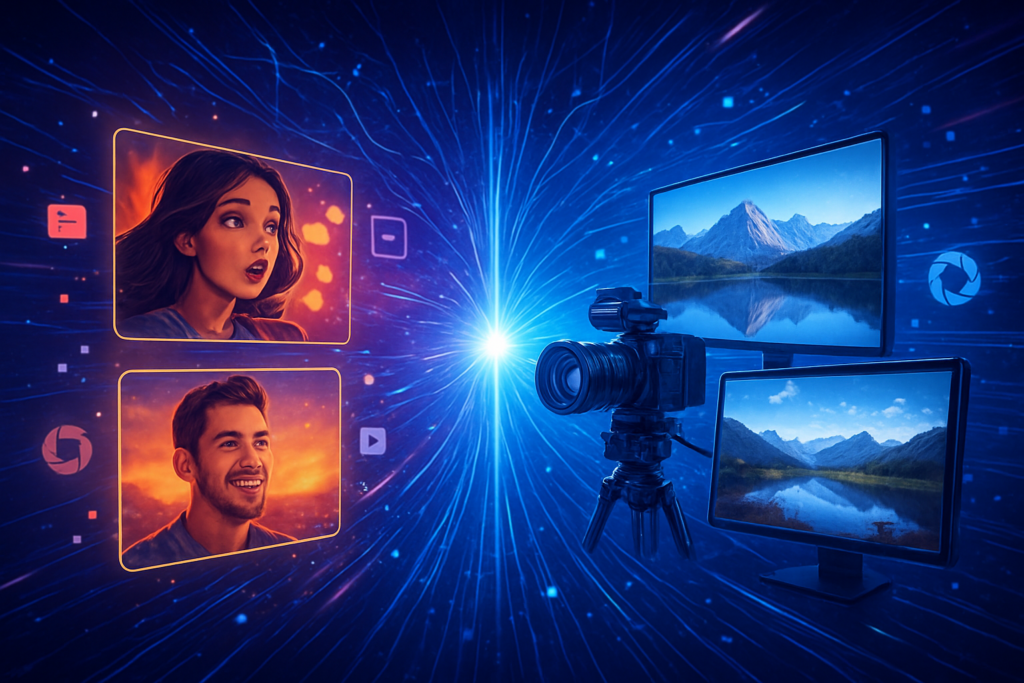
As of January 9, 2026, the generative video landscape has transitioned from a playground of experimental tech to a bifurcated industry dominated by two distinct philosophies. OpenAI and Alphabet Inc. (NASDAQ: GOOGL) have spent the last quarter of 2025 drawing battle lines that define the future of digital media. While the "GPT-3.5 moment" for video arrived with the late 2025 releases of Sora 2 and Veo 3, the two tech giants are no longer competing for the same user base. Instead, they have carved out separate territories: one built on the viral, participatory culture of social media, and the other on the high-fidelity demands of professional cinematography.
The immediate significance of this development cannot be overstated. We are moving beyond the era of "AI as a novelty" and into "AI as infrastructure." For the first time, creators can choose between a model that prioritizes narrative "cameos" and social integration and one that offers broadcast-grade 4K resolution with granular camera control. This split represents a fundamental shift in how AI companies view the value of generated pixels—whether they are meant to be shared in a feed or projected on a silver screen.
Technical Prowess: From 'Cameos' to 4K Precision
OpenAI’s Sora 2, which saw its wide release on September 30, 2025, has doubled down on what it calls "social-first storytelling." Technically, the model supports up to 1080p at 30fps, with a primary focus on character consistency and synchronized audio. The most talked-about feature is "Cameo," a system that allows users to upload a verified likeness and "star" in their own AI-generated scenes. This is powered by a multi-level consent framework and a "world state persistence" engine that ensures a character looks the same across multiple shots. OpenAI has also integrated native foley and dialogue generation, making the "Sora App"—a TikTok-style ecosystem—a self-contained production house for the influencer era.
In contrast, Google’s Veo 3.1, updated in October 2025, is a technical behemoth designed for the professional suite. It boasts native 4K resolution at 60fps, a specification that has made it the darling of advertising agencies and high-end production houses. Veo 3 introduces "Camera Tokens," allowing directors to prompt specific cinematic movements like "dolly zoom" or "15-degree tilt" with mathematical precision. While Sora 2 focuses on the "who" and "what" of a story, Veo 3 focuses on the "how," providing a level of lighting and texture rendering that many experts claim is indistinguishable from physical cinematography. Initial reactions from the American Society of Cinematographers have been a mix of awe and existential dread, noting that Veo 3’s "Safe-for-Brand" guarantees make it far more viable for corporate use than its competitors.
The Corporate Battlefield: Disney vs. The Cloud
The competitive implications of these releases have reshaped the strategic alliances of the AI world. OpenAI’s landmark $1 billion partnership with The Walt Disney Company (NYSE: DIS) has given Sora 2 a massive advantage in the consumer space. By early 2026, Sora users began accessing licensed libraries of Marvel and Star Wars characters for "fan-inspired" content, essentially turning the platform into a regulated playground for the world’s most valuable intellectual property. This move has solidified OpenAI's position as a media company as much as a research lab, directly challenging the dominance of traditional social platforms.
Google, meanwhile, has leveraged its existing infrastructure to win the enterprise war. By integrating Veo 3 into Vertex AI and Google Cloud, Alphabet Inc. (NASDAQ: GOOGL) has made generative video a plug-and-play tool for global marketing teams. This has put significant pressure on startups like Runway and Luma AI, which have had to pivot toward niche "indie" creator tools to survive. Microsoft (NASDAQ: MSFT), as a major backer of OpenAI, has benefited from the integration of Sora 2 into the Windows "Creative Suite," but Google’s 4K dominance in the professional sector remains a significant hurdle for the Redmond giant’s enterprise ambitions.
The Trust Paradox and the Broader AI Landscape
The broader significance of the Sora-Veo rivalry lies in the "Trust Paradox" of 2026. While the technology has reached a point of near-perfection, public trust in AI-generated content has seen a documented decline. This has forced both OpenAI and Google to lead the charge in C2PA metadata standards and invisible watermarking. The social impact is profound: we are entering an era where "seeing is no longer believing," yet the demand for personalized, AI-driven entertainment continues to skyrocket.
This milestone mirrors the transition of digital photography in the early 2000s, but at a thousand times the speed. The ability of Sora 2 to maintain character consistency across a 60-second "Pro" clip is a breakthrough that solves the "hallucination" problems of 2024. However, the potential for misinformation remains a top concern for regulators. The European Union’s AI Office has already begun investigating the "Cameo" feature’s potential for identity theft, despite OpenAI’s rigorous government ID verification process. The industry is now balancing on a knife-edge between revolutionary creative freedom and the total erosion of visual truth.
The Horizon: Long-Form and Virtual Realities
Looking ahead, the next frontier for generative video is length and immersion. While Veo 3 can already stitch together 5-minute sequences in 1080p, the goal for 2027 is the "Infinite Feature Film"—a generative model capable of maintaining a coherent two-hour narrative. Experts predict that the next iteration of these models will move beyond 2D screens and into spatial computing. With the rumored updates to VR and AR headsets later this year, we expect to see "Sora Spatial" and "Veo 3D" environments that allow users to walk through their generated scenes in real-time.
The challenges remaining are primarily computational and ethical. The energy cost of rendering 4K AI video at scale is a growing concern for environmental groups, leading to a push for more "inference-efficient" models. Furthermore, the "Cameo" feature has opened a Pandora’s box of digital estate rights—questions about who owns a person’s likeness after they pass away are already heading to the Supreme Court. Despite these hurdles, the momentum is undeniable; by the end of 2026, AI video will likely be the primary medium for both digital advertising and personalized storytelling.
Final Verdict: A Bifurcated Future
The rivalry between Sora 2 and Veo 3 marks the end of the "one-size-fits-all" AI model. OpenAI has successfully transformed video generation into a social experience, leveraging the power of "Cameo" and the Disney (NYSE: DIS) library to capture the hearts of the creator economy. Google, conversely, has cemented its role as the backbone of professional media, providing the 4K fidelity and "Flow" controls that the film and advertising industries demand.
As we move into the second half of 2026, the key takeaway is that the "quality" of an AI model is now measured by its utility rather than just its parameters. Whether you are a teenager making a viral Marvel fan-film on your phone or a creative director at a global agency rendering a Super Bowl ad, the tools are now mature enough to meet the task. The coming months will be defined by how society adapts to this new "synthetic reality" and whether the safeguards put in place by these tech giants are enough to maintain the integrity of our digital world.
This content is intended for informational purposes only and represents analysis of current AI developments.
TokenRing AI delivers enterprise-grade solutions for multi-agent AI workflow orchestration, AI-powered development tools, and seamless remote collaboration platforms.
For more information, visit https://www.tokenring.ai/.
If you believe this article contains misleading, harmful, or spam content, please let us know.
Report this articleMore News
View More


Recent Quotes
View MoreQuotes delayed at least 20 minutes.
By accessing this page, you agree to the Privacy Policy and Terms Of Service.