




Financial News
Permian Resources (NYSE:PR) delivers impressive Q3 2026

Oil and gas producer Permian Resources (NYSE: PR) announced better-than-expected revenue in Q3 2026, with revenue up 48.1% year on year to $1.96 billion. Its non-GAAP profit of $0.69 per share was 13.7% above analysts’ consensus estimates.
For more on Permian Resources, read our free full research report.
Permian Resources (PR) Q3 2026 highlights:
- Revenue $1.96 billion vs S&P analysts’ consensus estimates of $1.83 billion (48.1% year-on-year growth, 7.1% beat)
- Adjusted EPS $0.69 vs S&P analysts’ consensus estimates of $0.61 (13.7% beat)
- Operating margin 45.4%, up from 29.6% in the same quarter last year
- Oil production rose 11.3% year on year
- Market capitalization $20.1 billion
“Throughout the year our team has reacted quickly to higher commodity prices, growing production in order to maximize value for shareholders. Importantly, we have been able to accomplish this through rapid payback initiatives such as increasing working interest, accelerating workover activity and reducing cycle times, while maintaining our current rig and fleet counts,” said James Walter, Co-CEO of Permian Resources. “As a result of our team's relentless focus on driving higher free cash flow, our current plan is expected to generate an incremental $300 million of free cash flow this year compared to our original plan in February, normalized for commodity prices. This is a true testament to our team, and I would like to thank them for their hard work and dedication.”
Revenue growth
Cyclical sectors like energy often flatter weaker operators during favorable price environments, but a longer-term lens separates those from businesses that can consistently perform across market cycles. Over the last five years, Permian Resources grew its revenue at a strong 49.2% compounded annual growth rate. Its growth surpassed the average energy upstream and integrated energy company and shows its offerings resonate with customers.
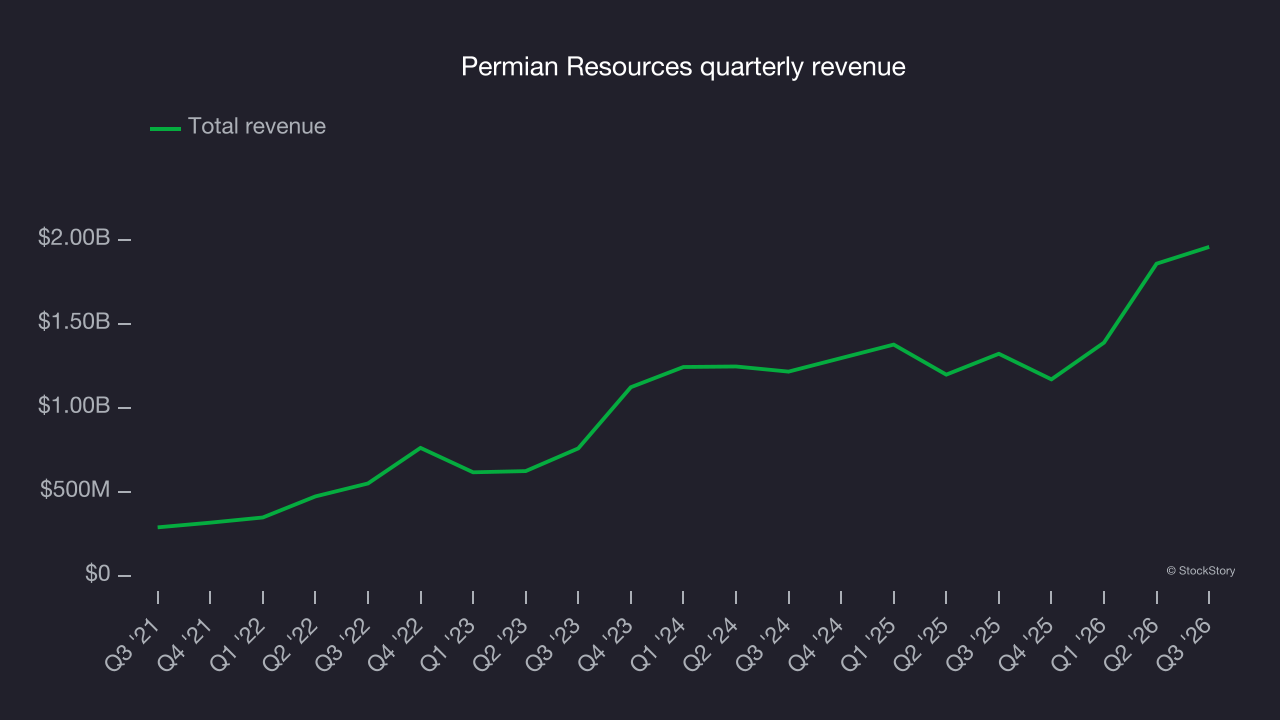
Within energy, a single timeframe, even a long one, only sheds light on how well a company rode the last commodity cycle. To better assess whether a company compounds through cycles, we validate our view with an even longer, ten-year view. Permian Resources’s annualized revenue growth of 49.7% over the last ten years aligns with its five-year trend, suggesting its demand was predictably strong.
While looking at revenue is important, it can also introduce noise around commodity prices and mergers and acquisitions. Analyzing drivers of revenue, on the other hand, highlights what is happening inside the asset base and whether the economic footprint of a company is expanding. Over the last two years, Permian Resources’s oil production averaged 13.4% year-on-year growth while its natural gas production averaged 7.3% year-on-year growth.
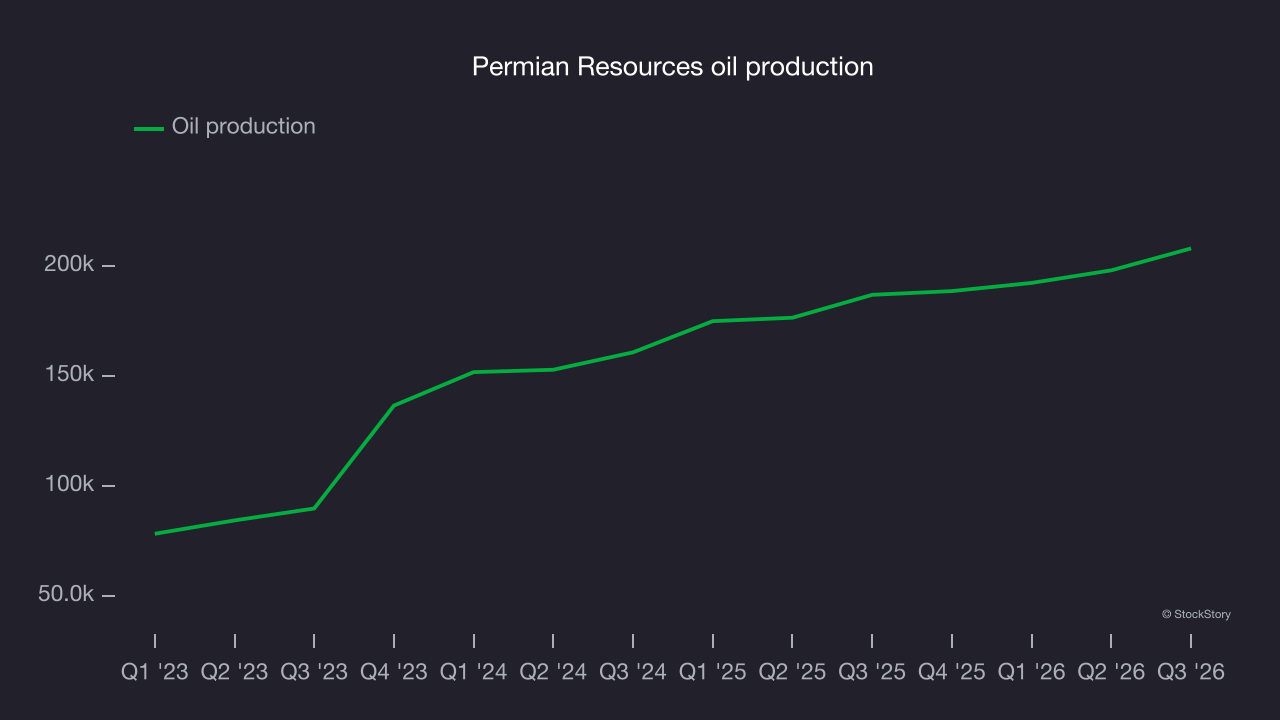
This quarter, Permian Resources reported strong year-on-year revenue growth of 48.1%, and its $1.96 billion in revenue beat Wall Street’s consensus estimates by 7.1%. Its oil production grew 11.3% year on year.
Adjusted EBITDA margin
Adjusted EBITDA margin strips out accounting distortions tied to depletion and historical drilling spend, providing a clearer view of the cash-generating power of the underlying asset base before financing and reinvestment decisions.
Permian Resources has performed well over the last five years. It demonstrated strong profitability for an upstream and integrated energy business, with an average EBITDA margin of 72.8%.
Looking at the trend in its profitability, Permian Resources’s EBITDA margin rose by 12.5 percentage points over the last year, as its revenue growth provided operating leverage.
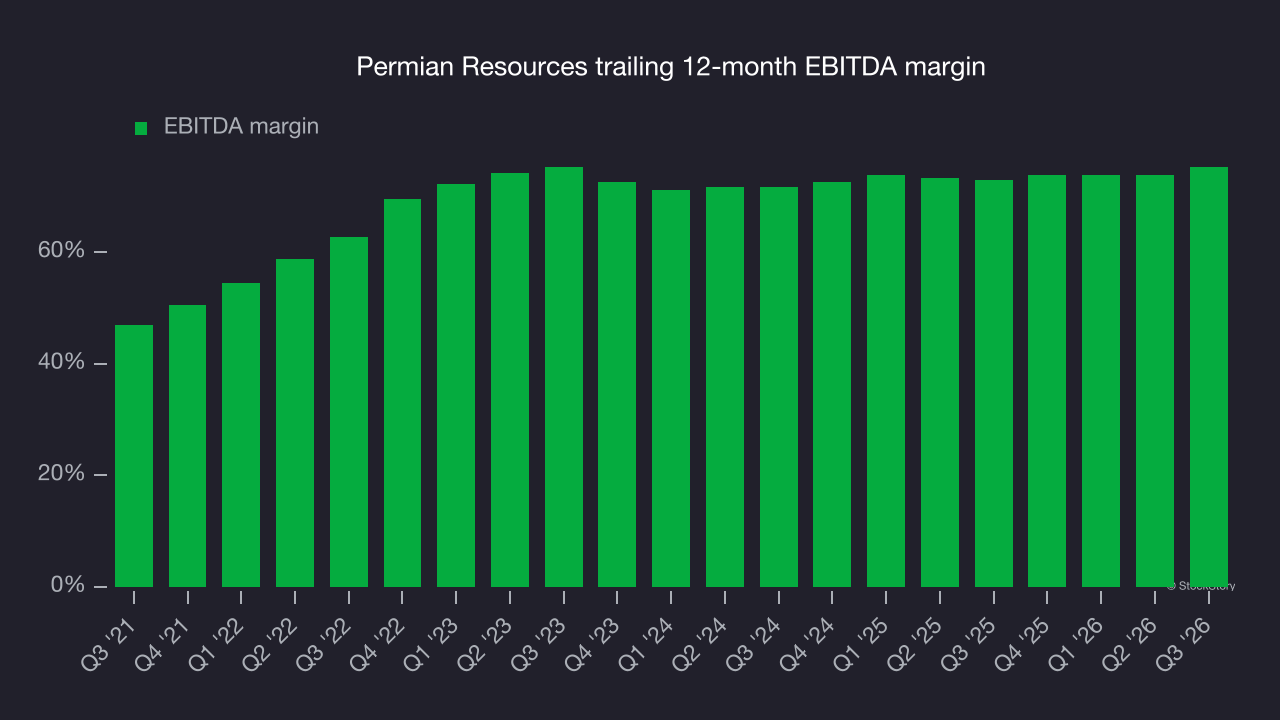
This quarter, Permian Resources generated an EBITDA margin of 76.6%, up 5.6 percentage points year on year. This increase was a positive development and shows it was more efficient. Adjusted EBITDA beat Wall Street’s consensus estimates by 11.8%.
Free cash flow
Adjusted EBITDA shows how profitable a company’s existing wells are before financing and reinvestment decisions, but free cash flow shows how much value remains after paying the cost of replacing those wells. In upstream energy, production naturally declines over time, so companies must continuously reinvest just to stand still. A producer can report strong EBITDA margins yet generate little or no free cash flow if its wells decline quickly or if new drilling is expensive. Free cash flow therefore captures not only how efficiently a company produces hydrocarbons today, but also how costly it is to sustain that production into the future.
Permian Resources has shown strong cash profitability, driven by its lucrative business model that enables it to reinvest, return capital to investors and maintain its competitive edge. The company’s free cash flow margin was among the best in the energy upstream and integrated energy sector, averaging 33.1% over the last five years.
Absolute free cash flow margin levels matter, but so does stability. All else equal, a 25.0% average free cash flow margin that stays steady across commodity price cycles is preferable to very high margins when times are good and negative ones when they’re tough.
Permian Resources’s ratio of quarterly free cash flow volatility to West Texas Intermediate, or WTI, crude price volatility over the past five years was 6 (lower is better), indicating strong insulation from commodity swings. This stability supports capital access in downturns and positions Permian Resources to act as a consolidator when weaker peers are forced to retrench.
Why assess stability against commodity prices at the free cash flow line? Why not compare revenue or EBITDA to WTI crude prices in the case of Permian Resources? Because what ultimately matters is not how much revenue or profit a company earns when prices are high but how much cash it can generate when prices are low. Free cash flow is the superior metric because it includes everything from hedging effectiveness to growth and maintenance capex to management behavior during good times and bad.
Key takeaways from Permian Resource's Q3 results
Permian Resources delivered a good quarter, with revenue well ahead of analysts’ consensus estimates and EPS also topping Wall Street’s expectations. Those beats were key positives, but investors were likely hoping for more. Shares edged lower 1.7% to $22.27 immediately after the report.
When deciding whether to buy the stock, consider the broader picture of valuation, business quality and the latest earnings. For more on these factors, read the free full research report here.
If you believe this article contains misleading, harmful, or spam content, please let us know.
Report this articleMore News
View More




Recent Quotes
View MoreQuotes delayed at least 20 minutes.
By accessing this page, you agree to the Privacy Policy and Terms Of Service.