




Financial News
Palomar Holdings (NASDAQ:PLMR) reports upbeat Q3 2026

Specialty insurance provider Palomar Holdings (NASDAQ: PLMR) reported Q3 2026 results exceeding the market’s revenue expectations, with revenue up 58% year on year to $386.6 million. Its non-GAAP profit of $3.01 per share was 16.3% above analysts’ consensus estimates.
For more on Palomar Holdings, read our free full research report.
Palomar Holdings (PLMR) Q3 2026 highlights:
- Net premiums earned $365.4 million vs analysts’ consensus estimates of $332.3 million (62.3% year-on-year growth, 10% beat)
- Revenue $386.6 million vs analysts’ consensus estimates of $356.7 million, according to S&P (58% year-on-year growth, 8.4% beat)
- Combined ratio 80.8% vs analysts’ consensus estimates of 82.3% (148 basis point beat)
- Adjusted EPS $3.01 vs analysts’ consensus estimates of $2.59, according to S&P (16.3% beat)
- Market capitalization $3.74 billion
Mac Armstrong, Chairman and Chief Executive Officer, commented, “Palomar’s third quarter of 2026 was exceptional; highlighted by record gross written premium and adjusted net income, our 16th consecutive earnings beat and the fourth increase to our 2026 adjusted net income guidance range. Profitable growth anchors Palomar 2X. This quarter’s 47% growth in adjusted net income and 33% adjusted return on equity demonstrate our ability to deliver on that strategy in a dynamic insurance market.”
Revenue growth
In general, insurance companies earn revenue from three primary sources. The first is the core insurance business itself, often called underwriting and represented in the income statement as premiums earned. The second source is investment income from investing the “float” (premiums collected upfront not yet paid out as claims) in assets such as fixed-income assets and equities. The third is fees from various sources such as policy administration, annuities or other value-added services. Palomar Holdings’s revenue grew at a strong 41.6% compounded annual growth rate over the last five years. Its growth surpassed the average insurance company and shows its offerings resonate with customers.
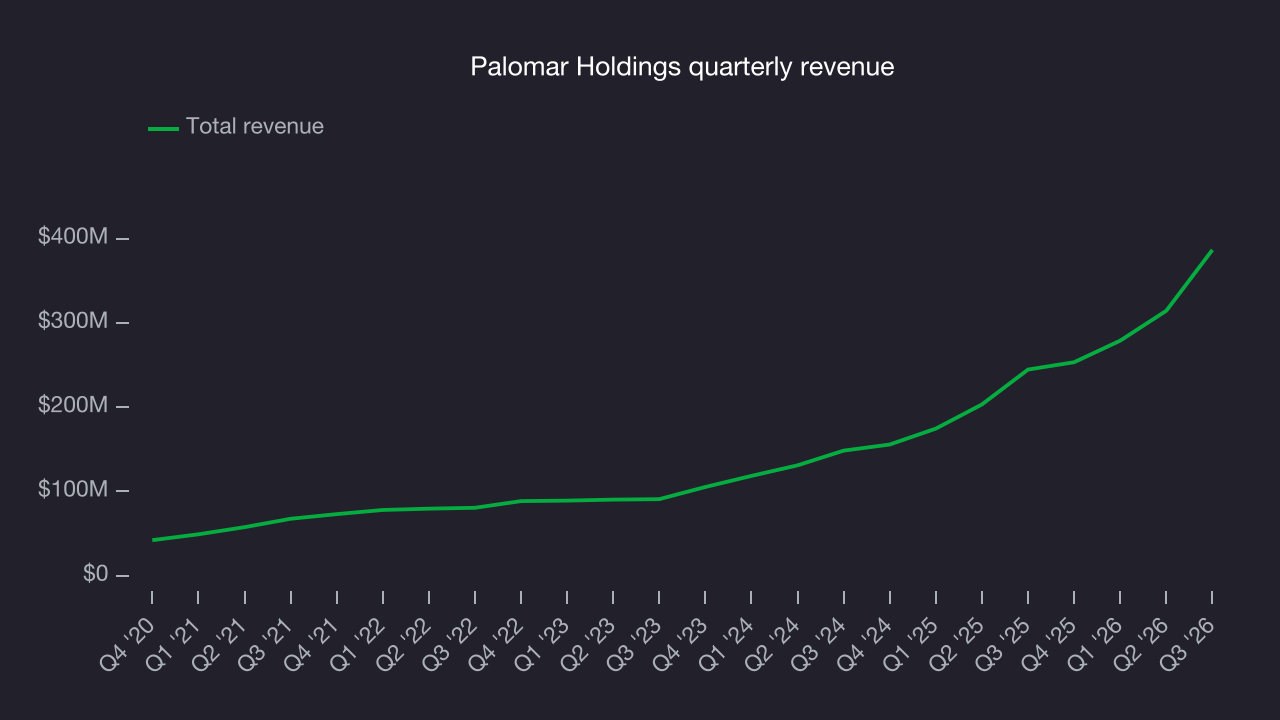
Long-term growth is the most important, but within financials, a half-decade historical view may miss recent interest rate changes and market returns. Palomar Holdings’s annualized revenue growth of 56.5% over the last two years is above its five-year trend, suggesting its demand was strong and recently accelerated. 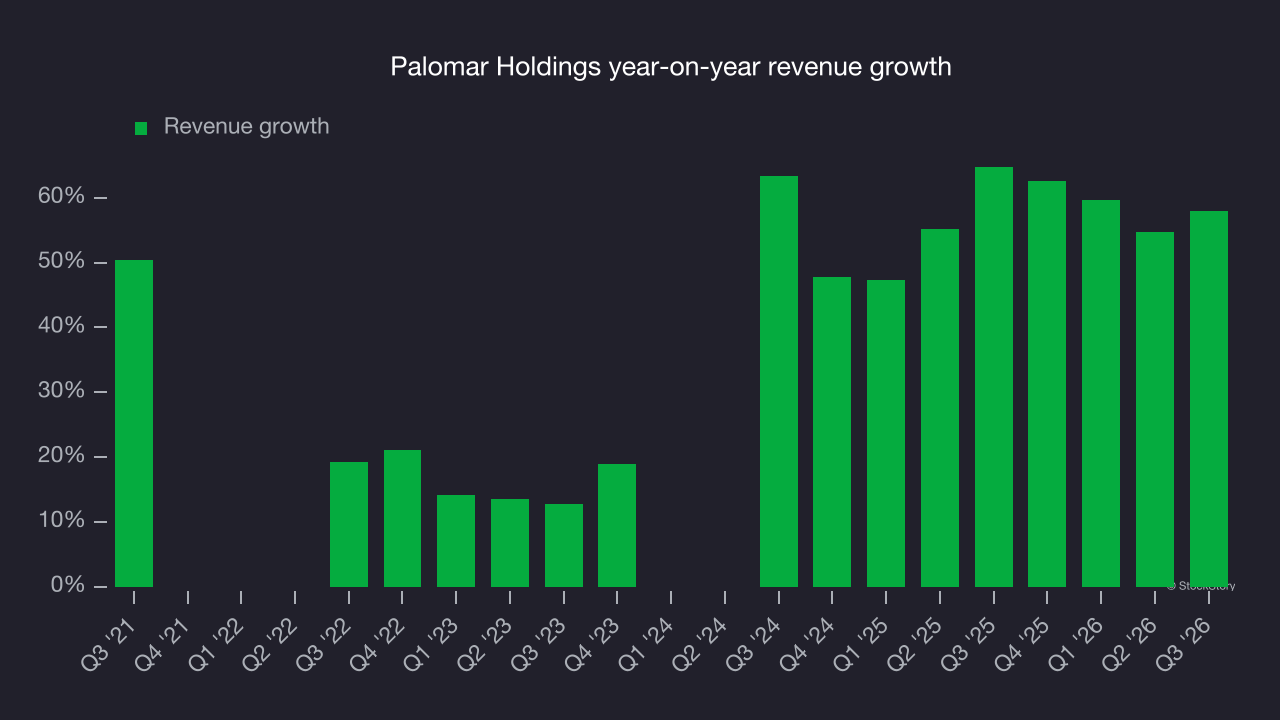 Note: Quarters not shown were determined to be outliers because they were impacted by outsized investment gains/losses that are not indicative of the recurring fundamentals of the business.
This quarter, Palomar Holdings reported strong year-on-year revenue growth of 58%, and its $386.6 million of revenue beat Wall Street’s consensus estimates by 8.4%.
Net premiums earned made up 92.8% of the company’s total revenue during the last five years, meaning Palomar Holdings depends heavily on its underwriting activities because non-insurance operations contribute little to revenue.
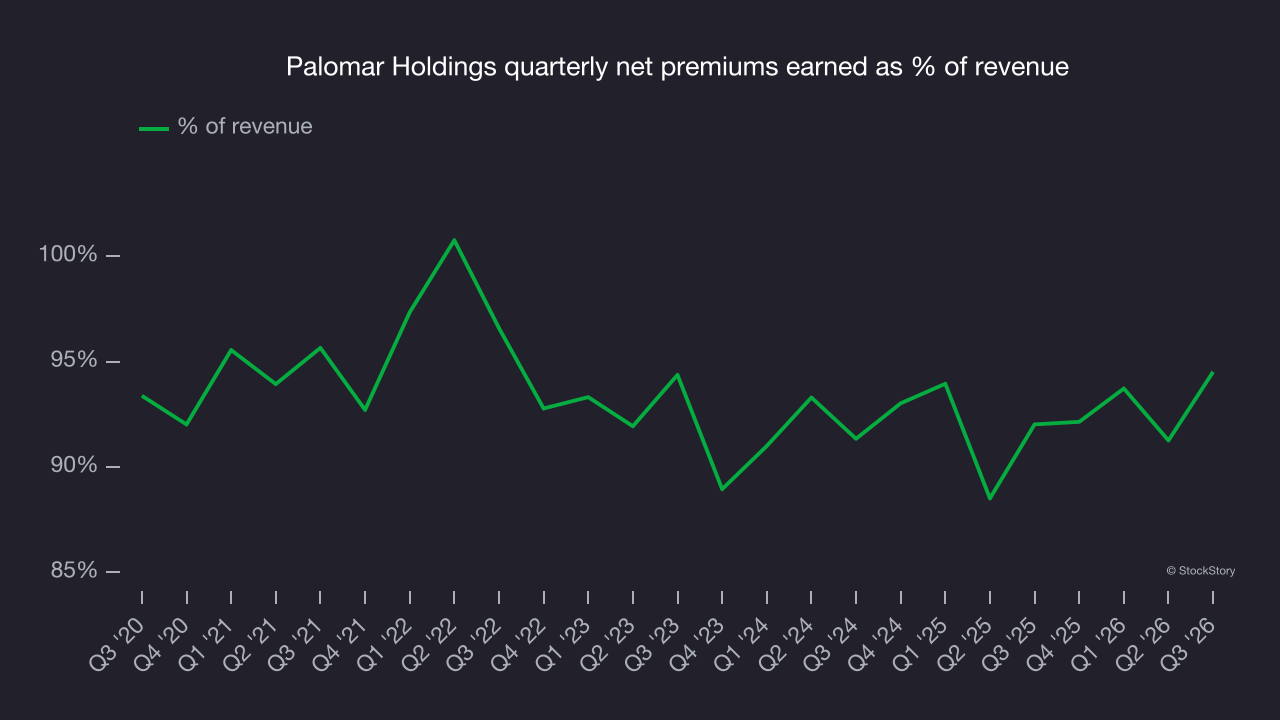
While insurers generate revenue from multiple sources, investors view net premiums earned as the cornerstone – their direct link to core operations stands in sharp contrast to the unpredictability of investment returns and fees.
Net premiums earned
When insurers sell policies, they protect themselves from extremely large losses or an outsized accumulation of losses with reinsurance (insurance for insurance companies). Net premiums earned are therefore net of what’s ceded to reinsurers as a risk mitigation and transfer strategy.
Palomar Holdings’s net premiums earned have grown at a 41.1% annualized rate over the last five years, much better than the broader insurance industry and in line with its total revenue.
Growth in Palomar Holdings’s net premiums earned accelerated to 58% annually over the last two years. Net premiums earned outpaced total revenue growth over this period, indicating that other line items such as investment income grew at a slower rate. These additional streams do play a key role in the bottom line, but their impact can vary. While some firms have excelled in consistently investing their float, sudden shifts in the fixed income and equity markets can heavily sway short-term performance.
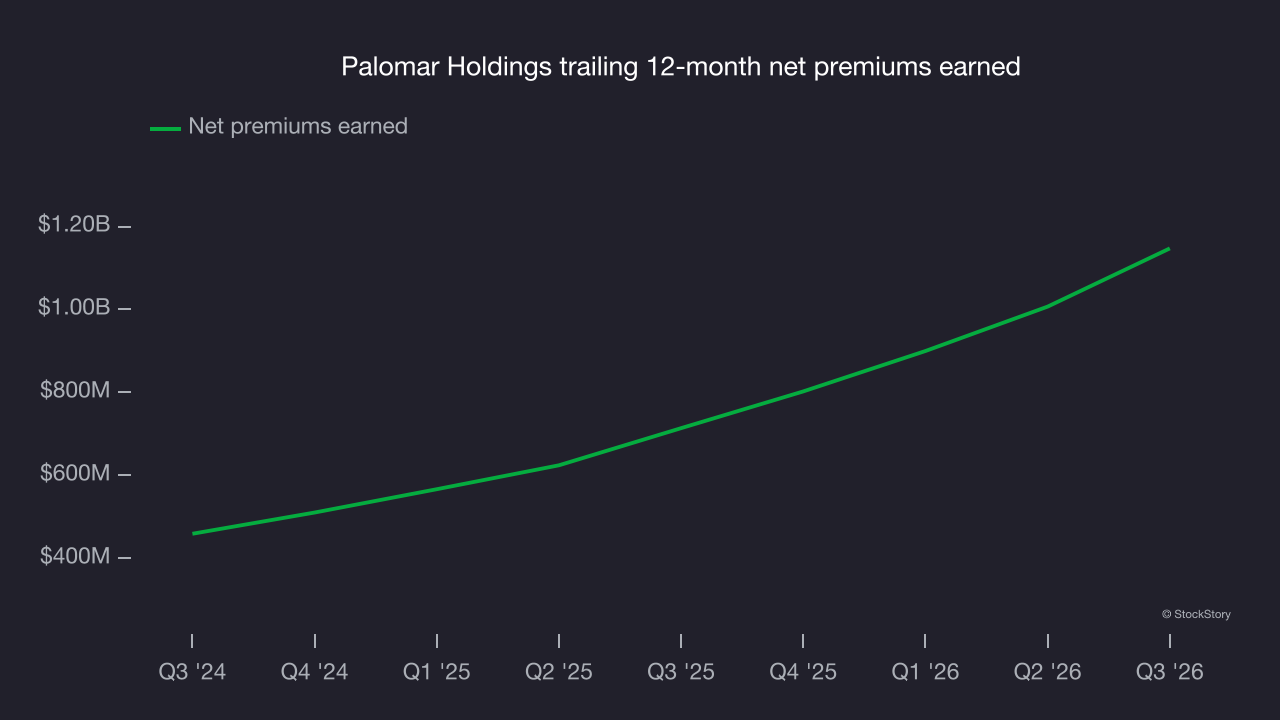
This quarter, Palomar Holdings’s net premiums earned were $365.4 million, rising 62.3% year on year and topping Wall Street’s consensus estimates by 10%.
Key takeaways from Palomar Holdings’s Q3 results
Palomar Holdings delivered a solid Q3, with net premiums earned and revenue both beating analysts’ consensus estimates by wide margins. Those beats were key positives for the quarter. Shares rose 2.1% to $146.78 immediately after the results.
Palomar Holdings had a solid quarterly earnings result, but is this stock a good investment? The latest quarter is only one factor in assessing longer-term business quality. Quality, combined with valuation, can help determine if the stock is a buy. Read the full research report here (it’s free).
If you believe this article contains misleading, harmful, or spam content, please let us know.
Report this articleMore News
View More




Recent Quotes
View MoreQuotes delayed at least 20 minutes.
By accessing this page, you agree to the Privacy Policy and Terms Of Service.