




Financial News
Myriad Genetics (NASDAQ:MYGN) reports upbeat Q3 2026, stock jumps 10.7%

Genetic testing company Myriad Genetics (NASDAQ: MYGN) reported Q3 2026 results beating Wall Street’s revenue expectations, but revenue fell by 1.5% year on year to $202.7 million. The company’s full-year revenue guidance of $785 million at the midpoint came in 0.9% above analysts’ consensus estimates. Its non-GAAP loss of $0.11 per share was 44.9% above analysts’ consensus estimates.
For more on Myriad Genetics, read our free full research report.
Myriad Genetics (MYGN) Q3 2026 highlights:
- Revenue $202.7 million vs S&P analysts’ consensus estimates of $191 million (1.5% year-on-year decline, 6.1% beat)
- Adjusted EPS -$0.11 vs S&P analysts’ consensus estimates of -$0.20 (44.9% beat)
- Adjusted EBITDA -$5.3 million (-2.6% margin, 168% year-on-year decline)
- Revenue guidance The company slightly lifted its revenue guidance for the full year to $785 million at the midpoint from $780 million
- Operating margin -19.7%, down from -11.3% in the same quarter last year
- Free cash flow -$8.6 million, down from $18.3 million in the same quarter last year
- Market capitalization $577.7 million
“We have made meaningful progress on our path to accelerate profitable growth and strengthen the company’s financial profile. Our third quarter 2026 financial results exceeded our expectations, led by our on-going focus on the Cancer Care Continuum (CCC). Average revenue per CCC test in the third quarter 2026 was higher than in the second quarter 2026 and reflects our team's ongoing work and early progress with payer engagement and revenue cycle management initiatives," said Sam Raha, President and CEO, Myriad Genetics. “The sale of our Prenatal Health business is a decisive step to support our strategic intent to increase profitable growth by focusing on the Cancer Care Continuum including screening, treatment selection and monitoring along with remission surveillance. We expect this action to benefit healthcare providers and patients we serve, as well as our employees and shareholders, and improve Myriad's revenue growth rate, profitability, and liquidity going forward. Lastly, we are increasing the mid-point of our full-year 2026 revenue guidance modestly, as we balance the positive third quarter 2026 performance with the timing of the sale of the Prenatal Health business, which is expected to close by early 2027."
Revenue growth
A company’s long-term performance is an indicator of its overall quality. Any business can put up a good quarter or two, but many enduring ones grow for years. Over the last five years, Myriad Genetics grew its revenue at a tepid 3.3% compounded annual growth rate, falling short of the healthcare sector standard.
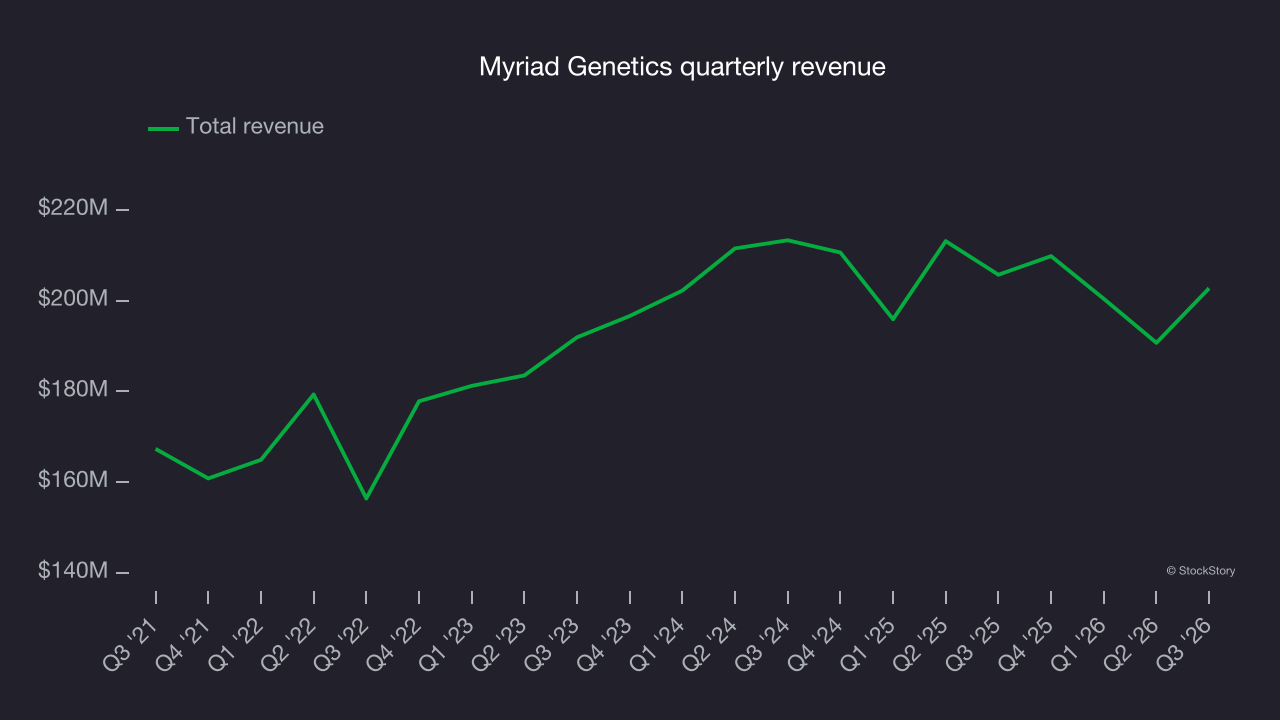
Long-term growth matters the most, but within healthcare, a half-decade historical view may miss recent innovations or disruptive industry trends. Myriad Genetics’s performance shows it grew in the past but gave back its gains over the last two years, as its revenue fell by 1.2% annually. 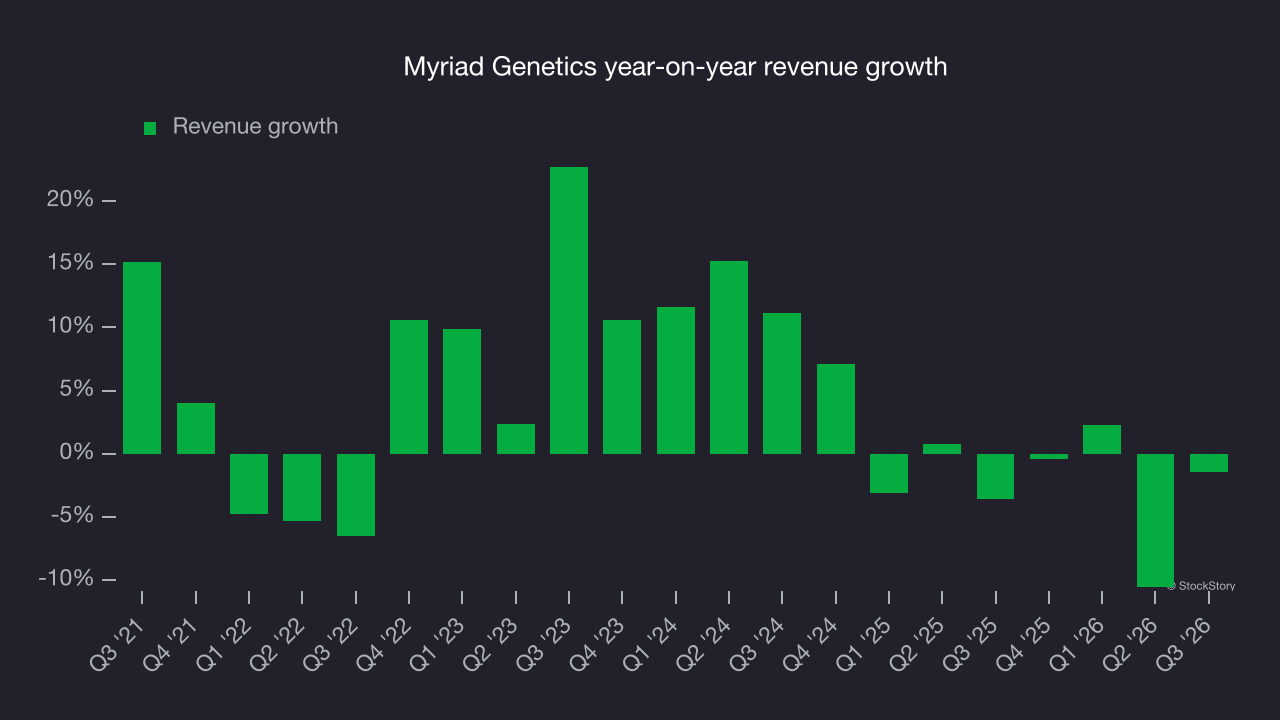
This quarter, Myriad Genetics’s revenue fell by 1.5% year on year to $202.7 million but beat Wall Street’s consensus estimates by 6.1%.
Looking ahead, sell-side analysts expect revenue to remain flat over the next 12 months, according to S&P. While this projection implies its newer products and services will fuel better top-line performance, it is still below the sector average.
Adjusted operating margin
Myriad Genetics’s high expenses have contributed to an average adjusted operating margin of negative 2.2% over the last five years. Unprofitable healthcare companies require extra attention because they may be vulnerable in a downturn. It’s hard to be confident that the business can endure a full cycle.
Looking at the trend in its profitability, Myriad Genetics’s adjusted operating margin decreased by 4.2 percentage points over the last five years. This performance was caused by more recent setbacks as the company’s margin fell by 9.7 percentage points on a two-year basis. These results are disappointing because they show its expenses were rising and it couldn’t pass those costs on to its customers.
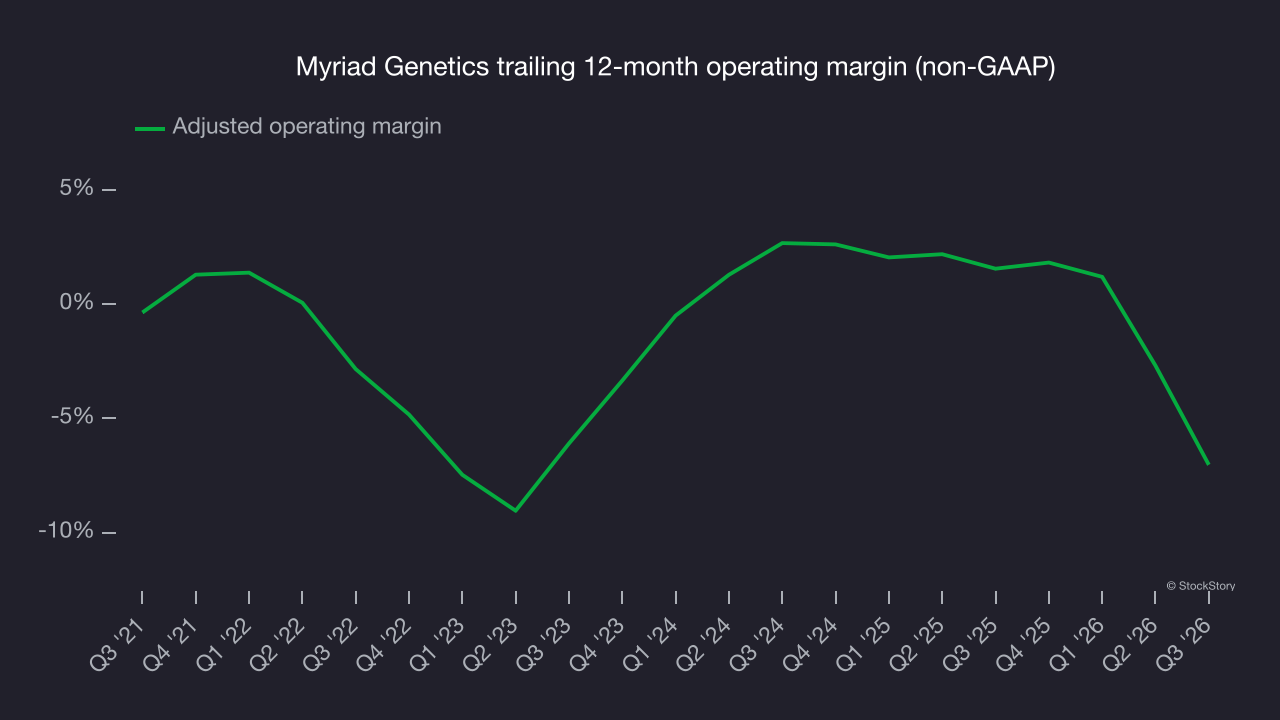
This quarter, Myriad Genetics generated a negative 15.1% adjusted operating margin. The company’s consistent lack of profits is a concern.
Earnings per share
Revenue trends explain a company’s historical growth, but the long-term change in earnings per share (EPS) points to the profitability of that growth; for example, a company could inflate its revenue through excessive spending on advertising and promotions.
Myriad Genetics’s earnings losses deepened over the last five years as its EPS dropped 38.7% annually. Falling EPS is a warning sign, as diminishing earnings could imply changing secular trends and preferences. If the tide turns unexpectedly, Myriad Genetics’s low margin of safety could leave its stock price susceptible to large downswings.
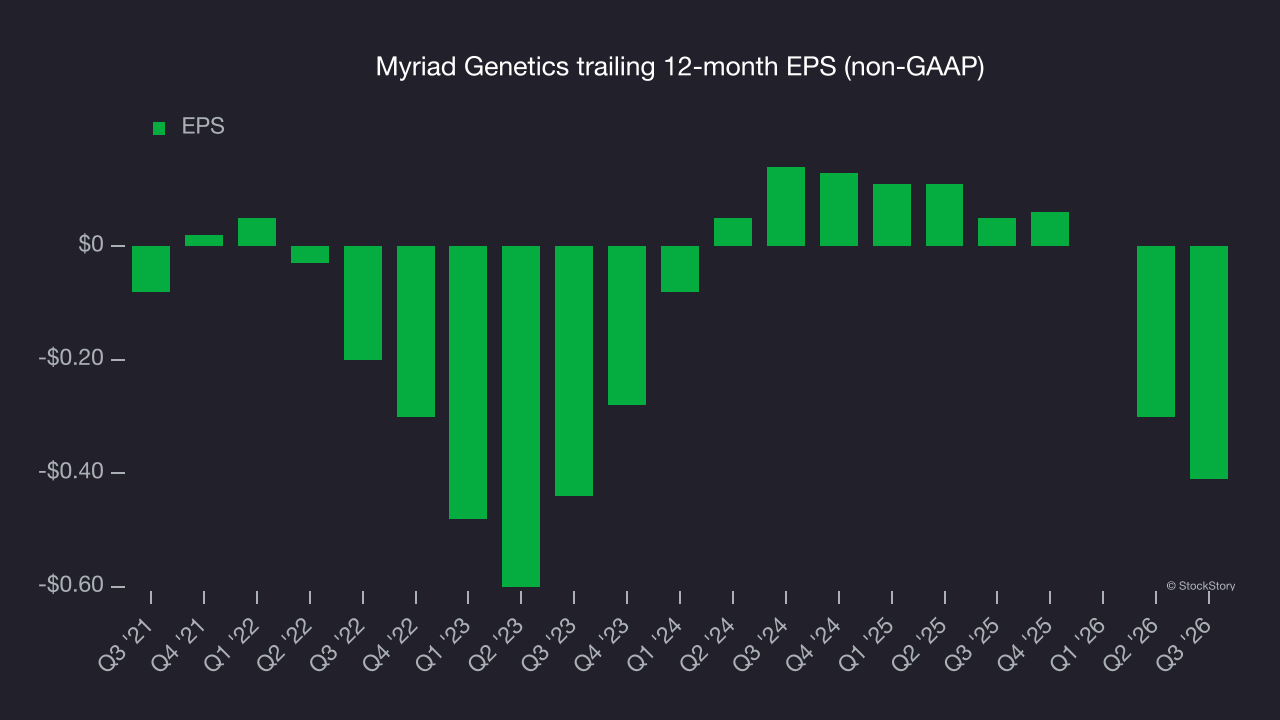
In Q3, Myriad Genetics reported adjusted EPS of negative $0.11, down from $0 in the same quarter last year. Despite falling year on year, EPS beat analysts’ consensus estimates by a wide margin. Over the next 12 months, Wall Street expects Myriad Genetics to perform poorly. Analysts forecast its full-year EPS will fall from negative $0.41 to negative $0.61, according to S&P.
Key takeaways from Myriad Genetics’s Q3 results
Myriad Genetics delivered a solid quarter, with revenue beating Wall Street’s consensus estimates by a wide margin and EPS also topping analysts’ consensus expectations. Shares soared 10.7% to $6.66 immediately after the report.
Myriad Genetics had a positive quarter, but one earnings result doesn’t necessarily make the stock a buy. That decision calls for a broader look at valuation, business quality and the latest earnings. For more on Myriad Genetics, read our full research report here (it’s free).
If you believe this article contains misleading, harmful, or spam content, please let us know.
Report this articleMore News
View More




Recent Quotes
View MoreQuotes delayed at least 20 minutes.
By accessing this page, you agree to the Privacy Policy and Terms Of Service.