




Financial News
JBT Marel (NYSE:JBTM) reports sales below analyst estimates in Q3 2026 earnings, stock drops

Food processing and aviation equipment manufacturer JBT Marel (NYSE: JBTM) fell short of the market’s revenue expectations in Q3 2026, with revenue flat year on year at $994 million. The company’s full-year revenue guidance of $3.98 billion at the midpoint came in 1.2% below analysts’ consensus estimates. Its non-GAAP profit of $2.19 per share was 4.5% above analysts’ consensus estimates.
For more on JBT Marel, read our free full research report.
JBT Marel (JBTM) Q3 2026 highlights:
- Revenue $994 million vs S&P analysts’ consensus estimates of $1.03 billion (flat year on year, 3.3% miss)
- Adjusted EPS $2.19 vs S&P analysts’ consensus estimates of $2.10 (4.5% beat)
- Adjusted EBITDA $179 million vs analysts’ consensus estimates of $177.3 million (18% margin, 0.9% beat)
- Revenue guidance The company lowered its revenue guidance for the full year to $3.98 billion at the midpoint from $4.03 billion, a 1.3% decrease
- Adjusted EPS guidance Management raised its full-year adjusted EPS guidance to $8.25 at the midpoint, a 1.9% increase
- EBITDA guidance $690.5 million at the midpoint for the full year, in line with analysts’ consensus estimates
- Operating margin 10.1%, in line with the same quarter last year
- Free cash flow margin 7.3%, up from 5.7% in the same quarter last year
- Backlog $1.52 billion at quarter end
- Market capitalization $5.93 billion
"We executed well in a dynamic environment, delivering third quarter adjusted EBITDA and margins above the midpoint of our guidance, notwithstanding lower book-and-ship volume," said Brian Deck, Chief Executive Officer. "Our strong quarterly and year-to-date margins reflect the meaningful benefits from our cost synergy initiatives, including labor productivity, supply chain savings, and footprint optimization. The commitment to our margin improvement program will continue to drive results even amid inflationary and tariff pressures."
Revenue growth
Reviewing a company’s long-term revenue performance reveals insights into its quality. Any business can experience short-term success, but top-performing ones sustain growth for years. JBT Marel’s revenue grew at a strong 16.7% compounded annual growth rate over the last five years. Its growth beat the average industrials company and shows its offerings resonate with customers.
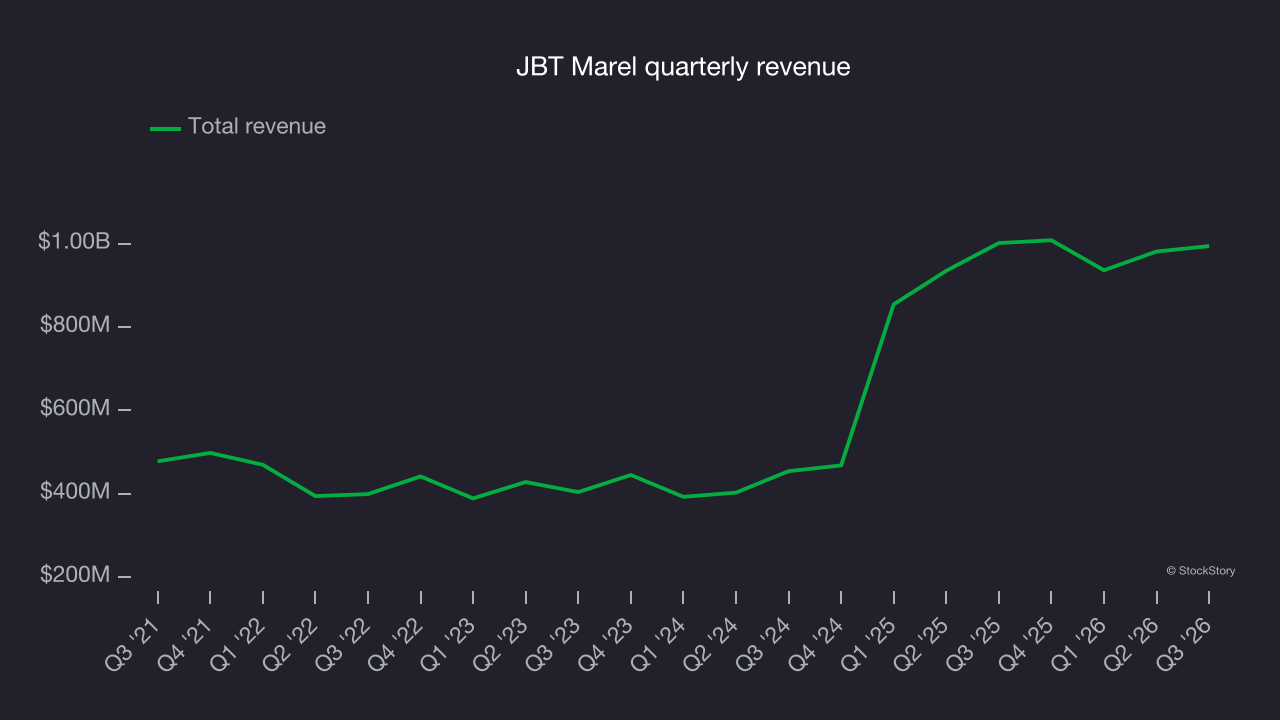
Long-term growth is the most important, but within industrials, a half-decade historical view may miss new industry trends or demand cycles. JBT Marel’s annualized revenue growth of 52.1% over the last two years is above its five-year trend, suggesting its demand was strong and recently accelerated. 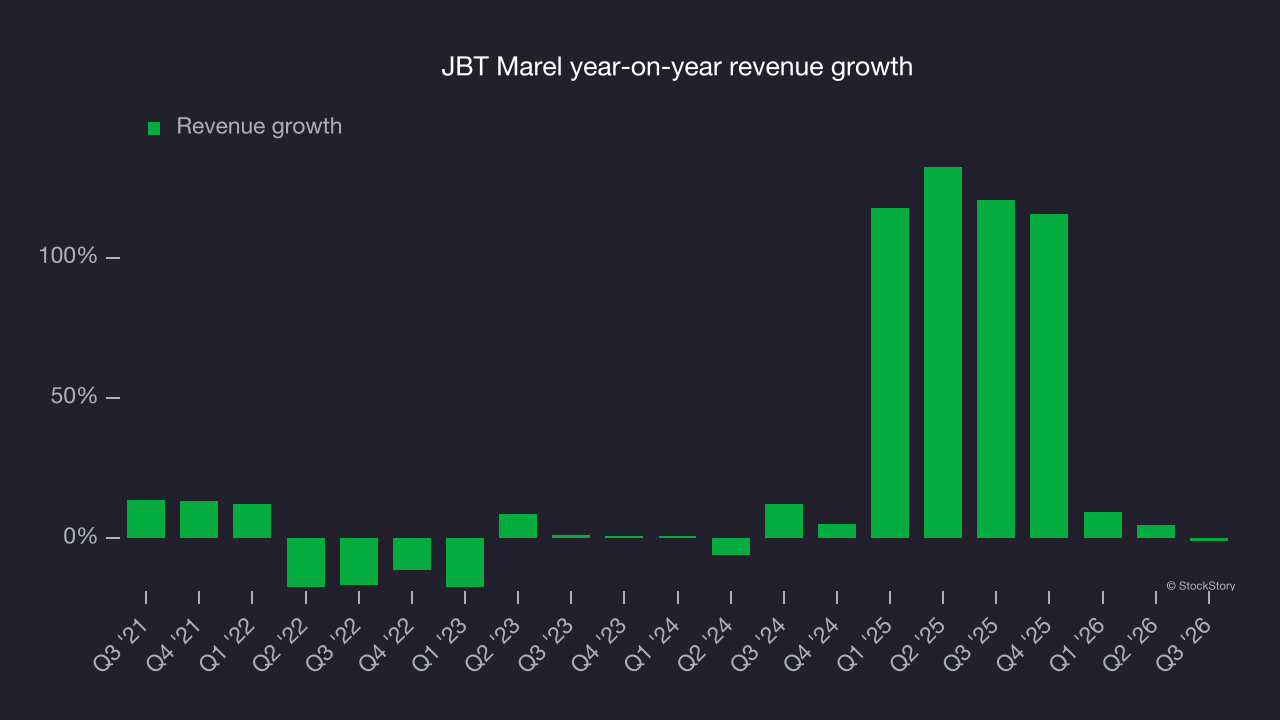
This quarter, JBT Marel’s $994 million of revenue was flat year on year, falling short of Wall Street’s consensus estimates.
Looking ahead, sell-side analysts expect revenue to grow 6.5% over the next 12 months, according to S&P, a deceleration versus the last two years. This projection is underwhelming and suggests its products and services will see some demand headwinds. Still, the company is tracking well in other measures of financial health.
Operating margin
Operating margin is an important measure of profitability as it shows the portion of revenue left after accounting for all core expenses, from the cost of goods sold to advertising and wages. It’s also useful for comparing profitability across companies with different levels of debt and tax rates because it excludes interest and taxes.
JBT Marel’s operating margin has risen over the last 12 months and averaged 7% over the last five years. Although its profitability is still mediocre, its strong revenue growth is giving it operating leverage as it scales. This gives it a chance at higher long-term profits if it can keep expanding.
Looking at the trend in its profitability, JBT Marel’s operating margin might have fluctuated slightly but has generally stayed the same over the last five years. This raises questions about the company’s expense base because its revenue growth should have given it leverage on its fixed costs, resulting in better economies of scale and profitability.
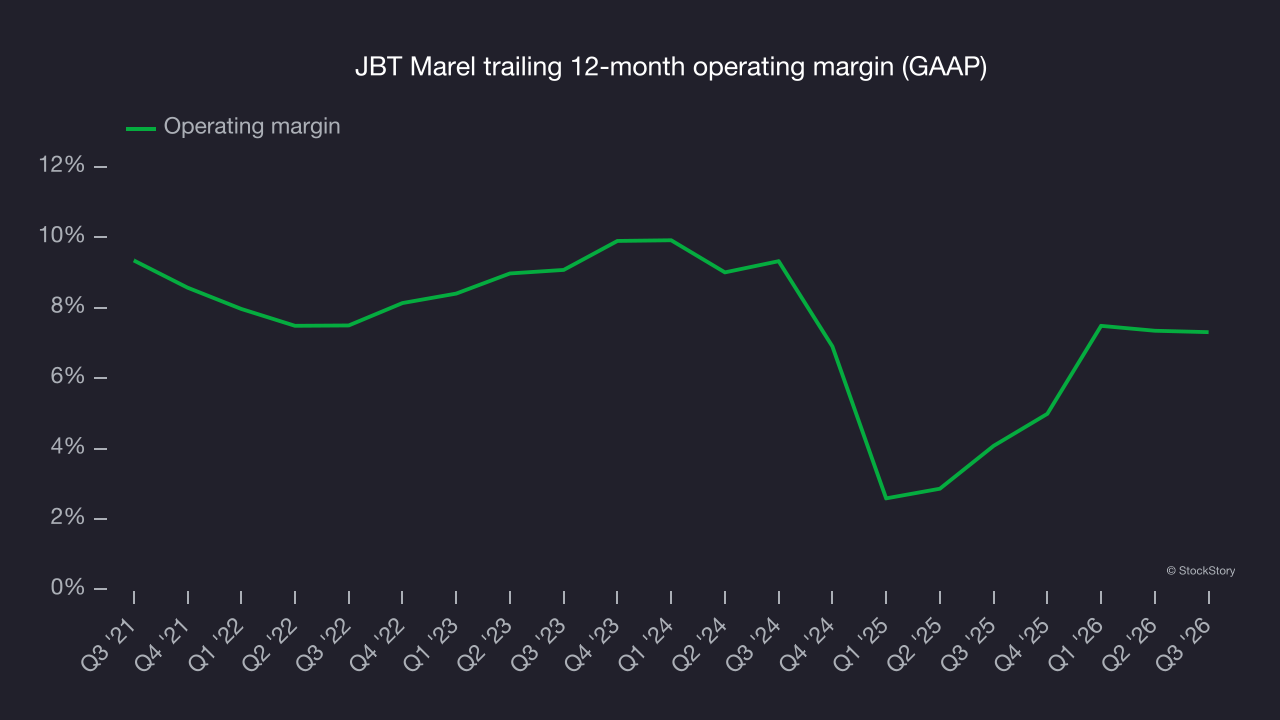
In Q3, JBT Marel generated an operating margin of 10.1%, in line with the same quarter last year. This indicates the company’s cost structure has recently been stable.
Earnings per share
We track the long-term change in earnings per share (EPS) for the same reason as long-term revenue growth. Compared to revenue, however, EPS highlights whether a company’s growth is profitable.
JBT Marel’s EPS grew at a strong 13.3% compounded annual growth rate over the last five years. Despite its operating margin improvement during that time, this performance was lower than its 16.7% annualized revenue growth, indicating that non-fundamental factors such as interest and taxes affected its ultimate earnings.
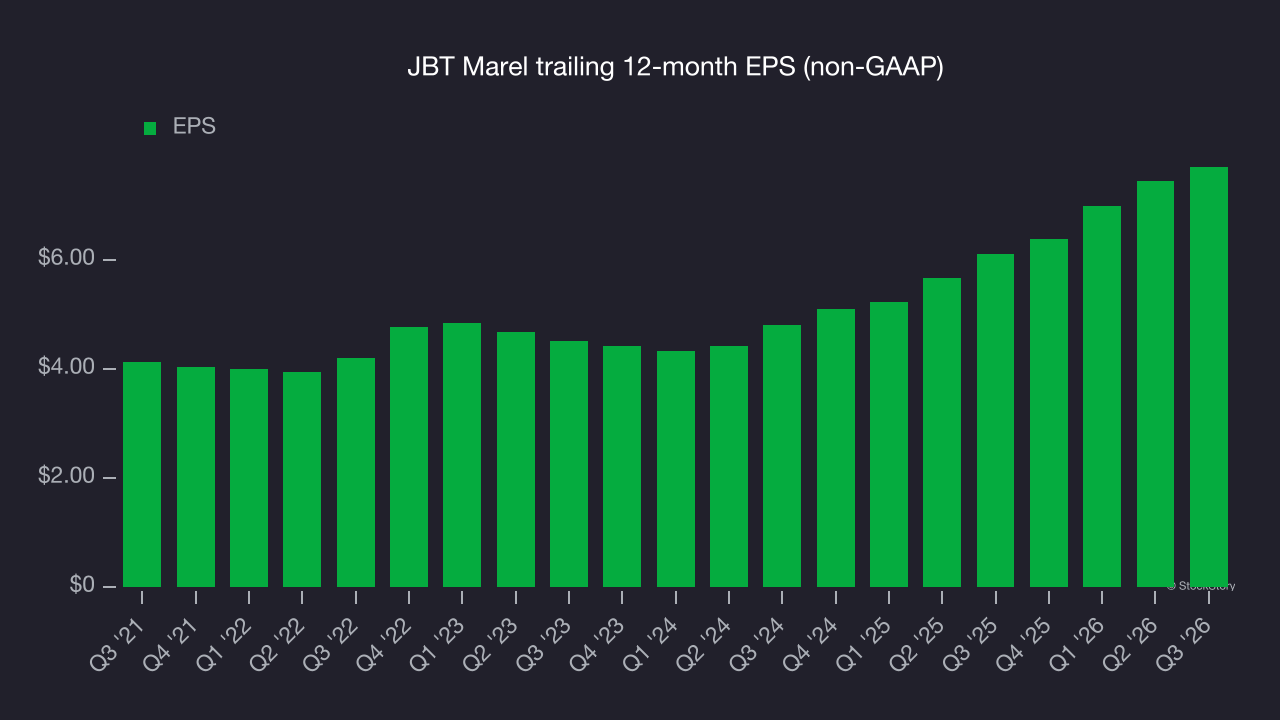
Diving into the nuances of JBT Marel’s earnings can give us a better understanding of its performance. A five-year view shows JBT Marel has diluted its shareholders, growing its share count by 60.7%. This has led to lower per share earnings. Taxes and interest expenses can also affect EPS but don’t tell us as much about a company’s fundamentals. 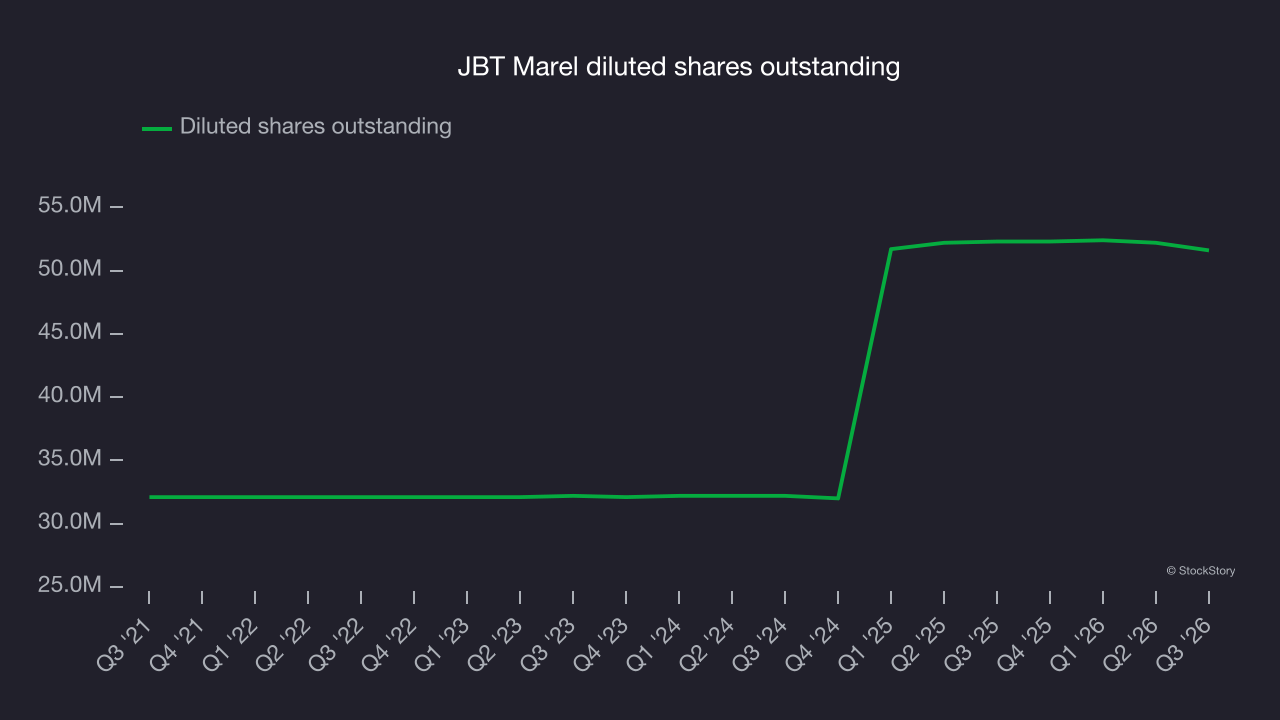
Like with revenue, we analyze EPS over a shorter period to see if we are missing a change in the business.
For JBT Marel, its two-year annual EPS growth of 26.7% was higher than its five-year trend. That acceleration is a positive, especially given the already high base.
In Q3, JBT Marel reported adjusted EPS of $2.19, up from $1.94 in the same quarter last year. This result beat analysts’ consensus estimates by 4.5%. Over the next 12 months, Wall Street expects JBT Marel’s full-year EPS to grow 15.2% from $7.70 to $8.87, according to S&P.
Key takeaways from JBT Marel’s Q3 results
JBT Marel’s EPS beat analysts’ consensus estimates and EBITDA narrowly topped Wall Street’s consensus, but revenue missed expectations and full-year revenue guidance fell slightly short of consensus. Those shortfalls made this a weaker quarter overall. Shares tumbled 6.6% to $107.32 immediately after the report.
JBT Marel had a tough quarter, but assessing whether the stock offers an investment opportunity requires a broader view. That decision should take into account valuation, business quality and the latest earnings. For more on JBT Marel, read the full research report here (it’s free).
If you believe this article contains misleading, harmful, or spam content, please let us know.
Report this articleMore News
View More




Recent Quotes
View MoreQuotes delayed at least 20 minutes.
By accessing this page, you agree to the Privacy Policy and Terms Of Service.