




Financial News
The Grinch Who Stole Wall Street: Santa Claus Rally Fails for Third Straight Year, Echoing 1950s Slump
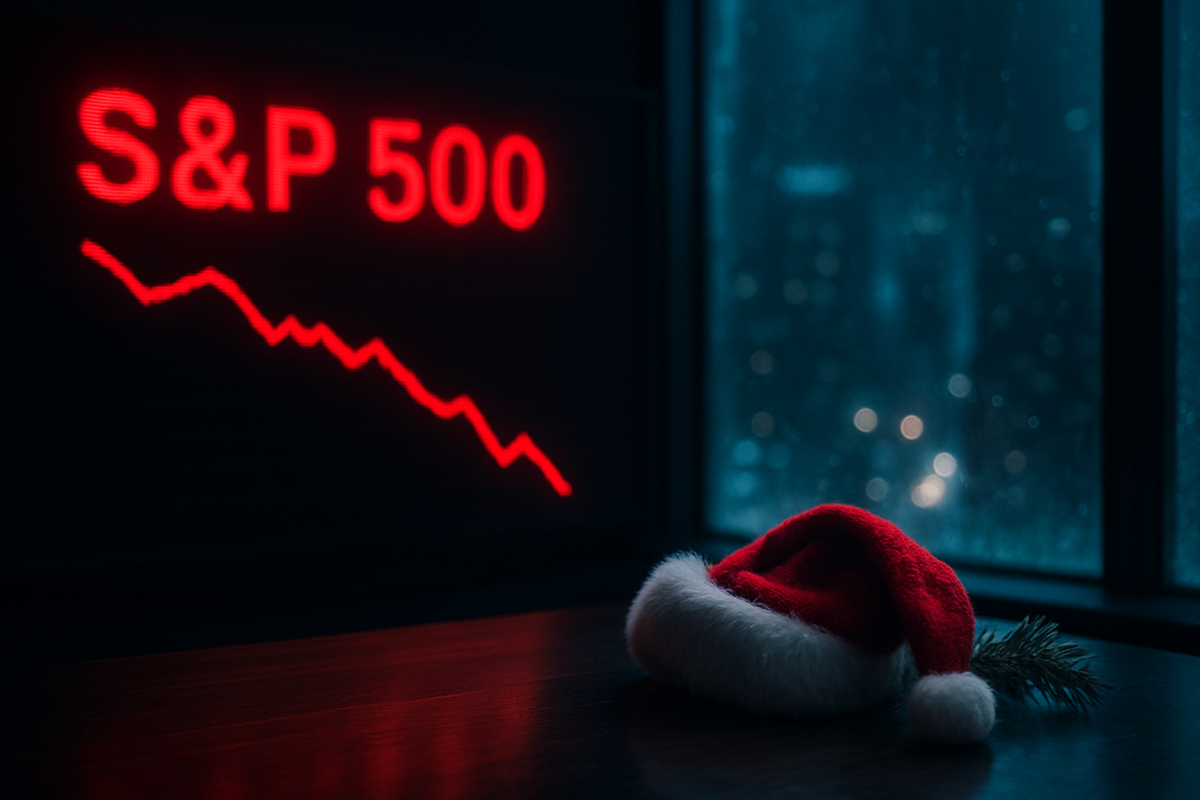
As the final trading bell of January 5, 2026, echoed across the floor of the New York Stock Exchange, a chilling realization set in for market historians and retail investors alike: the legendary "Santa Claus Rally" had failed to materialize for the third consecutive year. This seven-day trading window—spanning the final five sessions of December and the first two of January—is a hallmark of seasonal optimism, typically yielding a gain of 1.3% for the S&P 500 (NYSEARCA: SPY). Instead, the index closed the period down 0.6%, marking a rare and ominous "three-peat" of failures not seen in the market since the era of the Korean War.
The failure of the rally is more than just a seasonal quirk; it is a statistical anomaly that has historically served as a harbinger of volatility. According to the Stock Trader’s Almanac, the adage "If Santa Claus should fail to call, bears may come to Broad and Wall" has held a high degree of accuracy over the last 75 years. With the S&P 500 now entering 2026 on a defensive footing, the rare three-year drought of year-end gains suggests that the momentum which carried the market through the Artificial Intelligence (AI) boom of 2024 and 2025 may finally be reaching a point of exhaustion.
The Anatomy of the 2025-2026 "Santa Stall"
The timeline leading to this historic failure began in mid-December 2025, shortly after the Federal Reserve announced its third consecutive interest rate cut. While a rate cut usually serves as a catalyst for a year-end surge, Fed Chair Jerome Powell accompanied the move with "hawkish" guidance, signaling that the central bank would pause further easing in 2026 to combat "sticky" inflation in the services sector. This shift in tone caught investors off guard, dampening the holiday spirit just as the Santa Claus Rally window opened on December 24.
Throughout the final week of December, the market was plagued by "technical exhaustion." After the S&P 500 posted a robust 17.9% return in 2025, valuations had climbed to a trailing price-to-earnings (P/E) ratio of 26x—a level that many analysts deemed "priced for perfection." Institutional liquidity also plummeted to nearly 50% of its 20-day average during the holiday week, allowing even modest sell orders from tax-loss harvesting to trigger outsized downward swings. By the time the markets reopened for the first two sessions of January 2026, the damage was done, and the index failed to reclaim its Christmas Eve levels.
Key stakeholders, including major hedge funds and institutional desk traders, reportedly shifted their focus from growth-oriented tech to defensive "value" plays during the final sessions. This rotation was fueled by a realization that the "AI hype" had transitioned into a "show-me" phase, where infrastructure build-outs were no longer enough to satisfy investors; they now demanded clear evidence of bottom-line revenue growth. The lack of a year-end "melt-up" suggests that the "smart money" is increasingly concerned about the sustainability of current earnings multiples heading into a potentially slower 2026.
Winners and Losers: A Tale of Two Techs
The failure of the rally was not felt equally across all sectors, creating a stark divide between AI infrastructure plays and high-valuation software names. Nvidia Corp. (NASDAQ: NVDA), the poster child of the 2024-2025 bull run, saw significant profit-taking in the final days of December, dropping nearly 13% as investors locked in gains to offset losses elsewhere. Similarly, Broadcom Inc. (NASDAQ: AVGO) faced pressure after reporting that while AI-related revenues remained steady, the massive capital expenditures required to maintain its lead were beginning to weigh on quarterly margins.
The software and cybersecurity sectors were among the hardest hit during the "Santa Stall." Palo Alto Networks (NASDAQ: PANW) saw its shares slide approximately 8% in mid-December following reports of decelerating product revenue growth. Even more dramatic was the performance of Zscaler Inc. (NASDAQ: ZS) and Snowflake Inc. (NYSE: SNOW), which dropped 16.1% and 13.6% respectively. These companies, once the darlings of the cloud-computing era, found themselves victimized by a market that no longer rewards "growth at any cost," especially as interest rates remain higher than the pre-pandemic norm.
Conversely, a few "winners" emerged from the holiday gloom by offering stability. Alphabet Inc. (NASDAQ: GOOGL) remained a rare bright spot among the mega-caps, gaining 13% in December as its diversified revenue streams and more reasonable valuation compared to its peers attracted defensive tech investors. Outside of tech, traditional defensive stocks like Procter & Gamble Co. (NYSE: PG) and Johnson & Johnson (NYSE: JNJ) saw increased inflows as the "Santa Stall" encouraged a flight to quality. These companies are expected to benefit if the failed rally indeed signals a broader market correction in the first half of 2026.
Historical Precedents and the 1950 Parallel
The current three-year streak of failed Santa Claus Rallies (2024, 2025, and 2026) is an event with almost no modern precedent. The last time the market saw such persistent seasonal weakness was around 1950, a period characterized by post-war economic restructuring and geopolitical tension. Historically, when the Santa Claus Rally fails, the S&P 500's average return for the following year drops to roughly 5.0% to 6.8%, significantly lower than the 10.2% average seen when the rally succeeds.
This event fits into a broader industry trend of "indicator decay," where traditional seasonal patterns are being disrupted by the rise of algorithmic trading and the concentration of the market in a handful of mega-cap stocks. In the past, the Santa Claus Rally was driven by retail "January Effect" buying and institutional window dressing. Today, however, the dominance of passive index funds and high-frequency trading means that a few large sell orders in Microsoft Corp. (NASDAQ: MSFT) or Apple Inc. (NASDAQ: AAPL) can negate the seasonal buying pressure of thousands of smaller investors.
The failure also serves as the first leg of the "January Indicator Trifecta," which also includes the performance of the first five trading days and the full month of January. When all three indicators are positive, the market has historically finished the year higher 90% of the time. With the first leg already in the red, the pressure is now on the remaining weeks of January to "save" the 2026 outlook. If the full month of January ends in negative territory, historical data suggests a much higher probability of a flat or bearish year, similar to the market's performance in 2000 and 2008.
What Comes Next: A Defensive 2026?
In the short term, investors should prepare for heightened volatility as the market digests the implications of the "Santa Stall." The lack of a year-end rally often leads to a "mean reversion" in the first quarter, where overextended sectors face further corrections. We may see a strategic pivot among fund managers away from the "Magnificent Seven" and toward mid-cap stocks, such as those found in the S&P MidCap 400, which showed resilience in late 2025. This "broadening out" of the market could provide a silver lining, reducing the index's over-reliance on a few tech giants.
Longer-term, the failure of the rally may force a reset of earnings expectations. If 2026 is to be a positive year, it will likely be driven by fundamental earnings growth rather than multiple expansion. Companies will need to prove that their AI investments are translating into tangible productivity gains. This creates a challenging environment for "story stocks" but offers a significant opportunity for value investors who have been sidelined during the high-flying years of 2024 and 2025.
Potential scenarios for the coming months include a "sideways" market where the S&P 500 trades within a narrow range as it waits for clearer signals from the Federal Reserve. However, if inflation remains "sticky" and the Fed is forced to move back to a hawkish stance, the failed Santa Claus Rally could be remembered as the first crack in the bull market's foundation. Investors should watch for the "January Barometer" at the end of the month; a negative close for the full month would be a strong signal to increase allocations to cash or defensive assets.
Summary and Investor Outlook
The failure of the 2025-2026 Santa Claus Rally marks a historic departure from seasonal norms, echoing a level of market hesitation not seen in over seven decades. While the broader market remains resilient, the "three-peat" of failed rallies suggests that the era of easy gains driven by AI euphoria may be giving way to a more disciplined and cautious investment landscape. The immediate takeaway is clear: the "Santa Claus" indicator is flashing a warning sign that the "bulls on Broad and Wall" may be facing an uphill battle in the year ahead.
Moving forward, the market will likely prioritize "valuation consolidation." Investors should keep a close eye on the "January Trifecta" and the upcoming Q4 2025 earnings season, which will provide the first real test of whether the AI leaders can justify their premium prices. The lasting impact of this event may be a permanent shift in how seasonal indicators are viewed in an age of high-frequency trading and extreme market concentration.
For the savvy investor, the coming months will require a focus on quality, dividends, and earnings consistency. While the "Grinch" may have stolen the year-end rally, the resulting market reset could eventually provide more attractive entry points for those willing to look past the seasonal noise. Watch the 5,800 level on the S&P 500 closely; a break below this technical floor could confirm that the "Santa Stall" was indeed the start of a more significant correction.
This content is intended for informational purposes only and is not financial advice.
More News
View More



Recent Quotes
View MoreQuotes delayed at least 20 minutes.
By accessing this page, you agree to the Privacy Policy and Terms Of Service.