




Financial News
Precious Metals Whiplash: Gold Dips Near $4,400 and Silver Tests $74 Support Amid Global Volatility
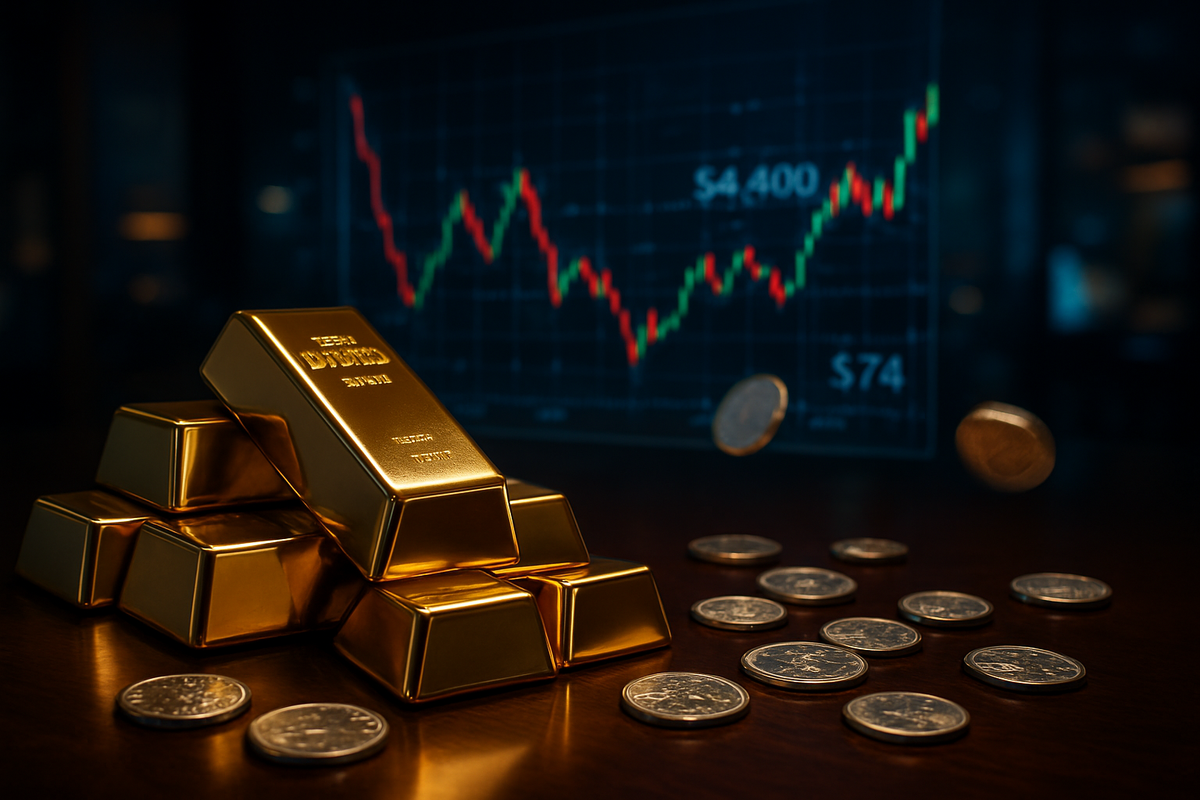
The precious metals market has entered 2026 with a staggering display of volatility, leaving investors and analysts alike scrambling to recalibrate their expectations for the year ahead. After a historic rally that saw Gold reaching for the stars in late 2025, the first week of January has delivered a sharp reality check. Gold prices, which recently flirted with the $4,550 mark, saw a sudden retreat toward the $4,400 per ounce level, while Silver—the breakout star of the previous year—plummeted from its $84 peak to briefly trade below $74 before finding its footing.
This "flash correction" has sent ripples through the global financial system, highlighting the fragile balance between speculative fervor and the underlying macroeconomic pressures of 2026. While the dip was sharp, a partial recovery in the following days suggests that the fundamental "debasement trade" remains intact, even as technical factors and institutional rebalancing force a temporary cooling of the market.
A Technical Storm in a Liquid Glass
The descent began in earnest during the first week of January 2026. Gold (XAU), which had hit an intraday record of $4,549.71 on December 26, 2025, faced a wave of selling pressure that pushed it down to approximately $4,420 by January 8. Silver (XAG) experienced an even more gut-wrenching slide; after peaking at $84 on December 29, it suffered its most significant daily percentage loss in over five years, tumbling to a low of $73.20.
According to analysis from Commerzbank AG (OTC: CRZBY), the primary catalyst for this sudden downdraft was a combination of thin holiday liquidity and a significant regulatory shift. Carsten Fritsch, a senior commodity analyst at Commerzbank, noted that the CME Group’s decision to hike margin requirements for silver futures—raising them from $22,000 to $32,500—triggered a cascade of forced liquidations. This was further compounded by the annual commodity index rebalancing of the S&P GSCI and Bloomberg Commodity Index, which reportedly triggered between $5 billion and $6 billion in mechanical selling as funds were forced to trim their winning positions in precious metals to maintain portfolio weightings.
Miners and ETFs in the Eye of the Hurricane
The volatility has created a bifurcated landscape for public companies and investment vehicles tied to the sector. Major mining giants like Newmont Corporation (NYSE: NEM) and Barrick Gold Corporation (NYSE: GOLD) have seen their stock prices mirror the metals' turbulence. Despite the recent dip, these companies continue to enjoy massive profit margins, with Barrick maintaining an All-In Sustaining Cost (AISC) near $1,500 per ounce—a far cry from the current $4,400 spot price. However, the sudden price drop led to a temporary sell-off in the VanEck Gold Miners ETF (NYSE Arca: GDX) as momentum traders exited positions.
In the silver space, Pan American Silver Corp. (NYSE: PAAS) has emerged as a focal point for institutional interest, particularly due to its high-performing Juanicipio mine. Meanwhile, streaming and royalty companies like Wheaton Precious Metals Corp. (NYSE: WPM) have shown more resilience, as their business model provides exposure to price upside without the direct operational risks of mining. On the investment side, the SPDR Gold Shares (NYSE Arca: GLD) and iShares Silver Trust (NYSE Arca: SLV) saw notable outflows during the first week of January, reflecting a shift from "paper" gold and silver back into physical holdings or other defensive assets.
Geopolitics and "Mineral Sovereignty"
Beyond technical factors, the market is grappling with profound geopolitical and structural shifts. A major driver of the recent silver squeeze was China’s January 1, 2026, implementation of strict export restrictions on refined silver. Citing "mineral sovereignty," Beijing has moved to secure silver supplies for its burgeoning AI and green energy sectors, effectively creating a geographic supply bottleneck that has panicked Western industrial buyers.
Furthermore, the geopolitical landscape remains fraught with tension. The recent U.S.-led military intervention in Venezuela and the subsequent capture of Nicolás Maduro have stoked fears of broader instability in Latin America, a key region for silver and gold production. This, combined with the looming leadership transition at the Federal Reserve in May 2026, has kept the market on edge. Investors are increasingly betting on a "debasement trade" as the U.S. national debt surpasses $35 trillion, positioning precious metals not just as hedges against inflation, but as essential reserve assets in a world of fiscal dominance.
The Road Ahead: Strategic Pivots and Scenarios
As the dust settles on the early January volatility, the market is watching for a "strategic pivot" from non-traditional players. There are growing reports that technology giants like Apple and Samsung may begin bypassing traditional commodity exchanges to sign direct "off-take" agreements with miners to secure the silver necessary for next-generation electronics. This move toward direct procurement could further tighten the physical market and decouple physical prices from the paper futures markets.
In the short term, the market will likely focus on the $4,400 support level for gold and the $74 zone for silver. If these levels hold, it could provide a springboard for a second leg of the supercycle. However, the upcoming Federal Reserve transition remains the ultimate wild card. If the new leadership adopts a more dovish stance to manage the interest burden on the national debt, it could provide the fuel needed to push gold toward the $5,000 milestone before the end of the year.
Summary: A New Era of Price Discovery
The recent volatility in gold and silver is more than just a market correction; it is a symptom of a global economy in transition. The combination of regulatory hurdles, such as the CME margin hikes, and structural shifts, like China’s export bans, has created a high-stakes environment for investors. While the dip to $4,400 and $74 was painful for those on the wrong side of the margin calls, the rapid partial recovery suggests that the underlying demand remains robust.
Moving forward, investors should keep a close eye on physical delivery premiums and central bank gold-buying trends. The "Great Metal Whiplash" of January 2026 may well be remembered as the moment the market realized that the era of cheap, easily accessible precious metals has come to a definitive end. As we move further into 2026, the focus will shift from speculative trading to securing physical supply in an increasingly fragmented global market.
This content is intended for informational purposes only and is not financial advice.
If you believe this article contains misleading, harmful, or spam content, please let us know.
Report this article




Quotes delayed at least 20 minutes.
By accessing this page, you agree to the Privacy Policy and Terms Of Service.