




Financial News
CES 2026: The Dawn of the 'Agentic AI' Era Sparks Market Rotation and Hardware Resurgence
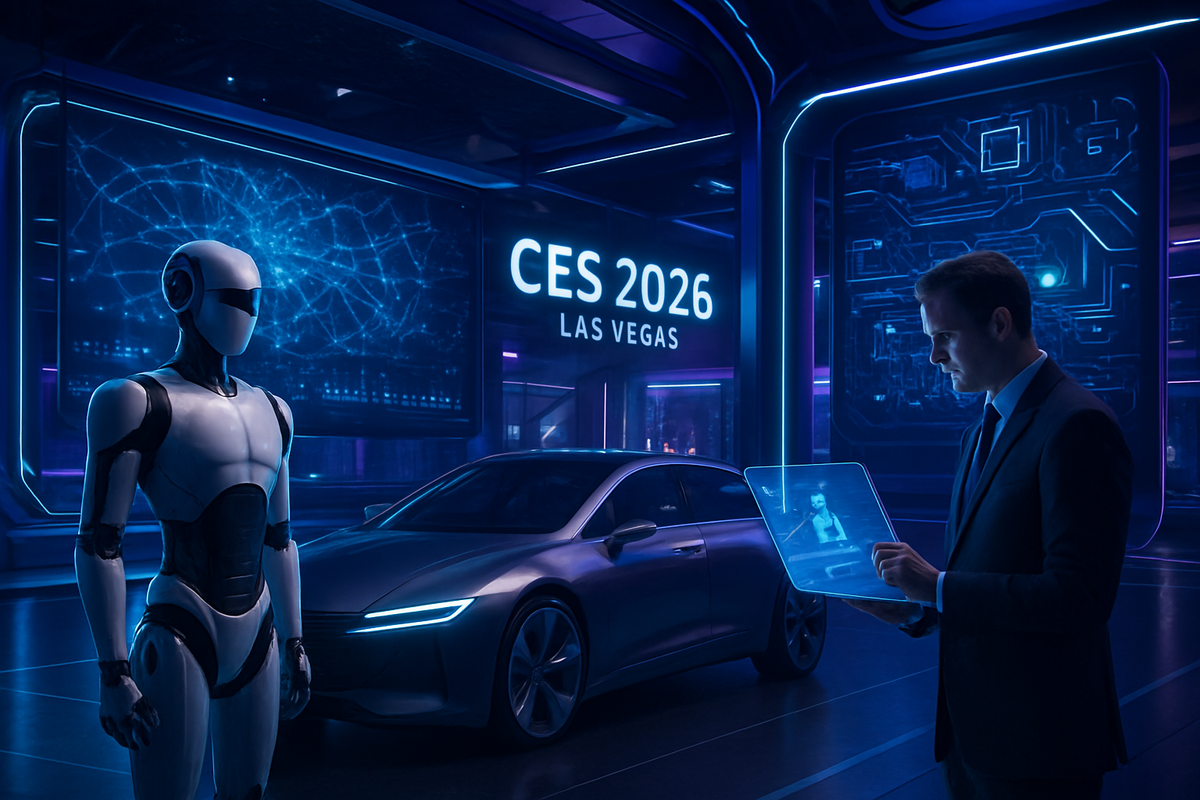
As the tech world converges on Las Vegas for CES 2026, the atmosphere is electric with a fundamental shift in the artificial intelligence narrative. No longer content with simple generative chatbots, the industry has pivoted toward "Agentic AI"—autonomous systems capable of reasoning, planning, and executing complex tasks without constant human oversight. This transition from passive tools to active digital agents is not just a technological milestone; it is a massive market catalyst that is reshuffling the deck for semiconductor giants and hardware manufacturers alike.
The immediate implications are clear: the "AI trade" is evolving. While the previous two years were defined by a mad dash for data center capacity, CES 2026 has signaled the rise of "Edge AI" and "Physical AI." Investors are beginning to rotate out of pure-play cloud infrastructure and into companies that can put AI into the hands of consumers and the sensors of robots. As of January 7, 2026, the market is rewarding those who have successfully bridged the gap between silicon innovation and real-world execution.
The Shift to Autonomy: Key Keynotes and Breakthroughs
The opening days of CES 2026 have been dominated by a relentless one-year product cadence that has now become the industry standard. NVIDIA (NASDAQ: NVDA) CEO Jensen Huang took the stage to unveil the "Vera Rubin" platform, the highly anticipated successor to the Blackwell architecture. Designed specifically for the massive context memory required by agentic systems, Vera Rubin boasts a 5x increase in inference performance. However, the true showstopper was "Alpamayo," a suite of open-source reasoning models for Physical AI. In a landmark partnership, Mercedes-Benz (OTC:MBGYY) announced it would be the first automaker to integrate Alpamayo into production vehicles starting in late 2026, moving beyond basic driver assistance toward true cognitive navigation.
Intel (NASDAQ: INTC) provided perhaps the most significant market surprise of the event. CEO Pat Gelsinger confirmed that the company’s Panther Lake processors, built on the cutting-edge 18A (2nm-class) manufacturing process, are in high-volume production. This marks a critical turning point for the storied chipmaker, signaling its return to the forefront of semiconductor lithography. The Panther Lake chips feature a 50 TOPS (Tera Operations Per Second) Neural Processing Unit (NPU), specifically designed to run AI agents locally on laptops, reducing reliance on the cloud and enhancing user privacy.
Meanwhile, AMD (NASDAQ: AMD) solidified its grip on the high-end enthusiast and developer markets. Dr. Lisa Su introduced the Ryzen 7 9850X3D, which utilizes second-generation 3D V-Cache technology to claim the title of the world’s fastest gaming processor. More importantly for the enterprise, AMD’s "Strix Halo" (Ryzen AI Max+) series was showcased as a mobile powerhouse for AI developers, capable of running 200-billion parameter models locally on ultra-thin workstations. This "developer-anywhere" philosophy highlights the industry's push to decentralize AI development from massive server farms to local edge devices.
Market Winners and Losers: A Tale of Two Tiers
The market reaction on January 7 has been nuanced, characterized by a "sell the news" sentiment for some established leaders and a "valuation validation" for others. Intel (NASDAQ: INTC) emerged as a primary winner, with shares climbing 3% as the successful ramp of the 18A process provided the long-awaited proof of the company's manufacturing turnaround. Qualcomm (NASDAQ: QCOM) also saw a 4% bump, driven by its aggressive expansion into robotics and the Snapdragon X2 Plus, which has successfully pushed "Windows on Arm" into the mainstream consumer consciousness.
In the small-cap and specialized sectors, Aeva Technologies (NYSE: AEVA) saw its stock price surge by 25%. As "Physical AI" becomes the dominant theme, the demand for high-performance lidar and 4D sensors has skyrocketed, with Aeva being viewed as a critical supplier for the next generation of humanoid robots and autonomous delivery drones. Tesla (NASDAQ: TSLA) also saw positive momentum, as analysts noted that the various "Physical AI" reveals from competitors actually highlighted Tesla's massive lead in real-world data collection and vertical integration.
Conversely, the shift in technology has created unexpected losers. Traditional data center cooling companies like Johnson Controls (NYSE: JCI) and Trane Technologies (NYSE: TT) saw their shares slide nearly 10%. This drop followed NVIDIA’s announcement that the Vera Rubin architecture would shift almost entirely toward direct liquid cooling, specifically utilizing warm-water cooling systems. This move threatens to disrupt the traditional air-cooling and chiller markets that these companies have dominated for decades, forcing a rapid and expensive strategic pivot toward liquid-based solutions.
The Broader Significance: AI Gets a Body and a Brain
CES 2026 marks the moment AI moved from the "cloud" to the "ground." This event fits into a broader industry trend where the bottleneck is no longer just compute power, but the ability of AI to interact with the physical world. The emergence of humanoid robots—showcased by various startups and established players like Boston Dynamics—suggests that we are entering a "Robotics Supercycle." This has profound implications for global labor markets and manufacturing, as AI agents begin to take over multi-step physical tasks in factories and warehouses.
Furthermore, the move toward Edge AI represents a major shift in data privacy and sovereignty. By processing AI tasks locally on devices from Intel (NASDAQ: INTC), AMD (NASDAQ: AMD), and Apple (NASDAQ: AAPL)—who, while not officially at CES, looms large over the VR/AR space—companies are addressing the growing regulatory concerns regarding data harvesting in the cloud. We are seeing a "localization" of intelligence that mirrors the geopolitical trend of "onshoring" critical manufacturing.
The regulatory landscape is also shifting. As Agentic AI gains the ability to make decisions and execute transactions on behalf of users, policymakers are beginning to scrutinize the "liability of the agent." CES 2026 has acted as a catalyst for these discussions, with tech leaders calling for a unified framework to define where human responsibility ends and autonomous liability begins.
The Road Ahead: From Infrastructure to Application
In the short term, the market will be laser-focused on the H2 2026 shipping dates for the Vera Rubin and Panther Lake platforms. Any delays in these timelines could trigger significant volatility, as the "one-year cycle" leaves very little room for error. Strategic pivots are already underway; software companies that spent 2024 and 2025 building wrappers around LLMs are now scrambling to rebuild their architectures to support "Agentic" workflows that can actually do work rather than just talk about it.
Longer term, the "Physical AI" trend will likely lead to a wave of M&A activity. Expect the mega-cap tech giants to begin acquiring specialized sensor and robotics companies to complete their "Agentic" stacks. The challenge for investors will be identifying the companies that can successfully monetize these agents through subscription models or "success-based" fees, rather than just one-time hardware sales.
Summary and Investor Outlook
CES 2026 has successfully moved the needle from artificial intelligence as a novelty to artificial intelligence as a functional, autonomous infrastructure. The key takeaways are the validation of Intel’s 18A process, the arrival of NVIDIA’s Vera Rubin, and the industry-wide embrace of Agentic and Physical AI. The market is currently in a state of healthy rotation, moving away from "AI hype" and toward "AI execution."
Investors should watch for the following in the coming months:
- Supply Chain Readiness: Can the liquid-cooling infrastructure keep up with the demand for Vera Rubin systems?
- Software Integration: Which enterprise software companies are the first to successfully deploy autonomous agents that provide measurable ROI?
- Manufacturing Milestones: Continued updates from Intel on the yield and volume of their 18A chips will be a major indicator for the broader hardware sector.
As we exit the halls of Las Vegas, it is clear that 2026 will be the year the "AI Brain" finally found its "Body."
This content is intended for informational purposes only and is not financial advice.
More News
View More

Recent Quotes
View MoreQuotes delayed at least 20 minutes.
By accessing this page, you agree to the Privacy Policy and Terms Of Service.