




Financial News
The Tariff Shock of 2025: How Trump’s North American Trade Offensive Redrew the Market Map
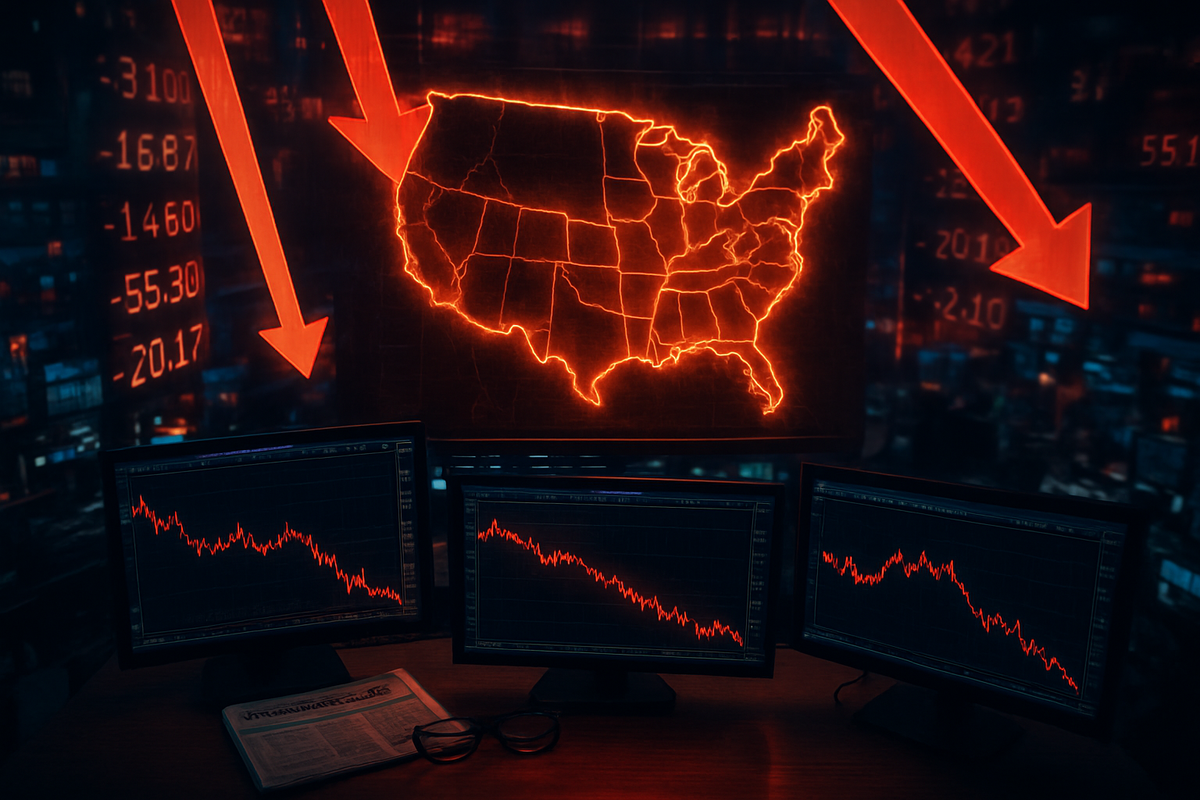
On March 3, 2025, the relative calm of the North American trade landscape was shattered by a midday announcement from the Roosevelt Room. President Donald Trump, citing a national emergency under the International Emergency Economic Powers Act (IEEPA), declared the immediate implementation of sweeping tariffs on goods imported from Canada and Mexico. The move, which ended a month-long period of suspense and failed bilateral negotiations, sent shockwaves through Wall Street. The immediate implications were stark: a sudden "tax" on the world’s most integrated supply chain, threatening to reignite inflation and derail the post-pandemic recovery.
The market response was swift and brutal. By the closing bell on March 3, the S&P 500 had plunged 1.8%, marking its worst single-day performance of the year to that point. The tech-heavy Nasdaq Composite fared even worse, tumbling 2.6% as investors dumped high-growth stocks sensitive to supply chain disruptions and global trade friction. For market participants, the announcement was a "black swan" event that signaled the end of the free-trade era and the beginning of a volatile new regime where trade policy is inextricably linked to border security and national sovereignty.
The Midday Meltdown: A Timeline of the March 3 Declaration
The implementation of the tariffs was not entirely unexpected, but the lack of further "carve-outs" for critical industries caught many off guard. The President’s announcement followed a tense February where tariffs were signed but stayed to allow for negotiations regarding illegal border crossings and the flow of fentanyl. When the March 3 deadline arrived without what the White House deemed "sufficient progress," the administration moved forward with a 25% general tariff on all Canadian and Mexican imports. A slightly lower 10% rate was applied to Canadian crude oil and potash, a small concession intended to prevent a total energy price spike in the Midwest.
The reaction on trading floors was chaotic. Within minutes of the statement, shares of Nvidia (NASDAQ: NVDA) began a downward spiral, eventually closing nearly 9% lower on fears that disrupted logistics would hamper its complex global manufacturing network. Broadcom (NASDAQ: AVGO) followed suit with a 6% decline. The sell-off was not limited to tech; the Dow Jones Industrial Average shed over 649 points as industrial and retail giants braced for a spike in input costs. The timeline of the "Tariff Shock" extended into the following weeks, with the S&P 500 entering official correction territory—a 10.1% drop from its February highs—by mid-March.
Key stakeholders, including Canadian Prime Minister Justin Trudeau and Mexican President Claudia Sheinbaum, initially reacted with vows of retaliation. This geopolitical friction created a feedback loop of uncertainty. By March 4, the Canadian S&P/TSX Composite had tumbled 1.54%, and the Mexican Peso reached multi-year lows against the dollar. The "initial" reaction was merely the opening salvo in what would become a year-long transformation of North American commerce, characterized by emergency board meetings across the continent as executives scrambled to reassess their "just-in-time" inventory models.
Winners and Losers: The Industrial Great Divide
The tariff wall created a sharp divide between companies with domestic manufacturing strength and those reliant on cross-border integration. Among the clear winners were U.S. steel and aluminum producers. Nucor (NYSE: NUE) and United States Steel (NYSE: X) saw their prospects brighten overnight as the 25% duty on imported metal effectively priced out Canadian competitors like Algoma Steel (NASDAQ: ASTL). By early 2026, Nucor’s stock had reached new 52-week highs, benefiting from a surge in domestic orders as U.S. manufacturers localized their supply chains to avoid the "Trump Tax." Similarly, Cleveland-Cliffs (NYSE: CLF) leveraged the tariffs to push through several rounds of price hikes, significantly boosting its margins throughout 2025.
Conversely, the losers were concentrated in the automotive and financial sectors. Ford (NYSE: F) and General Motors (NYSE: GM) were hit by "cost-stacking," where parts crossing the border multiple times during the assembly process were taxed at each interval. While Tesla (NASDAQ: TSLA) fared better due to its higher level of U.S. localization, the traditional "Big Three" saw their earnings forecasts slashed. In the financial sector, the Canadian "Big Six" banks, including Royal Bank of Canada (NYSE: RY) and TD Bank (NYSE: TD), faced a grim outlook. Analysts at the time predicted a massive increase in provisions for credit losses as the Canadian economy braced for a tariff-induced recession. Scotiabank (NYSE: BNS) and Bank of Montreal (NYSE: BMO) were particularly vulnerable given their extensive North American commercial lending portfolios.
Other notable laggards included the spirits giant Diageo (NYSE: DEO), which faced skyrocketing costs for its Mexican-produced tequila and beer imports. Meanwhile, niche players like Greenwave Technology Solutions (NASDAQ: GWAV) saw speculative gains as the demand for domestic scrap metal rose to feed hungry U.S. steel mills. The divide was clear: if your value chain was rooted in the American heartland, you were a beneficiary; if it straddled the Rio Grande or the 49th parallel, you were in the crosshairs.
A Fundamental Shift: Trade as a National Security Tool
The significance of the March 3 tariffs extends far beyond a simple tax on goods. It marked a definitive shift in U.S. policy where trade is no longer viewed through the lens of economic efficiency, but rather as a primary tool for national security and border enforcement. By linking 25% duties to fentanyl interdiction and migration numbers, the Trump administration effectively bypassed traditional trade diplomacy. This event fits into a broader trend of "de-globalization" or "near-shoring," where political reliability is prioritized over low-cost production.
Historically, this event is frequently compared to the 2018 trade tensions with China, but with a crucial difference: the targets were the United States' closest allies and largest trading partners. The ripple effects were felt globally, leading to the "Liberation Day" market crash on April 2, 2025, when the administration announced its intent to apply reciprocal tariffs to any nation with a trade surplus against the U.S. This policy has forced a total re-evaluation of the USMCA (United States-Mexico-Canada Agreement), which many now view as a "zombie treaty"—technically in effect but superseded by executive actions and emergency declarations.
The regulatory implications have been immense. Companies are now required to provide granular documentation of "rules of origin" to qualify for any exemptions. This has created a secondary industry in supply chain auditing and trade compliance. Furthermore, the precedent set in March 2025 has encouraged other nations to consider similar "security-linked" tariffs, threatening the very foundations of the World Trade Organization (WTO) and the rules-based international order that has governed global trade since 1945.
The Long Road to July 2026: What Lies Ahead
As we navigate the early weeks of 2026, the market remains in a state of "permanent negotiation." The initial shock of March 2025 has evolved into a series of 90-day "remissions" and "escalations." Mexico’s recent implementation of its own 50% tariff on Chinese goods—part of the "Plan Mexico" negotiated in late 2025—was a direct response to U.S. pressure to stop Chinese transshipment. While this provided a temporary reprieve for some sectors, the underlying tariffs on steel, aluminum, and autos remain a heavy weight on North American trade volumes.
The next major milestone is the mandatory six-year review of the USMCA, scheduled for July 2026. The Trump administration has already signaled that it views this review not as a formality, but as an opportunity for a "total reset." Investors should expect heightened volatility as that deadline approaches. Strategic pivots are already underway; many multinational corporations are moving away from "just-in-time" manufacturing toward "just-in-case" models, holding larger domestic inventories to buffer against sudden policy shifts.
Short-term opportunities may emerge in domestic logistics and automation as companies look to offset higher tariff costs with increased efficiency on American soil. However, the long-term challenge remains the potential for structural inflation. If the "State of Permanent Negotiation" continues, the increased cost of goods will eventually be passed on to the consumer in full, potentially forcing the Federal Reserve into a more hawkish stance than the markets currently anticipate.
Final Assessment: Navigating the New Protectionist Reality
The March 3, 2025, tariff announcement was a watershed moment for the financial markets, signaling that the "Great Moderation" of global trade is officially over. For investors, the key takeaway is that geopolitical risk is no longer an "outer-rim" concern—it is a core component of equity valuation. The sharp sell-off in early 2025 was a painful lesson in the fragility of modern supply chains and the power of executive action to reshape entire industries in an afternoon.
Moving forward, the market is likely to remain bifurcated. Domestic industrial and energy sectors will continue to act as "tariff hedges," while the tech and consumer discretionary sectors will remain highly sensitive to every headline from the White House or the border. The "Tariff Shock" was not a one-day event but the start of a multi-year transition to a more protectionist American economy.
Investors should watch for the results of the monthly border security metrics, as these now serve as the unofficial "interest rate" for trade duties. As we head toward the July 2026 USMCA review, the ability of companies to adapt their supply chains will be the primary determinant of their long-term survival. The North American market is no longer a single, seamless entity; it is a fortress under construction, and the cost of entry has never been higher.
This content is intended for informational purposes only and is not financial advice.
More News
View More



Recent Quotes
View MoreQuotes delayed at least 20 minutes.
By accessing this page, you agree to the Privacy Policy and Terms Of Service.