




Financial News
The 150-Year Echo: Why Analysts Are Flashing an 'Ominous Warning' for 2026 Despite Record Highs
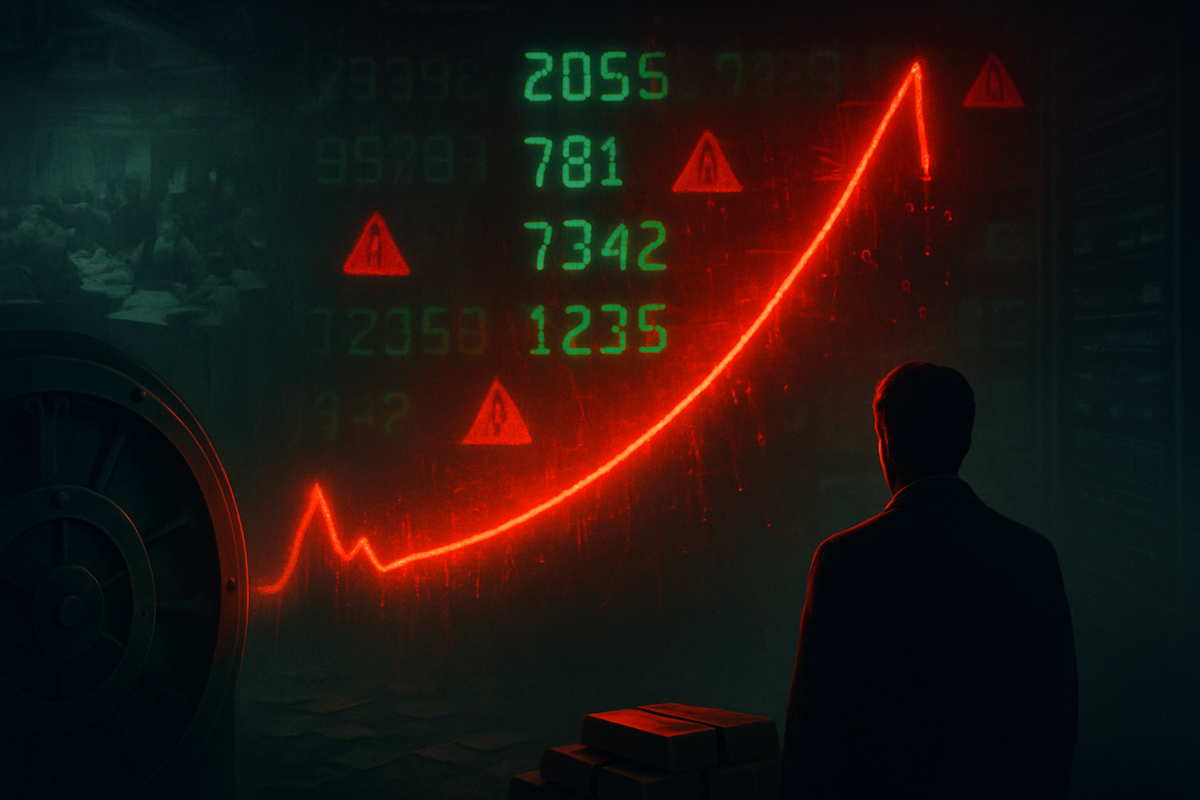
As the curtain begins to close on 2025, the financial world finds itself in a state of cognitive dissonance. On the surface, the markets are celebrating a period of unprecedented prosperity; the S&P 500 (NYSEARCA:SPY) is hovering near all-time highs of 6,839, capping off a staggering three-year run of double-digit gains. However, beneath this veneer of euphoria, a rare and historically "ominous warning" is flashing across the dashboards of technical analysts and market historians. For only the third time in 153 years, the market has reached a level of overextension that has previously preceded the most catastrophic collapses in financial history.
The immediate implication of this signal is a growing "fragility" in the current market structure. While the "melt-up" driven by Artificial Intelligence (AI) and expectations of a dovish transition at the Federal Reserve continues to push indices higher, the margin for error has effectively vanished. Analysts warn that the current trajectory mirrors the final stages of the 1920s "Roaring Twenties" and the late 1990s Dot-com bubble. As we head into 2026, the question is no longer if the market is overvalued, but whether the historical gravity that pulled down the giants of 1929 and 2000 is about to reassert itself.
The 150-Year Echo: Deciphering the 80% Surge Signal
The core of the current alarm stems from a specific technical phenomenon: the S&P 500 has surged approximately 80% over the last three years. According to historical data spanning back to the 1870s, a three-year rally of this magnitude has occurred only twice before. The first instance culminated in the Great Crash of 1929, and the second ended with the bursting of the Dot-com bubble in March 2000. In both cases, the parabolic move created a vacuum of buyers at the top, leading to multi-year bear markets that erased trillions in wealth. This "80% Signal" is viewed by many as a definitive marker of a market that has decoupled from its fundamental economic reality.
Leading up to this moment in late 2025, several other indicators have aligned to create a "perfect storm" of overvaluation. The Shiller CAPE Ratio—a measure of inflation-adjusted earnings over a decade—has climbed to 40. This is nearly double its historical mean and is approaching the peak of 44 seen just before the 2000 crash. Simultaneously, the "Buffett Indicator," which compares total market capitalization to U.S. GDP, has reached a record 219%. This suggests that the stock market is now more than twice the size of the actual economy it is supposed to represent, a level that Warren Buffett has historically described as a signal to exercise extreme caution.
Key players in this unfolding drama include major institutional bears and cautious veterans. Berkshire Hathaway (NYSE: BRK.B), led by Buffett, has notably spent the last 12 consecutive quarters as a net seller of stocks, accumulating a record cash pile of $381.7 billion as of December 2025. This massive hoarding of liquidity is being interpreted by market participants as a "silent vote of no confidence" in current valuations. While retail investors remain bullish, the "smart money" appears to be heading for the exits, waiting for a reset that many believe will begin in the first half of 2026.
The AI Giants vs. The Cash Kings: Winners and Losers in a Fragile Market
The potential fallout from a 2026 correction would not be felt equally across the board. The primary victims are likely to be the "Magnificent" leaders of the AI revolution. Companies like Nvidia (NASDAQ: NVDA) and Microsoft (NASDAQ: MSFT) face a looming "Capex Cliff." There is growing concern that the $500 billion-plus annual investment in AI infrastructure by hyperscalers may not yield the immediate ROI that investors have priced in. If these tech titans report even a slight slowdown in AI-related revenue growth in early 2026, the extreme concentration of the market—where the top 10 stocks represent 40% of the index—could lead to a "single-point-of-failure" cascade.
Other potential losers include high-debt mid-cap and small-cap companies, often tracked via the Russell 2000 (NYSEARCA:IWM). These firms are facing a "refinancing cliff" in 2026, as trillions in corporate debt taken out at near-zero rates during the pandemic must be rolled over at the significantly higher rates of the mid-2020s. This could squeeze profit margins and lead to a wave of credit downgrades, further dampening market sentiment. In contrast, traditional defensive players and cash-rich entities are positioned to weather the storm. J.P. Morgan (NYSE: JPM) and other major financial institutions with robust balance sheets may find opportunities to acquire distressed assets if a liquidity crunch occurs.
On the winning side, "safe haven" assets and defensive sectors are expected to attract capital as the warning signs grow louder. Utilities (NYSEARCA:XLU) and Consumer Staples (NYSEARCA:XLP) typically outperform during periods of high volatility and economic uncertainty. Additionally, gold and precious metals (NYSEARCA:GLD) are being eyed by analysts as the ultimate hedge against the potential policy instability and inflationary pressures that could arise from the 2025 administration's aggressive tariff strategies and potential challenges to Federal Reserve independence.
Beyond the Charts: The Macro-Economic and Geopolitical Fault Lines
The 2026 warning is not merely a product of technical charts; it is deeply rooted in broader industry and geopolitical shifts. The most significant trend is the "No Hire, No Fire" economy. While the stock market reflects corporate buybacks and AI-driven efficiency, the actual hiring rate in the U.S. has collapsed to cycle lows. This divergence suggests a "silent contraction" where the real economy is stagnating while the financial economy inflates. Historical precedents, such as the period leading into the 1970s stagflation, suggest that such a gap is eventually closed by a sharp market correction that aligns stock prices with consumer reality.
Furthermore, the "Benner Cycle" and other historical rhythm models point to 2026 as a pivotal transition year. The Benner Cycle, which has accurately predicted "years of hard times" for over a century, identifies 2026 as the conclusion of a major favorable period. This aligns with the 7-year "Shmita" cycle of market volatility, which previously signaled the 2008 and 2015 downturns. These cyclical warnings are being compounded by regulatory and policy risks. The potential for a trade war driven by new tariffs and the uncertainty surrounding the successor to Jerome Powell at the Federal Reserve in May 2026 are creating an environment of "instability" rather than just "uncertainty."
Navigating the Transition: Strategic Pivots for 2026
In the short term, the market may experience a final "melt-up" as momentum-driven algorithms and FOMO (fear of missing out) push prices to even more irrational levels in the first quarter of 2026. However, strategic pivots are already underway among sophisticated investors. The shift from "growth at any price" to "quality and liquidity" is becoming the dominant theme. Investors are increasingly looking for companies with high free-cash-flow yields and low debt-to-equity ratios to protect against the 2026 refinancing cliff.
Market opportunities may emerge in the form of "volatility harvesting." As the 150-year pattern suggests a high probability of a 10-20% correction—or even a full bear market—derivatives and inverse ETFs could become popular tools for downside protection. For the long-term investor, the potential 2026 reset represents a necessary "cleansing" of the market’s excesses. A significant pullback would bring the Shiller CAPE and Buffett Indicator back toward historical norms, potentially creating the best buying opportunity for the remainder of the decade.
The Verdict: Preparing for a Potential Market Reset
The historical "ominous warning" flashing for 2026 serves as a sobering reminder that record highs are often the precursor to significant volatility. The 80% three-year surge, the record Berkshire cash pile, and the extreme market concentration all point toward a fragile ecosystem that is highly sensitive to external shocks. While the AI revolution provides a genuine fundamental tailwind, the speed at which it has been priced into the market has left no room for the inevitable hiccups in implementation or global economic friction.
Moving forward, the market in 2026 will likely be defined by a transition from liquidity-driven expansion to earnings-driven reality. Investors should closely monitor the Federal Reserve's leadership transition in May and the health of the corporate bond market as the refinancing cliff approaches. While the headlines of late 2025 are filled with optimism, the lessons of 1929 and 2000 suggest that the most important thing to watch in the coming months is not how high the market can go, but how solid the ground is beneath it.
This content is intended for informational purposes only and is not financial advice.
More News
View More




Recent Quotes
View MoreQuotes delayed at least 20 minutes.
By accessing this page, you agree to the Privacy Policy and Terms Of Service.