




Financial News
From Point Forecasts to Regime Classification: A Better Way to Predict Market Turns
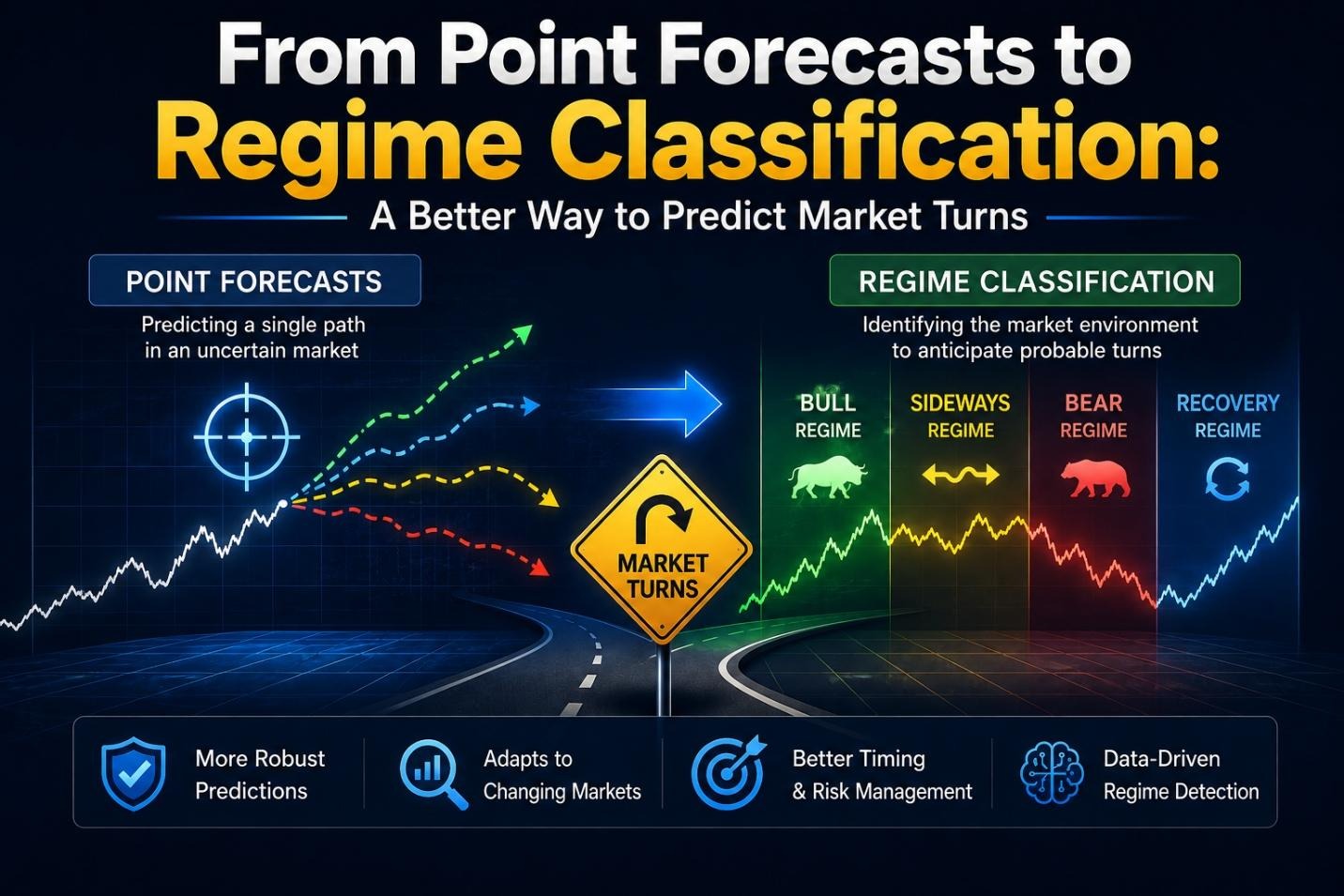
Most stock market forecasts are built to answer the wrong question.
When people ask for an S&P 500 forecast, what they usually want is a number: "Where will the index be in three months?" That framing makes intuitive sense, but it forces a forecasting model into a corner it is structurally bad at solving. Markets are noisy, non-stationary, and path-dependent. A single-point prediction is almost always wrong, and even when it is right, it is rarely right for the right reasons.
A better approach is to stop predicting price levels and start predicting the state of regimes and forecast S&P 500 market swings.
Why Regime Classification Beats Price Targeting
A regime is a durable market state: bull, weakening, correction, or recovery. Each regime has its own signature in volatility, breadth, credit spreads, and cross-asset behavior. A correction looks different from a pullback — not just in magnitude, but in the structure of how risk propagates. The useful question is not the exact index level in three months. It is which state the market is currently in, and how stable that state looks.
This is why the strongest financial forecasting systems treat prediction as a classification problem rather than a regression problem.
Regime classification has several practical advantages over price targeting:
Robustness to noise. A 2% daily swing does not flip a regime. The classifier reads the broader structure of the market, not the most recent candle.
Interpretable framing. A regime label describes an observable market condition. It communicates more than a number does, because it carries the reasoning with it.
Explainability. A regime call can be traced back to specific inputs: breadth deterioration, credit stress, volatility structure, cross-asset confirmation. A black-box price target cannot.
Calibration. A probability distribution across regimes is more informative than a single confidence interval around a level.
The Four Signals That Matter
Regime classification works best when it is built from multiple independent signals rather than one monolithic model. The most robust S&P 500 frameworks combine four:
Bull-regime durability. Measures whether the current bull regime is aging or intact — not by duration alone, but by whether the market is still led by broad participation, strong internals, and healthy credit conditions.
Bear-regime onset. Flags early evidence of a transition into a correction or bear regime, typically through breadth breakdowns, credit spread widening, and volatility regime shifts.
Break confirmation. Separates a real regime transition from a false alarm. Many models over-fire on short-term volatility; confirmation filters improve precision by requiring cross-asset agreement and persistence.
Recovery validation. Identifies when a bear regime is ending. This is often the hardest signal to build, because markets bottom before the economy does and the early recovery is volatile and widely disbelieved.
Together, the four cover the full cycle rather than a single directional event.
Why Machine Learning Helps — and Why It Is Not Enough
Machine learning is useful in regime classification because it can surface relationships across many variables that are not obvious from visual inspection. But ML alone has a flaw: it can learn historical patterns without understanding the economic regime that produced them. A model trained entirely on 2010–2021 data will struggle in 2022, because the macro environment changed underneath it.
The better systems combine ML with rules-based regime discipline. The ML layer finds structure in breadth, credit, volatility, and macro data. The rules layer enforces economic coherence — certain signals should not fire unless the surrounding macro conditions support them. That hybrid design reduces overfitting to any one market period.
The Real Test: Out-of-Sample Results
The most important measure of a forecasting system is not how well it fits history, but how it behaves on data it has never seen. Walk-forward validation is the standard: refit on an expanding window, predict the next period, roll forward. This simulates real-time use and exposes overfitting quickly.
A well-built regime classifier will not catch every move. It will miss short-term wiggles. But if it is calibrated correctly, it identifies the major transitions ahead of consensus with a manageable false-positive rate. That is the actual objective — not perfect accuracy, but reliable classification at the turns.
What This Means for Analysts and Builders
For anyone reading the market, the practical shift is to stop asking for a precise number and start asking for the regime: what state the market is in, the probability of transitioning out of it, and the variables that would change that probability.
For data scientists and builders, the lesson is to design the target variable carefully. A regime label is more durable and more defensible than a price target, and the evaluation metrics change accordingly — precision, recall, and false-positive rate matter more than mean squared error.
Several frameworks now apply this approach to public equities. One example is RegimeSignal, which uses a hybrid machine-learning and rules-based engine to classify the active S&P 500 regime and flag transitions before consensus reprices them. The system pairs walk-forward validated signals with macro context and cross-asset confirmation rather than predicting a single index level. More detail at https://regimesignalai.com.
Conclusion
The market does not owe anyone a clean price target. It does move through identifiable regimes with enough regularity that classification is a tractable problem. The shift from point forecasting to regime classification is a shift from guessing a number to characterizing a condition — and across a full cycle, that is the more useful form of prediction.
If you believe this article contains misleading, harmful, or spam content, please let us know.
Report this article




Quotes delayed at least 20 minutes.
By accessing this page, you agree to the Privacy Policy and Terms Of Service.