




Financial News
Can You Find Social Media by Phone Number? We Compared the Available Options
A phone number is often the first piece of information people exchange online. It may come from a dating app, a marketplace conversation, a new professional contact, or simply an unfamiliar call. But having a number does not necessarily mean you know which social media accounts belong to the person behind it.
That creates a practical question: can you find social media by phone number, and which type of tool is actually useful when social profiles – rather than caller information – are the goal?
The answer depends heavily on the service. Some tools focus on caller identification. Others search broader people-search records. A smaller group is designed specifically to connect a phone number with possible social profiles.
We compared the approaches based on what they actually return, what information is required to begin, and how useful the results are when your main objective is finding accounts on platforms such as Instagram, Facebook, TikTok, and X.
What We Looked for in a Phone-to-Social Search Tool
A useful comparison needs to start with the same question for every service: what happens after you enter a phone number?
We focused on five practical criteria:
- Can you start with a phone number alone?
- Does the service look specifically for social media accounts?
- Which social networks can it check?
- Can you see anything useful before paying?
- Does the service clearly explain the limitations of its results?
That last point matters. Phone numbers are reassigned, usernames change, accounts disappear, and old associations can remain. No responsible lookup service should treat every result as definitive identity verification.
Socialprofiler: Built Around Phone-to-Social Search
Socialprofiler takes the most direct approach of the tools we reviewed because its reverse-phone workflow is specifically designed around finding possible social profiles.
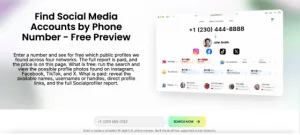
Users can enter a complete 10-digit U.S. phone number without already knowing a name, email address, username, social handle, or profile URL. Socialprofiler then checks for signals connecting that number with possible profiles across Instagram, Facebook, TikTok, and X. Socialprofiler
For someone trying to find social media by phone number, that distinction is important. The search does not stop after returning a possible subscriber name or carrier.
There is also a free-preview stage. When a possible match is found, Socialprofiler can show the associated network and profile photo while keeping the name, username or handle, and direct profile link blurred. The user can therefore decide whether the result looks potentially relevant before opening the paid report.
Paid results can reveal available account names or handles and direct profile links. Depending on the information available, the broader report may also include Top Interests, Friends or mutual followers, Red Flags, an Executive Summary, and AI-based report tools.
There are limitations. Socialprofiler currently specifies a complete U.S. phone number for this workflow, and not every number returns a social-profile match. The company also explicitly notes that associations can be outdated or relate to a previous subscriber, so results need to be reviewed rather than treated as proof of identity.
Best suited for: someone whose primary goal is locating possible social media profiles from a U.S. phone number.
Truecaller: Better Suited to Identifying the Caller
Truecaller approaches phone lookup from a different direction.
The Federal Trade Commission warns that caller ID can be spoofed, making independent checks useful when an unfamiliar number calls.
According to Truecaller, a reverse lookup may provide a caller name, general location, line type, and spam or scam information when available. Its broader product is centered heavily on caller ID, spam detection, blocking, and communication safety.
But that is not the same task as trying to find someone’s Instagram, TikTok, Facebook, or X account. Truecaller’s own description of its reverse lookup emphasizes caller identification and spam information rather than returning a set of possible profiles across those social networks.
Best suited for: identifying unknown callers and checking whether a number has spam or scam signals.
Native Social Media Discovery: Free, but Inconsistent
Another option is to use the social platforms themselves.
Some platforms use phone numbers for account discovery or contact recommendations when users have enabled the relevant settings. In practice, however, this is very different from entering a number into a conventional search box and receiving a matching profile.
It can also require syncing contacts or changing account-discovery settings, depending on the platform.
The biggest advantage is obvious: it does not require paying a third-party lookup service. The disadvantage is that the process is fragmented. Finding an account on one network tells you little about whether the same person uses another username on a different network.
For a single known platform, however, it can still be worth checking before paying for anything.
Best suited for: occasional searches when you already know which social network you expect the person to use.
Search Engines and Manual Research
The simplest method is sometimes overlooked: search the number itself.
Try several formatting variations, including the full number in quotation marks. A number may appear on a business website, professional profile, classified listing, forum post, or another indexed page.
If the search reveals a name or username, that information can become the starting point for a second search across social platforms.
This method costs nothing and can work surprisingly well for business numbers or numbers that have been deliberately published online.
Its weakness is coverage. A phone number does not need to be visibly displayed on a social profile for there to be an association between the number and the account. Manual web search therefore cannot be expected to reproduce what a dedicated phone-to-profile service does.
Best suited for: numbers likely to have been published openly on websites or business pages.
The Tools Are Solving Different Problems
Putting the options side by side makes the differences clearer.
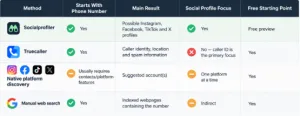
This is why “reverse phone lookup” can be a misleadingly broad category. Two services may accept exactly the same input while producing very different types of information.
If you want to know whether an unknown caller has been repeatedly reported as spam, a caller-ID service makes more sense. If you already have a likely name and only want to check one platform, manual searching may be enough.
If the goal is specifically to find social media by phone number, a service built around phone-to-profile discovery is the more direct approach.
What About Individual Social Networks?
There are situations where you do not need a four-network search.
Perhaps you already know the person uses Facebook and simply cannot locate the correct account among dozens of people with the same name. In that case, a network-specific search can reduce the amount of irrelevant information you need to review.
Socialprofiler, for example, also provides a workflow to find a Facebook account with a phone number. It accepts a complete U.S. number without requiring the Facebook name, username, email address, or existing profile link. When a possible match is available, the free preview can show the profile photo before the identifying details are revealed in the paid result.
The same caution still applies: a match is a lead. Socialprofiler notes that numbers can be reassigned, Facebook names can change, and account information can become outdated.
A “No Match” Is Also Information – But Not Proof
One of the easiest mistakes in phone-number research is interpreting an unsuccessful search too broadly.
If a service returns no Instagram or Facebook account, that does not establish that the person does not use that platform.
The number may be new. It may have been reassigned. The relevant account may use information that cannot be connected reliably with the number, or the available sources may simply not contain enough information to produce a match.
Socialprofiler explicitly uses this distinction: when its search returns “No match found for this number,” it does not substitute unrelated profiles, and an unsuccessful search is not charged.
That is a useful principle regardless of which service you use: absence of a result is not evidence of absence.
Which Approach Makes Sense?
The right method depends on the goal. Caller-ID tools make sense for unfamiliar calls, while ordinary web search may be enough for published business numbers. Native platform discovery can work when you already know which network to check.
If the objective is to find social media by phone number across multiple networks, Socialprofiler is built around that workflow, checking Instagram, Facebook, TikTok, and X.
Whatever method you use, treat results as leads. Compare profile photos, usernames, location clues, and other known information before concluding that an account belongs to a particular person.
If you believe this article contains misleading, harmful, or spam content, please let us know.
Report this articleMore News
View More




Recent Quotes
View MoreQuotes delayed at least 20 minutes.
By accessing this page, you agree to the Privacy Policy and Terms Of Service.