




Financial News
SaaS Marketing Statistics 2026: AI Native Platforms Grow 40% to 60% as Traditional SaaS Lags
DELHI, IN / ACCESS Newswire / October 23, 2026 / SaaS Ultra has published a 2026 report on SaaS marketing statistics, based on 60+ verified data points. It shows a global market that is restructuring, not just growing, as AI reshapes pricing and churn. Over 80% of companies now run AI enabled apps, up from 5% in 2023, according to Vena Solutions.

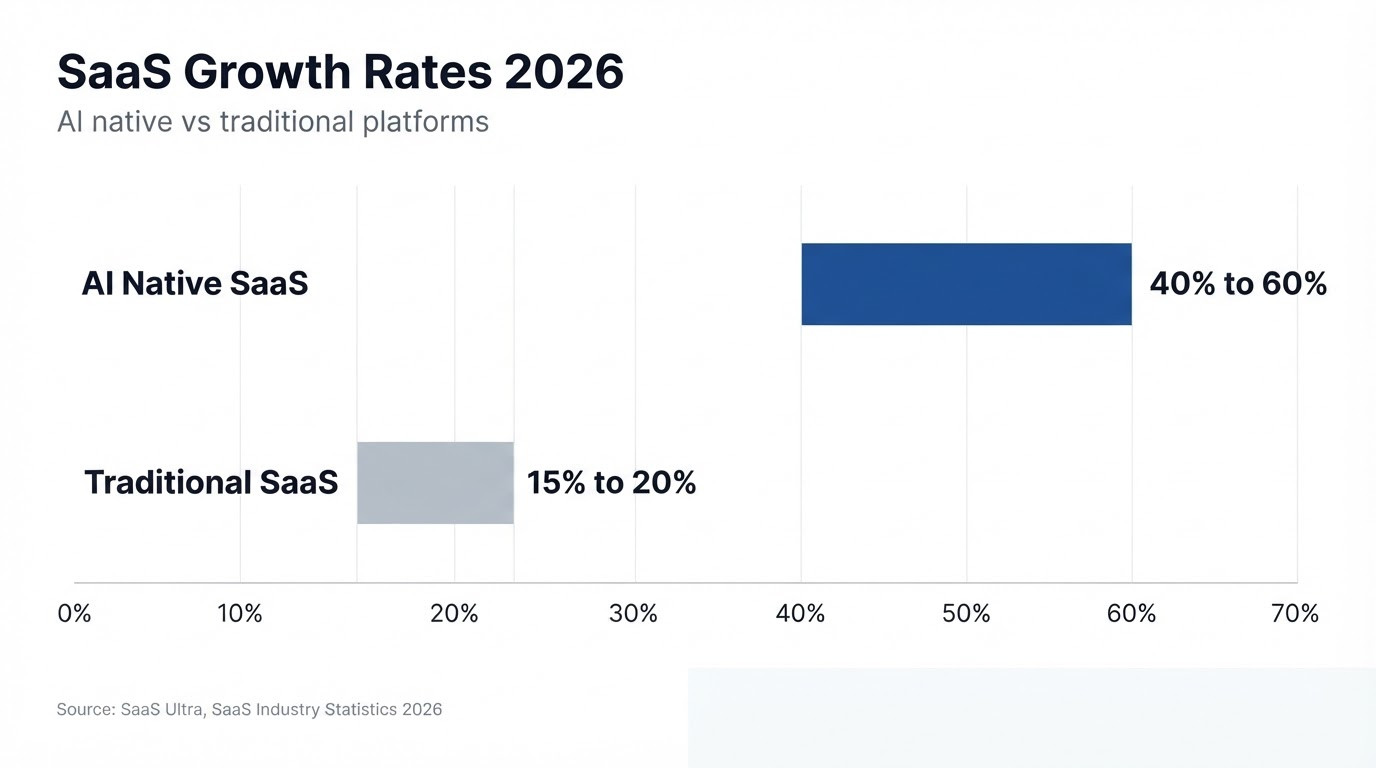
Summary: SaaS Ultra compiled 60+ data points on the 2026 SaaS market. AI native platforms grow 40% to 60% a year. Traditional platforms grow 15% to 20%. Marketing spend holds at 8% of ARR. The median annual revenue churn is 12%.
How Big Is the SaaS Market in 2026?
The global SaaS market is worth between $344 billion and $465 billion in 2026. Gartner gives the lower figure. Precedence Research gives the higher one.
The two estimates differ on scope. Precedence Research counts more categories, including vertical platforms and AI native tools. Gartner uses a narrower definition.
Mordor Intelligence puts the B2B SaaS market alone at $492.34 billion in 2026. That is above both global figures, which shows how far definitions vary. Mordor projects $1.58 trillion by 2031.
Fortune Business Insights projects the global market will reach $1.48 trillion by 2034. Vena Solutions expects 19.38% annual growth from 2025 to 2029. Even the cautious figures point to steady expansion.
AI Native vs Traditional SaaS Growth
AI native SaaS companies are growing 40% to 60% a year. Traditional SaaS companies grow 15% to 20%. The median for all SaaS sits near 26%.
These growth benchmarks come from SaaSHero, Baremetrics, Vena Solutions, and IdeaProof, as compiled by SaaS Ultra. The gap is the restructuring story in one number.
The AI SaaS market is growing at a 38.28% CAGR, according to BetterCloud. It rises from $71.54 billion in 2023 to a projected $775 billion by 2031. That pace is roughly double the wider market.
Top 5 SaaS stats for 2026:
- 80%+ of companies run AI enabled apps, up from 5% in 2023 (Vena Solutions).
- 62% of SaaS platforms offer AI premium pricing tiers (McKinsey).
- $55.7 million is the average annual SaaS spend per organization, up 8% (Zylo).
- 8% of ARR is the median SaaS marketing spend (SaaS Capital).
- 12% is the median annual revenue churn. Best in class is under 5% (Noizz.io).
SaaS Marketing Statistics on Budgets and Spend
The median SaaS company spends 8% of ARR on marketing, according to SaaS Capital. That share did not change from the prior year. Teams must win more buyers on the same slice of revenue.
Buyers feel pressure too. The average organization spends $55.7 million a year on SaaS, up 8%, according to Zylo. That makes every renewal a harder conversation.
Pricing adds more pressure. 66.5% of IT leaders faced unexpected SaaS charges in 2025, according to Thunderbit. Surprise bills make buyers slower and more cautious.
Data Led Content and SaaS Marketing Benchmarks
Content is where a flat budget can still go further. 88% of marketers report positive results from proprietary research, according to Position Digital. Original data gives journalists and AI systems something to cite.
64% say data led content converts better, also according to Position Digital. Numbers give buyers a reason to trust a claim.
What Is a Good SaaS Churn Rate in 2026?
Median annual revenue churn is 12%, according to Noizz.io. Best in class companies stay under 5%. That gap separates healthy businesses from leaky ones.
Median B2B monthly logo churn is 3.5%, according to the Averi AI 2026 Benchmarks Report. Of that, 0.8% is involuntary, mostly failed payments. That revenue can be recovered without new acquisition spend.
About 30% of public SaaS companies clear the Rule of 40, per the same compiled benchmarks. The rule says growth plus profit margin should exceed 40%. Retention lifts both sides of that equation.
"At 8% of ARR, most marketing teams cannot outspend this market," said Jitendra Vaswani, founder of SaaS Ultra. "The teams that win will protect the revenue they already have before chasing new logos."
What Changed in SaaS Since Last Year
Vendors are moving away from per seat plans. They are shifting to usage based and outcome based pricing. The report links this to buyers who want to pay for results.
62% of SaaS platforms now offer AI premium tiers, according to McKinsey's 2026 Software Pricing Report. Buyers budget 25% to 35% more when AI features are included. AI is now a line item, not a bonus.
Average apps per organization fell from 112 to 106, according to BetterCloud. Companies are cutting tools, but the tools they keep cost more.
By 2026, 85% of business apps are expected to be SaaS based, according to Colorlib. Software choice is now more often a renewal decision than a first purchase.
What SaaS Marketing Teams Should Do Now
The data points to four moves:
- Fund retention first. Put onboarding and churn recovery ahead of new ad spend.
- Fix failed payments. Automated retries target the 0.8% involuntary churn.
- Publish original data. Sourced numbers earn links, press, and AI citations.
- Price on outcomes. Tie plans to results buyers can measure.
The full set of SaaS marketing statistics, with tables and source notes, is in the SaaS industry statistics report. It is free to read on SaaS Ultra. Journalists may cite the figures with credit to the original sources.
About SaaS Ultra
SaaS Ultra is a SaaS tools review platform that reviews and compares software for marketers, founders, and buyers. It publishes tool reviews, comparisons, and sourced industry statistics to help teams choose their next platform.
Method Note
SaaS Ultra compiled these figures from third party sources. It did not conduct original research. The sources are Gartner, Precedence Research, Mordor Intelligence, Fortune Business Insights, Vena Solutions, the Zylo 2026 SaaS Management Index, BetterCloud, Colorlib, the McKinsey 2026 Software Pricing Report, Thunderbit, SaaSHero, Baremetrics, IdeaProof, Noizz.io, Averi AI, SaaS Capital, and Position Digital. Report figures were verified against primary sources as of March 2026. App counts come from BetterCloud data for 2023 and 2024. Surprise charge data covers 2025.
FAQ
How big is the SaaS market in 2026?
Between $344 billion and $465 billion. Gartner gives the narrow figure. Precedence Research gives the broad one. The gap comes from how each defines SaaS.
How fast are AI native SaaS companies growing?
AI native SaaS grows 40% to 60% a year. Traditional SaaS grows 15% to 20%. The overall median is about 26%.
How much do SaaS companies spend on marketing?
The median is 8% of ARR, according to SaaS Capital. That share did not change from the prior year.
What is a good SaaS churn rate?
Median annual revenue churn is 12%. Best in class is under 5%. Median B2B monthly logo churn is 3.5%.
Media Contact
Jitendra Vaswani, Founder, SaaS Ultra
Email: Affiliate@saasultra.com
Website:www.saasultra.com
SOURCE: SaaS Ultra
View the original press release on ACCESS Newswire
If you believe this article contains misleading, harmful, or spam content, please let us know.
Report this articleMore News
View More


Recent Quotes
View MoreQuotes delayed at least 20 minutes.
By accessing this page, you agree to the Privacy Policy and Terms Of Service.