



Financial News
Vadzo Imaging Validates Falcon-900MGS: 3MP Sony IMX900 Monochrome Global Shutter USB Camera with Quad HDR for High Dynamic Range Imaging
FORT WORTH, TX / ACCESS Newswire / October 12, 2026 / Vadzo Imaging, a provider of embedded vision camera products for OEMs and system integrators, today announces validation of the Falcon-900MGS IMX900 Mono Global Shutter USB Camera, a 3MP monochrome global shutter camera built on the Sony IMX900 sensor with Quad HDR for high dynamic range imaging. Part of Vadzo's USB camera portfolio, the Falcon-900MGS pairs the IMX900's global shutter architecture with a four-exposure HDR fusion pipeline, giving security integrators and industrial OEMs a camera that resolves extreme contrast scenes a standard sensor or a simpler two-exposure HDR technique cannot fully capture. With this validation, Vadzo delivers an IMX900 Quad HDR Camera that extends usable dynamic range specifically for backlit, high-contrast, and mixed lighting scenes, giving security system integrators, machine vision engineers, and robotics OEMs a camera module ready for direct integration into surveillance, inspection, and guidance products without the detail loss a lesser dynamic range sensor would introduce.
Technical Problem Definition
A standard dynamic range sensor can only expose correctly for one brightness level at a time, and any scene containing both a very bright region and a very dark region within the same frame forces a compromise. Exposing for the bright region renders shadow detail as solid black, while exposing for the shadow renders the bright region as a featureless white blowout, and neither result gives a downstream inspection, detection, or recognition algorithm the complete picture the scene actually contains. A simple two-exposure HDR technique improves on a standard dynamic range sensor, but scenes with truly extreme contrast, such as a backlit entryway where a person stands silhouetted against bright daylight, or an industrial inspection scene combining a highly reflective metal surface with a dark recessed area, frequently exceed what two exposures can adequately resolve, leaving a compressed middle ground that still sacrifices detail at one extreme or the other. Multi-frame HDR techniques that combine several sequentially captured exposures introduce a separate problem when anything in the scene moves during that capture sequence, since combining frames captured at different moments produces ghosting or blurred edges around any object that shifted position between exposures, an artifact that directly undermines the same detection and recognition tasks the wider dynamic range was meant to support. A Sony IMX900 Quad Sensor that has only been validated with a basic two-exposure technique leaves genuinely extreme contrast scenes unaddressed, and an IMX900 Multi Frame HDR Sensor that combines exposures without confirming motion integrity risks introducing exactly the ghosting artifacts a security or inspection application cannot tolerate. Integrators who discover this gap only after footage from a live deployment shows ghosted edges around a moving subject face a costly camera swap rather than the straightforward validation a properly specified sensor would have provided from the start.
Engineering Explanation
The Falcon-900MGS addresses both limitations through Quad HDR, a four-exposure fusion technique built into the Sony IMX900 sensor that captures four separate exposure and gain combinations within a single frame period and combines them into one output image with substantially extended dynamic range compared to a standard or two-exposure sensor. The IMX900 is a 3MP monochrome global shutter sensor from Sony's Pregius S family, and its global shutter architecture is directly relevant to how well this four-exposure fusion performs, since every pixel across the sensor is exposed simultaneously rather than row by row, which keeps the four source exposures free of the frame-to-frame timing offset that would otherwise let a moving object shift position between captures. This makes the camera a genuine IMX900 HDR Global Shutter Sensor platform, since the dynamic range extension and the motion integrity of that extension are validated together rather than treated as separate, unrelated specifications. Vadzo confirms this Global Shutter Quad HDR Sensor behavior specifically under scenes containing moving objects against extreme background contrast, verifying that the four-exposure fusion process does not introduce the ghosting or edge blurring artifacts a sequentially captured multi-frame technique would present under the same conditions. This qualifies the camera as a genuine Multi Exposure USB HDR Camera, extending dynamic range well beyond a standard sensor while preserving the geometric accuracy a global shutter architecture is chosen for in the first place. The camera connects over USB 3.2 GEN 1, providing sufficient bandwidth for full 3MP capture as well as 1080p and 720p downsampled modes for applications that prioritize frame rate over maximum resolution. The camera is rated across a -30 degree C to 70 degree C operating range, matching the environmental conditions typical of outdoor security installations, warehouse facilities, and factory floor deployments. Vadzo validates Quad HDR motion integrity against recorded scenes containing genuine object motion rather than a static test chart alone, since dynamic range performance confirmed only under still conditions says nothing about how the fusion process behaves once a real subject moves through the frame.
Product Overview
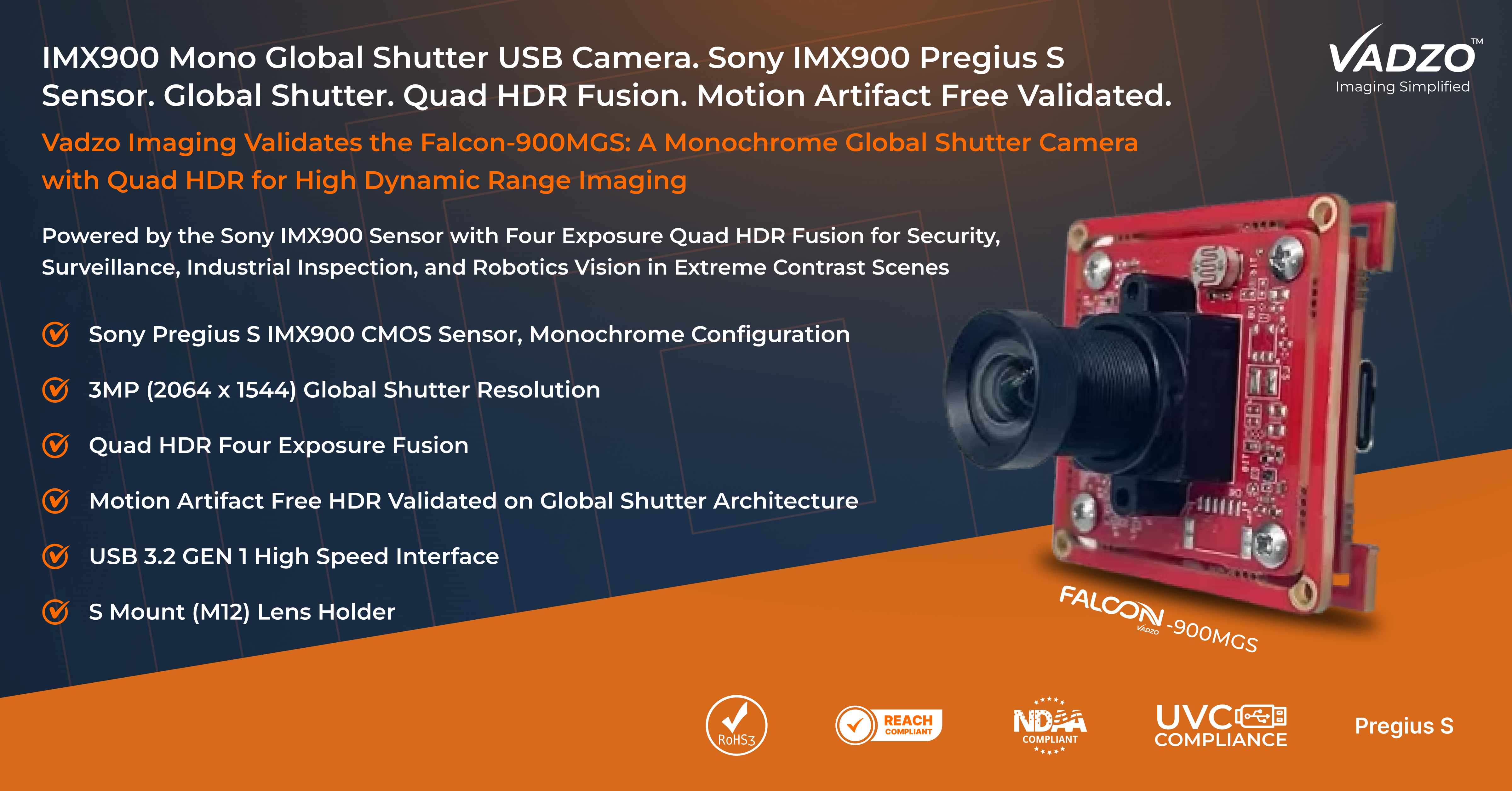
The Falcon-900MGS is an IMX900 Mono Global Shutter USB Camera built on the Sony IMX900 sensor and validated specifically for Quad HDR performance across extreme contrast scenes. As a 3MP Quad HDR USB Camera, it is purpose-built for OEMs who need genuinely extended dynamic range validated together with motion integrity, rather than a dynamic range specification confirmed only under static bench conditions that says nothing about how the camera performs once something in the scene actually moves. The 3MP Global Shutter USB Camera designation reflects Vadzo's validation of the IMX900 sensor's global shutter architecture specifically as the foundation the four-exposure fusion process depends on for artifact-free output. The camera module houses the IMX900 sensor, ISP, and USB 3.2 GEN 1 controller in a compact form factor with a standard M12 lens holder, functioning as a Quad Frame HDR USB Camera that ships validated rather than requiring independent dynamic range characterization after delivery. As an IMX900 Quad HDR USB Camera, output modes include full 3MP, 1080p, and 720p, selectable to balance resolution against frame rate and USB bandwidth for the target workflow, and the IMX900 High Dynamic Range USB Camera designation specifically confirms this dynamic range behavior across every output mode. As a 3MP Monochrome Quad HDR USB Camera, the camera enumerates as a standard UVC device on Windows, Linux, and Android, requiring no proprietary drivers for evaluation or production integration.
Key specs: 3MP (2064 x 1544) | Sony Pregius S IMX900 1/3.1-inch 2.25-micron pixel | Monochrome | Global Shutter | Quad HDR | S Mount M12 Lens | USB 3.2 GEN 1 | 3MP / 1080p / 720p | Windows Linux Android | -30°C to 70°C
Key Capabilities of the Sony IMX900 Quad HDR Machine Vision USB
3MP Monochrome Resolution with Quad HDR
Many monochrome global shutter camera products deliver accurate geometry through their shutter architecture while offering only standard dynamic range or a basic two-exposure HDR technique that struggles with genuinely extreme contrast scenes. The Falcon-900MGS, positioned as a 3MP Mono Quad HDR Sensor, captures a full 3MP (2064 x 1544) frame with four exposure fusion active, giving OEMs building a 3MP HDR USB Sensor Module deployment both the resolution and the extended dynamic range that a backlit or high-contrast scene actually requires. This makes it a genuine High Dynamic Range Mono Camera that resolves detail across both bright and dark regions within a single frame rather than sacrificing one extreme to preserve the other.
Quad HDR Four Exposure Fusion Architecture
A two-exposure HDR technique captures one short exposure and one long exposure, which extends dynamic range meaningfully but still compresses detail at the truly extreme ends of a very high contrast scene. The Falcon-900MGS's Quad HDR technique captures four separate exposure and gain combinations instead of two, extending usable dynamic range further than a simpler technique can reach, available as a Quad HDR Sensor Kit and a Mono Quad HDR Camera Kit that ships as a complete validated platform rather than a sensor requiring independent HDR tuning after delivery.
Global Shutter Motion Integrity During Multi Exposure Fusion
Combining multiple exposures into one output frame only works reliably if those exposures represent the same instant in time, and a rolling shutter or a sequentially captured multi-frame technique cannot guarantee this for any object in motion within the scene. The Falcon-900MGS's global shutter architecture exposes every pixel simultaneously across all four Quad HDR exposures, functioning as a Wide Dynamic USB Sensor that keeps the fusion process free of the ghosting and edge blurring artifacts a moving object would otherwise introduce, which matters directly for security and industrial scenes where the subject of interest is rarely stationary.
Quad HDR Compared to Standard Dual Exposure HDR
Dynamic range specifications on a datasheet do not distinguish between a sensor that combines two exposures and one that combines four, even though the practical difference matters considerably once a scene's contrast becomes genuinely extreme. The Falcon-900MGS's four-exposure Quad HDR technique resolves detail across a wider brightness range than a two-exposure approach can achieve, which is the specific reason OEMs facing scenes like a backlit entryway or a mixed reflective and shadowed industrial surface should confirm which HDR technique a candidate camera actually implements rather than relying on a general HDR label alone. Two camera products that both advertise HDR support can produce meaningfully different results on the same extreme contrast scene, and the exposure count behind that HDR label is often the deciding factor.
Multi-Resolution Output for Vision Workflows
Selectable output resolution lets a single Falcon-900MGS serve multiple roles within the same security or industrial deployment. Full 3MP mode captures maximum spatial detail for precise identification or fine inspection tasks. The 1080p mode balances resolution and USB bandwidth for continuous monitoring applications, while 720p mode supports higher frame rate operation for rapid detection or positioning tasks. Because every output mode benefits from the same Quad HDR fusion pipeline, switching resolution modes introduces no change in dynamic range performance, which matters for automated systems that expect consistent behavior regardless of which output mode a given task requires.
USB 3.2 GEN 1 Plug and Play Integration for OEM Programs
The Falcon-900MGS connects to any USB 3.2 GEN 1 host port on Windows, Linux, or Android without additional interface boards or proprietary drivers, since the camera enumerates as a standard UVC class device. Available as a USB Quad HDR Camera Kit for evaluation, the camera lets engineering teams confirm Quad HDR performance across their own representative high-contrast scenes before committing to a production order. For OEMs evaluating Vadzo as an OEM Quad HDR USB Module supplier, this means lens matching, firmware customization, and enclosure design support are available alongside the core camera hardware rather than as a separate engagement. As a Plug and Play HDR USB device, the Falcon-900MGS is validated across common security and industrial host platforms used in surveillance and inspection programs. Vadzo's position as a Quad HDR USB Camera Supplier extends beyond the camera module itself to include lens matching and dynamic range characterization support, while its track record as a Quad HDR USB Camera Manufacturer covers production programs spanning multiple sensor families and interface types for OEM customers building high contrast vision products.
"Security integrators and machine vision engineers dealing with genuinely extreme contrast scenes- a backlit doorway, a reflective metal part next to a dark recess- kept telling us that a standard HDR label on a datasheet does not tell them what they actually need to know, whether the camera combines two exposures or four, and whether that fusion process holds up once something in the frame moves. The Falcon-900MGS was built to answer both questions directly. By validating the Sony IMX900's four-exposure Quad HDR technique together with its global shutter architecture's motion integrity, we give OEMs a camera that resolves genuinely extreme contrast scenes without the ghosting artifacts a lesser HDR implementation would introduce the moment a subject moves through frame." - Alwin Vincent, Product Manager, Vadzo Imaging.
Application Specific Sections
Backlit Entryway and Doorway Monitoring
Entryways and doorways frequently present the most extreme contrast challenge a security camera faces, with a person silhouetted against bright daylight or an illuminated exterior visible through the same frame as a dim interior. The Falcon-900MGS functions as a Backlit Scene USB Camera for these deployments, resolving facial and identifying detail on a backlit subject that a standard dynamic range camera would render as a featureless silhouette. Access control and identity verification applications depend specifically on this capability, since a security system that cannot resolve a backlit face provides no real identification value regardless of how well it performs under more favorable lighting. This distinction becomes especially important at building entrances facing east or west, where direct sun angle changes throughout the day make backlighting an unavoidable, recurring condition rather than an occasional edge case.
High Contrast Outdoor Security Scenes
Outdoor security scenes spanning sunlit pavement and deep shadow, or a parking area with both direct sun exposure and shaded structure, present the same fundamental contrast challenge as a backlit doorway across a wider field of view. The Falcon-900MGS serves as a High Contrast Scene USB Camera for these deployments, extending usable detail into both the brightest and darkest regions of a scene that a standard sensor would only partially resolve.
Surveillance and NVR Recording Systems
Surveillance systems recording continuous footage across a full day depend on consistent detail regardless of how a scene's lighting and contrast shifts throughout that period, particularly at dawn, dusk, and any point where direct sun and shadow appear together in frame. The Falcon-900MGS operates as a Quad HDR Surveillance USB Sensor for these systems, giving NVR platforms footage that retains usable detail across the full range of contrast conditions a fixed camera position encounters over a full operating day. Recorded footage that stays usable through sunrise, midday, and sunset transitions reduces the gaps in evidentiary quality that operators otherwise encounter when reviewing incidents that occurred during a difficult lighting transition.
Industrial Inspection with Reflective and Shadowed Surfaces
Industrial inspection scenes frequently combine a highly reflective metal or glossy surface with an adjacent dark recessed area, a contrast combination that challenges standard dynamic range sensors and even basic two-exposure HDR techniques. The Falcon-900MGS functions as a Quad HDR Inspection USB Camera for these applications, resolving defect and dimensional detail across both the reflective and shadowed regions of a part within the same captured frame, and its suitability as a High DR USB Vision Camera extends to any fixed or moving inspection station presenting this same contrast challenge. Inspection algorithms that depend on consistent edge detection across an entire part benefit directly from this extended range, since a region lost to blowout or shadow in a lower dynamic range capture can hide exactly the defect an inspection station was set up to catch.
Robotics Vision in Mixed Lighting Environments
Robotics platforms operating across a facility encounter mixed lighting conditions as they move between brightly lit and shadowed areas, and a guidance or detection algorithm depends on consistent image quality regardless of which lighting zone the robot currently occupies. The Falcon-900MGS serves as a Quad HDR Robotics USB Camera for these deployments, with global shutter motion integrity ensuring that Quad HDR fusion remains artifact-free even as the robot itself moves through the scene during capture.
Frequently Asked Questions
Q: What is Quad HDR and how is it different from standard two exposure HDR?
A: Vadzo Imaging designs this camera around a four-exposure fusion technique that combines four separate exposures and gain combinations into a single output frame, extending usable dynamic range further than a standard two-exposure HDR approach can reach. Vadzo Imaging validates this specifically because scenes with truly extreme contrast, such as a backlit doorway or a reflective industrial surface next to a dark recess, frequently exceed what two exposures alone can adequately resolve. Vadzo Imaging considers this distinction meaningful enough that OEMs should confirm exposure count directly rather than relying on a general HDR label to predict performance.
Q: Does combining four exposures into one frame introduce motion blur or ghosting artifacts?
A: No. Vadzo Imaging validates this camera's four-exposure fusion process together with its global shutter architecture, which exposes every pixel simultaneously across all four exposures rather than capturing them sequentially over time. Vadzo Imaging confirms this combination specifically to avoid the ghosting and edge blurring artifacts that a rolling shutter or a sequentially captured multi-frame HDR technique would introduce the moment anything in the scene moves.
Q: What kinds of scenes benefit most from Quad HDR imaging?
A: Vadzo Imaging designs this camera for scenes containing both very bright and very dark regions within the same frame, such as a backlit entryway, an outdoor area combining direct sun and shadow, or an industrial surface combining reflective and recessed regions. Vadzo Imaging validates that this four-exposure technique resolves detail across both extremes simultaneously, which a standard dynamic range sensor or a basic two-exposure HDR technique cannot fully achieve in genuinely high contrast conditions. Vadzo Imaging recommends this camera specifically for deployments where a lower dynamic range solution has previously produced silhouetted subjects or blown-out backgrounds.
Q: Does using Quad HDR reduce the camera's frame rate significantly?
A: Vadzo Imaging validates practical frame rates with Quad HDR active across all supported output resolutions, and also provides 1080p and 720p modes for applications that prioritize frame rate alongside extended dynamic range. Vadzo Imaging positions this selectable output specifically so OEMs can choose the resolution and frame rate balance their application actually requires without sacrificing the dynamic range performance Quad HDR provides.
Q: Why should OEMs building high contrast vision applications choose Vadzo Imaging as their camera supplier?
A: Vadzo Imaging offers more than a camera module built around a capable sensor. OEMs building high-contrast vision applications and working with Vadzo Imaging receive a camera validated for genuine four-exposure Quad HDR performance together with global shutter motion integrity, along with engineering support covering lens selection, firmware customization, and dynamic range characterization guidance. Vadzo Imaging maintains evaluation kits with no minimum order requirement, so engineering teams can confirm Quad HDR performance across their own representative high-contrast scenes before committing to volume production. This combination of validated dynamic range performance and low minimum evaluation access is why security and industrial OEMs continue to choose Vadzo Imaging for high contrast vision camera programs, and Vadzo Imaging extends the same validation discipline across its broader monochrome global shutter lineup for OEMs whose deployment spans multiple contrast and lighting conditions.
Availability
The Falcon-900MGS IMX900 Mono Global Shutter USB Camera built on the Sony IMX900 sensor is available now for evaluation and production orders. Evaluation kits include the camera module, S-Mount lens, USB 3.2 GEN 1 cable, and platform driver documentation, with no minimum order requirement. Engineering teams can confirm Quad HDR performance directly across their own representative high-contrast scenes before committing to a production bill of materials, which matters more for this camera than a datasheet dynamic range figure alone could confirm, and can validate motion integrity using their own moving subjects rather than a static reference chart. Browse the full range of monochrome global shutter camera options at Vadzo's website or contact Vadzo at support@vadzoimaging.com to request an evaluation unit or discuss OEM integration requirements for security, surveillance, industrial inspection, and robotics camera programs.
About Vadzo Imaging
Vadzo Imaging is a global provider of embedded vision solutions and delivers high-performance camera technologies and imaging platforms for applications in robotics, industrial automation, UAVs, edge AI, and medical systems. Its products are designed for seamless integration with leading embedded platforms. Vadzo supports customers through hardware customization, firmware development, and module-level drivers, enabling faster development and deployment of vision-based systems across USB, MIPI, GigE, Wi-Fi, and SerDes camera interfaces.
Media Contact
Alwin Vincent
Vadzo Imaging
Email: alwin@vadzoimaging.com
LinkedIn: Vadzo Imaging
YouTube: Vadzo Imaging
X: Vadzo Imaging
SOURCE: Vadzo Imaging
View the original press release on ACCESS Newswire
If you believe this article contains misleading, harmful, or spam content, please let us know.
Report this articleMore News
View More




Recent Quotes
View MoreQuotes delayed at least 20 minutes.
By accessing this page, you agree to the Privacy Policy and Terms Of Service.