




Financial News
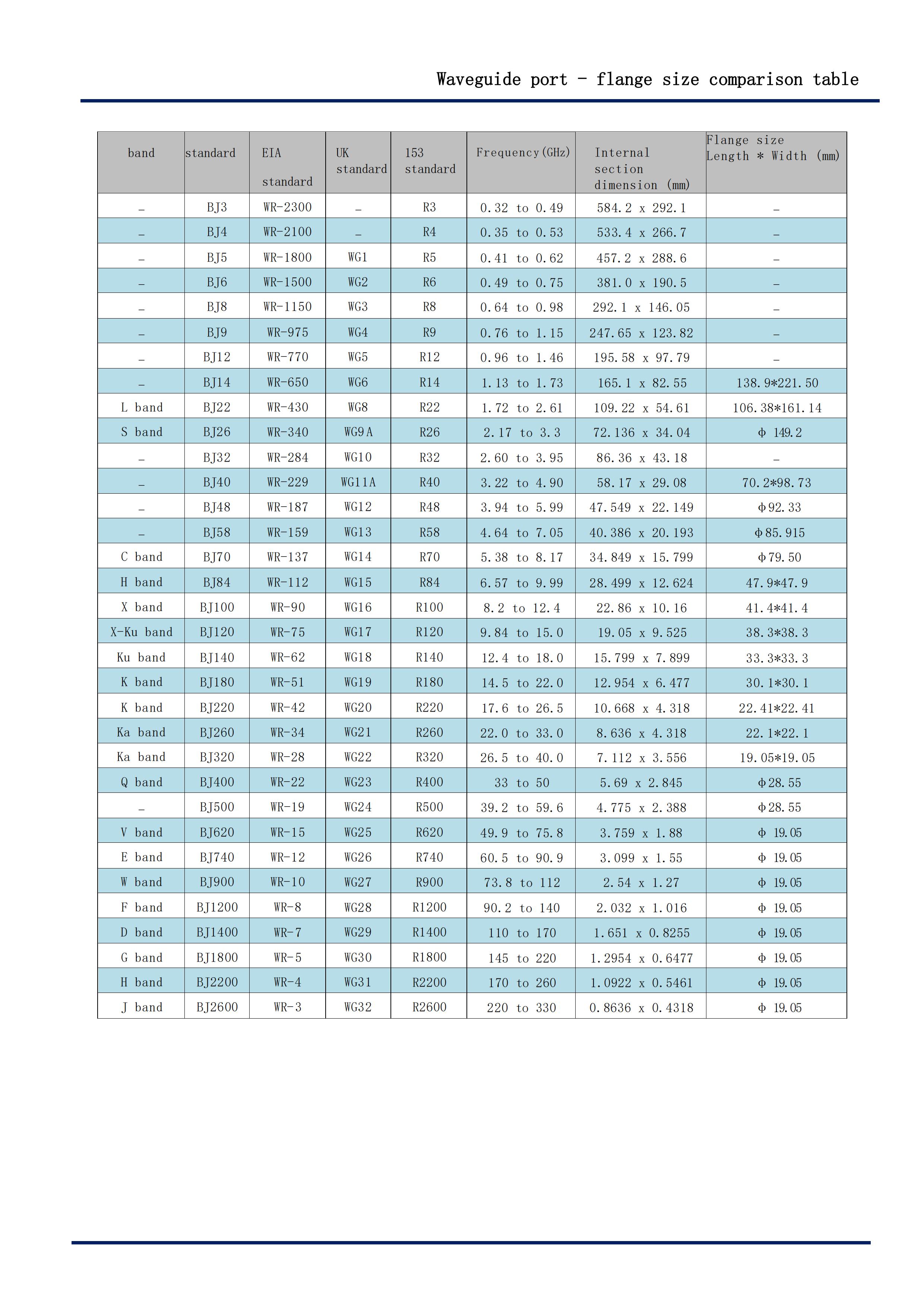
Waveguide port – flange size comparison table
The relationship between waveguide port dimensions, flange sizes, and frequency bands is standardized to ensure mechanical compatibility and optimal RF performance. Below is a simplified comparison table and key principles for common rectangular waveguides and their associated flanges.
Key Concepts
1. Waveguide Designation: Waveguides are labeled with "WR" (Waveguide Rectangular) followed by a number (e.g., WR-90). The number approximates the inner broad-wall dimension in hundredths of an inch (e.g., WR-90 ≈ 0.90" inner width).- Example: WR-90 = 0.9" (22.86 mm) inner width.
2. Flange Types: Flanges standardize the connection between waveguides. Common types include: - UG/UPC (MIL-STD): Standardized military flange (e.g., UG-387/UPC). - CPR (Commercial): European standards (e.g., CPR-137). - Choke Flanges: For low-leakage, high-power applications. - Cover Flanges: Simpler, used for vacuum sealing.
3. Frequency Bands: Each waveguide supports a specific frequency range based on its dimensions.
Waveguide-to-Flange Comparison Table Waveguide Frequency Range Flange Type Flange Dimensions (Typical) Applications WR-90 8.2–12.4 GHz (X-band) UG-387/UPC (MIL) Bolt Circle: 1.872" (47.5 mm) Radar, satellite comms. WR-112 7.05–10 GHz (C-band) UG-595/UPC Bolt Circle: 2.400" (61.0 mm) Radar, telecom WR-62 12.4–18 GHz (Ku-band) UG-385/UPC Bolt Circle: 1.250" (31.75 mm) Satellite, military systems WR-42 18–26.5 GHz (K-band) UG-383/UPC Bolt Circle: 0.800" (20.3 mm) High-frequency radar WR-28 26.5–40 GHz (Ka-band) UG-599/UPC Bolt Circle: 0.600" (15.2 mm) 5G, automotive radar WR-15 50–75 GHz (V-band) UG-387Mini/UPC Bolt Circle: 0.400" (10.2 mm) mmWave, research
Flange Dimensions (Typical) 1. Bolt Circle Diameter (BCD): Diameter of the circle formed by the centers of the mounting bolts. 2. Hole Spacing: Distance between bolt holes (e.g., 4-hole or 8-hole patterns). 3. Waveguide Aperture: Matches the waveguide’s inner dimensions.
Key Relationships
1. Waveguide Size ↔ Flange Size:- Larger waveguides (lower frequencies) use larger flanges (e.g., WR-112 flange > WR-90 flange).- Smaller waveguides (higher frequencies) use compact flanges (e.g., WR-28, WR-15).
2. Flange Compatibility:- Flanges must match mechanically (hole alignment, BCD) and electrically (impedance continuity).- Mixing flange types (e.g., UG-387 with CPR-137) requires adapters.
3. Standards by Region:- MIL-STD (UG/UPC): Common in U.S. defense systems.- IEC/CPR: Common in European commercial systems.
Example Flange Standards Flange Type Waveguide Compatibility Key Features UG-387/UPC WR-90, WR-62, WR-42 4-hole, MIL-STD-392, widely used. UG-599/UPC WR-28, WR-15 Compact, for mmWave systems. CPR-137 WR-112, WR-90 European standard, 8-hole pattern. Choke Flange All Grooved design for reduced leakage.
Notes- Always verify mechanical drawings from manufacturers for exact dimensions. - Mismatched flanges cause impedance discontinuities, leading to VSWR degradation. - For vacuum systems, use O-ring sealed cover flanges.
Let me know if you need a specific waveguide-flange combination!
Media Contact
Company Name: Chengdu Leader Microwave Technology Co., Ltd
Email: Send Email
Country: China
Website: https://www.leader-mw.com/
If you believe this article contains misleading, harmful, or spam content, please let us know.
Report this articleMore News
View More




Recent Quotes
View MoreQuotes delayed at least 20 minutes.
By accessing this page, you agree to the Privacy Policy and Terms Of Service.