




Financial News
Arsenal of the Americas: Defense Stocks Surge as US Intervention in Venezuela Reshapes Geopolitical Landscape
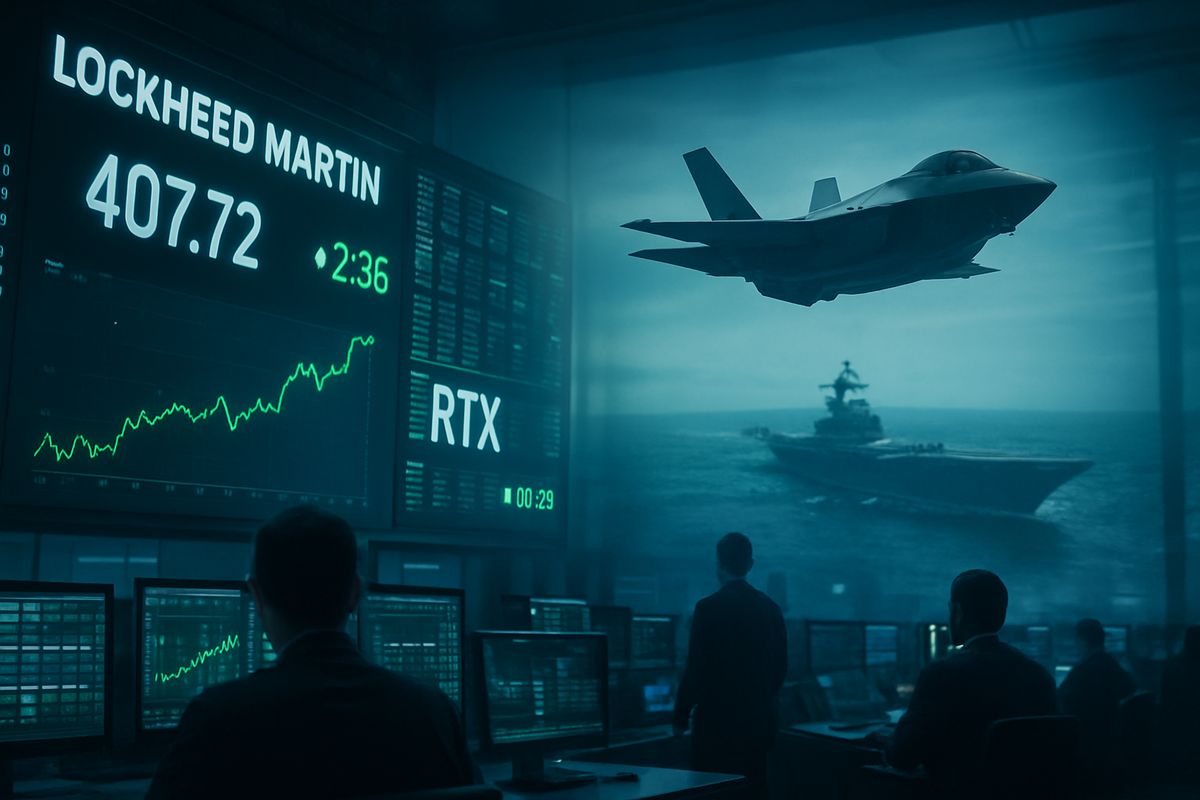
In a dramatic opening to the 2026 trading year, defense equities skyrocketed on Monday, January 5, following a weekend of unprecedented military action in South America. The United States military successfully executed "Operation Absolute Resolve," a multi-domain strike and extraction mission that resulted in the capture of Venezuelan President Nicolás Maduro. As markets processed the news of Maduro’s extradition to New York to face narco-terrorism charges, investors flooded the aerospace and defense sectors, betting on a sustained period of increased military spending and "active stabilization" in the Western Hemisphere.
The immediate implications for the financial markets are profound. The S&P 500's Aerospace & Defense sub-index jumped over 4% in early trading, outpacing the broader market as capital rotated out of high-growth technology and into "security-first" assets. With the U.S. government now overseeing a transition in Caracas, analysts anticipate multi-billion dollar contracts for infrastructure protection, border security, and long-term naval presence, signaling the end of the post-pandemic "peace dividend" and a return to high-intensity regional engagement.
Operation Absolute Resolve: A New Era of Hemispheric Dominance
The intervention, which began in the early hours of Saturday, January 3, 2026, was the culmination of a "slow burn" escalation that dominated the latter half of 2025. Operation Absolute Resolve involved over 150 U.S. aircraft, including F-35A Lightning IIs and B-1B Lancer bombers, which conducted a coordinated strike to disable Venezuelan integrated air defense systems. Simultaneously, elite units from Delta Force and the 160th Special Operations Aviation Regiment (SOAR) raided presidential residences in Caracas. The capture of Maduro and his inner circle was executed with high precision, followed by their immediate extradition to U.S. soil.
The timeline leading to this moment was marked by increasing friction throughout 2025. Tensions peaked in late 2025 during "Operation Caribbean Shield," a maritime anti-narcotics campaign that saw U.S. Southern Command (SOUTHCOM) engage in several naval skirmishes with Venezuelan vessels. The situation reached a breaking point when Venezuela moved approximately 15,000 troops to the border of Guyana, attempting to annex the oil-rich Essequibo region. The U.S. responded by deploying the USS Gerald R. Ford carrier group, framing the eventual intervention as both a humanitarian necessity and a law-enforcement mission against a "narco-state."
Initial market reactions have been overwhelmingly bullish for the primary contractors involved in the mission's hardware. By mid-day Monday, the defense sector was the clear leader on the New York Stock Exchange. Traders are not only pricing in the cost of the operation itself but the anticipated "long tail" of maintenance, logistics, and surveillance contracts required to stabilize a nation of 28 million people and secure its vast energy reserves.
The Big Winners: Defense Giants Lead the Rally
Lockheed Martin (NYSE: LMT) emerged as the primary beneficiary of the news, with its stock rising 3.5% to reach new heights. The central role of the F-35 Lightning II in the initial suppression of enemy air defenses (SEAD) highlighted the platform's indispensability in modern theater entry. Furthermore, Lockheed’s recent $9.8 billion contract for PAC-3 interceptors is now viewed as a critical asset for protecting regional allies from potential retaliatory strikes by Venezuelan-aligned paramilitary groups.
RTX Corporation (NYSE: RTX), formerly Raytheon, saw its shares climb 2.1%, hitting an all-time high of approximately $190. The company’s missile systems and Collins Aerospace surveillance technology were backbone components of the Caracas "cyber-blackout" that preceded the ground raid. Investors are particularly bullish on RTX’s defensive systems, which are expected to be deployed heavily across the Caribbean to protect shipping lanes from asymmetric threats.
General Dynamics (NYSE: GD) and Northrop Grumman (NYSE: NOC) also saw significant gains, rising 2.4% and 1.3% respectively. General Dynamics is expected to secure long-term naval support and "active stabilization" contracts as the U.S. Navy maintains a persistent presence to protect ExxonMobil (NYSE: XOM) offshore assets and other critical infrastructure. Meanwhile, Northrop Grumman’s ISR (Intelligence, Surveillance, and Reconnaissance) satellite and drone platforms were essential in the real-time tracking of Venezuelan leadership throughout the 2025 buildup.
Beyond the "Big Four," Palantir Technologies (NYSE: PLTR) surged 3.8% on speculation regarding its AI-driven data analytics' role in planning the mission. The operation’s success is being viewed as a "proof of concept" for Palantir’s Gotham platform in orchestrating complex, multi-domain special operations. Conversely, companies with heavy exposure to Chinese and Russian markets saw slight volatility, as the intervention signaled a hardening of the "Maximum Pressure 2.0" policy which could lead to further global trade bifurcations.
Wider Significance: Monroe Doctrine 2.0 and the Global Shift
The intervention in Venezuela represents a seismic shift in U.S. foreign policy, moving away from the "pivot to Asia" or the focus on Eastern Europe, and back toward the Monroe Doctrine—a policy of Western Hemisphere primacy. This "hemispheric dominance" strategy suggests that the U.S. is no longer willing to tolerate adversarial "outposts" in its immediate neighborhood. For the defense industry, this opens a new geographic market for high-end military hardware and persistent surveillance services that had previously been focused on the Indo-Pacific.
This event also sets a historical precedent comparable to the 1989 invasion of Panama, but on a much larger and more technologically advanced scale. The use of "narco-terrorism" as a legal framework for military action—following the 2025 designation of the Venezuelan gang Tren de Aragua as a Foreign Terrorist Organization—provides a new playbook for U.S. interventions. Competitors in the defense space, particularly those in Europe like BAE Systems (LSE: BA) and Rheinmetall (FWB: RHM), have also seen their stocks rise as the global "security-first" trend gains momentum.
Furthermore, the regulatory and policy implications are vast. The U.S. administration’s stance that it will "temporarily run the country" to ensure a transition implies a massive, multi-year nation-building project. This will likely require congressional approval for expanded defense and State Department budgets, providing a "floor" for defense stock valuations for the foreseeable future. The integration of AI and cyber-warfare into the mission also suggests that future defense budgets will increasingly favor software-defined warfare and autonomous systems.
What Comes Next: Stability, Scenarios, and Strategic Pivots
In the short term, the market will be watching for the emergence of an insurgency or "stay-behind" forces loyal to the former Maduro regime. If the transition to a provisional government is met with prolonged guerrilla warfare, the demand for tactical vehicles, loitering munitions, and persistent drone surveillance will remain elevated. Defense contractors may need to pivot their production lines to support "low-intensity conflict" hardware, which differs significantly from the high-end "great power competition" gear used in the initial strike.
Long-term, the primary opportunity lies in the rehabilitation of Venezuela’s oil infrastructure. As the U.S. works to bring Venezuelan crude back into the global market under a friendly administration, the "securitization of energy" will be a major theme. Defense firms that specialize in infrastructure protection and maritime security will likely see a steady stream of contracts. However, the challenge remains in the potential for diplomatic blowback from regional powers like Brazil or Colombia, which could complicate the U.S. military’s footprint in the region.
Market participants should also prepare for a "Scenario B" where the intervention triggers a broader regional conflict involving Venezuelan allies. While the initial strike was surgical, the "Maximum Pressure" environment could lead to increased tensions in other theaters, further fueling the global arms race. Investors should watch for the upcoming Q1 2026 earnings calls from the major contractors, where executives are expected to provide guidance on "Absolute Resolve" related backlogs.
Summary and Investor Outlook
The events of early January 2026 have fundamentally altered the risk-reward profile of the defense sector. The successful capture of Nicolás Maduro has not only removed a long-standing geopolitical thorn for the United States but has also served as a massive catalyst for the "Arsenal of the Americas." The rally in stocks like Lockheed Martin (NYSE: LMT) and RTX Corporation (NYSE: RTX) reflects a market that is now pricing in a permanent state of active military engagement in the Western Hemisphere.
Moving forward, the market will likely remain sensitive to any signs of instability in Caracas or shifts in U.S. occupation policy. The "peace dividend" era is firmly in the rearview mirror, replaced by a "security-first" investment thesis that prioritizes defense, cybersecurity, and energy independence. For investors, the key will be to distinguish between the immediate "pop" from the intervention and the long-term, structural growth in defense spending that this new era of hemispheric dominance promises.
In the coming months, keep a close eye on the 2027 defense budget proposals and the progress of the Venezuelan provisional government. The ability of the U.S. to maintain order without a "forever war" scenario will determine whether the current surge in defense stocks is a sustainable trend or a temporary spike driven by geopolitical shock.
This content is intended for informational purposes only and is not financial advice.
More News
View More




Recent Quotes
View MoreQuotes delayed at least 20 minutes.
By accessing this page, you agree to the Privacy Policy and Terms Of Service.