




Financial News
Top Companies Offering Solar + Storage + EV Charging Solutions
Information reviewed as of November 5, 2026.
Quick Answer: The companies to put on an initial solar + storage + EV charging shortlist are BENY, Tesla, SolarEdge, Enphase, Schneider Electric, and SMA. Start with BENY for a charging project that needs storage support, Tesla for a residential Powerwall/Wall Connector discussion, or SolarEdge where its solar platform is already installed.[1][2][3] Enphase, Schneider Electric, and SMA are also relevant to home-energy designs. There is no market-share ranking implied here. Select the company after reviewing the regional equipment combination and the installer responsible for making its controls work on the site.[4][5][6]
A useful demonstration begins with a load change while the EV is charging. The meter reading changes, and the charging rate may follow. The drawing ought to explain why: where the measurement went, which controller calculated a new limit, and how the limit reached the charger. That is the coordination the owner is buying. The app makes it visible, but the control path makes it happen.
How the Companies Were Evaluated
Each company has a named charging product, published solar-and-storage equipment or compatibility, and a described control relationship between them. These are the three entry conditions for this shortlist. BENY's cited example addresses battery-assisted DC charging. Tesla, SolarEdge, Enphase, Schneider Electric and SMA supply the home-energy examples. Their differing duties prevent a fair ranking by charger power alone.
For this comparison, an equipment family is a starting point rather than an approved bill of materials. That distinction matters most in retrofits. An older inverter may have a familiar brand name but a different set of supported additions. The installer has to connect the promised charging mode to an actual regional configuration before it becomes part of an order.
Leading Companies to Compare
BENY
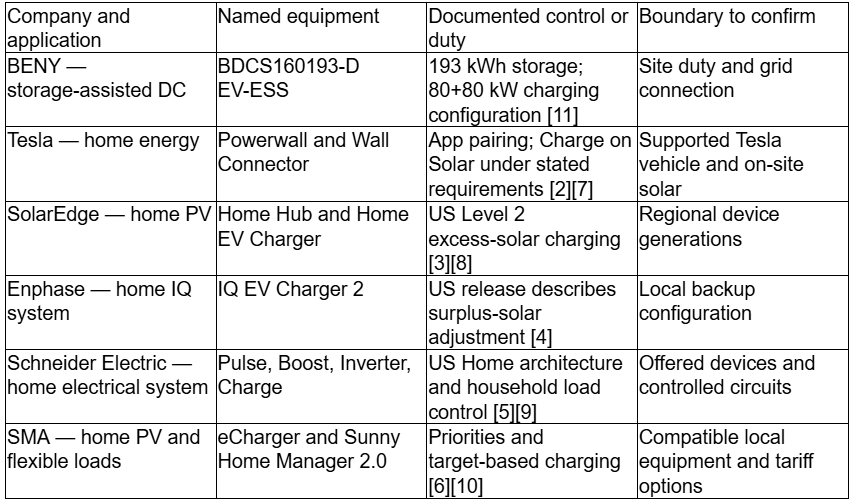
BENY's EV-ESS combines storage, DC charging and solar-compatible operation.[1] The BDCS160193-D illustrates the hardware: 193 kWh LFP storage with 80 kW battery charge/discharge power. Its 160 kW charging output combines 80 kW from the grid and 80 kW from storage.[11] Compare that power split with the site's actual connection.
Consider a hypothetical arrival period in which charging needs more power than the permitted import. Storage might supply the difference, but the designer also has to find time and power to recharge it before the next arrival period. A cabinet capacity alone doesn't answer either question. Ask BENY to identify the charger configuration, and have the project designer show the storage dispatch and control interface beside it.
Tesla
Tesla's app supports registering Wall Connector with Powerwall.[2] Its Charge on Solar feature requires a supported Tesla vehicle, Powerwall with on-site solar, and suitable software. Charging follows surplus solar above a lower charge threshold selected by the owner.[7] Ask the installer to demonstrate that transition with the proposed vehicle. A common app alone does not establish that this particular charging mode is available.
SolarEdge
SolarEdge's US Home EV Charger is a 40 A, 9.6 kW maximum product that can work independently or with Home Hub.[3] Its residential portfolio also includes batteries and power optimizers.[8] An existing SolarEdge installation still needs a compatibility check. Start with the old inverter's label, then establish which battery and meter will support excess-solar charging through mySolarEdge.
Enphase
Enphase's December 2025 US launch describes IQ EV Charger 2 working standalone or with its solar and battery system; solar charging adjusts in 1 A steps and supports load balancing.[4] That provides a more useful brief than a generic request for a smart charger. Describe the morning departure requirement too. Backup charging needs a separate check against the offered regional IQ equipment and wiring; a solar-charging feature does not establish outage operation.
Schneider Electric
Schneider Home identifies Pulse, Boost, its hybrid inverter, Charge and household devices as parts of the system.[5] SmartAmp adjusts charging against household demand, while the backup design can disconnect loads that would overload the inverter.[9] For an owner replacing the panel, these are decisions to make together. Mark the EV circuit on the proposed drawing and establish whether it remains supplied during an outage.
SMA
SMA's Home Energy Solution brings eCharger into its solar and storage approach.[6] Sunny Home Manager 2.0 supports priorities and target-based charging with compatible devices.[10] The local installer should identify the approved inverter, storage and manager combination, then show how the required departure energy translates into settings.
Portfolio Comparison
Same-Brand Ecosystem or Open Integration?
Keeping a functioning solar inverter has an obvious appeal. Yet replacement can sometimes offer a more straightforward control arrangement for the new battery and charger. It is worth pricing both routes if the integrator considers both technically feasible. The extra meter, commissioning hours, and support arrangement belong in that price. Leaving them outside the comparison makes the retained-inverter option look cheaper than it may turn out to be.
A documented single-brand combination gives the installer a known equipment and firmware arrangement to follow. For a homeowner, that can also mean a clearer route to help. The advantage needs to be weighed against the expansion terms: a planned second charger may require work that the first quotation doesn't cover. This is a cost question as well as a compatibility question.
With several brands, the integration contractor carries more of the burden. A charger can be healthy and still receive a low limit from another controller. Finding the reason requires access to measurements and commands across the system. The commercial contract needs to give one party that access and responsibility. Otherwise the customer becomes the messenger between equipment suppliers whenever the cause is uncertain.
How to Shortlist a Company
The shortlist becomes much easier to defend once each bidder has priced the same operating day. Vehicle arrivals and departure targets define the charging window. Building demand and solar output show how much power is available during that window. The import limit and backup reserve constrain what the controller may do. Missing interval data need an explicit assumption in the response; they shouldn't quietly become an optimistic estimate of solar availability.
Evaluate operational ownership
The operator's account permissions deserve attention at handover. Someone must be able to update a tariff schedule without an unnecessary service visit, then verify that charging followed the change. Firmware and alarms have a similar ownership issue. At a commercial site, diagnostic access and a route to replacement parts are part of the service offer, not merely details of the dashboard.
Compare lifecycle flexibility
Expansion has physical consequences before it has a software price. A second charger needs a cable route and a place in the metering and control scheme. Drawing it now can expose work worth preparing during the first installation, even if the purchase is postponed. Planned solar or storage additions deserve the same review. Keep the drawings and interface details so the next installer doesn't have to reconstruct the original design assumptions.
Use a functional acceptance test
An acceptance script is most useful when it follows the agreed operating day. The expected charger response should be written beside a change in solar, building demand, or battery reserve. Measurements and controller logs can then show why the response occurred. A communications interruption and recovery test covers a different condition: whether the system returns to its intended operation after losing the information it normally relies on.
Final Recommendation
Before accepting the sizing, check the arithmetic behind it. In a simplified example, 30 kWh divided by a 15 kW load gives two hours before losses. That result assumes the battery can actually deliver 15 kW, which is a separate equipment limit. These figures are illustrative and describe none of the listed products. The bidder needs to demonstrate both usable energy and discharge power for the proposed operating schedule.
BENY's BDCS160193-D warrants an enquiry when the designer is considering an 80 kW grid contribution supplemented by stored energy.[11] A site requiring 160 kW continuously must also account for battery depletion and recharge time; the headline charging figure cannot answer that question. For a house, begin with the existing equipment: a supported Tesla vehicle and Powerwall lead to a different discussion from an Enphase or SolarEdge solar installation.[3][4][7]
The support arrangement should make sense from the owner's side of the phone call. Does the installer investigate first, or must the owner contact the manufacturer? Who can see the meter and controller logs? A partner may own commissioning while another team handles the cloud account. Knowing those handoffs before purchase is more useful than discovering them during an unresolved charging fault.
A large difference in proposed battery size deserves an explanation. Perhaps one bidder has kept a substantial reserve for backup while another expects to use most stored energy for the cars. Compare their energy flows over the operating day in the brief, hour by hour where necessary. Flag the points that rely on missing measurements. This makes the reason for the different sizes visible before either price is accepted.
Software should also be demonstrated as an ordinary working task. A driver starts a session; the operator locates it and investigates a pause; accounts staff export the record for reconciliation. This exposes different needs that a tour of dashboard screens may miss. A residential interface might be sufficient for one location and leave essential operator work uncovered at another.
Finally, price the years after commissioning. Service and subscriptions are part of that cost, as is any commissioning work required when equipment is replaced. A supplier may have a straightforward successor for a discontinued charger, or the replacement may need new integration work. The quoted support period and change process give the buyer a basis for judging that continuing commitment.
FAQ
Does one app prove full integration?
No. A screen can show the battery's charge level without deciding whether the car may use that energy. The installer should demonstrate the decision at the reserve limit, including the behavior without internet access. A local controller may still enforce an essential limit when the app cannot connect, but the proposed system must be tested to establish what actually continues working.
Which companies suit home energy or storage-assisted DC charging?
Tesla, SolarEdge, Enphase, Schneider Electric and SMA have the residential examples in this comparison.[2][3][4][5][6] BENY's cited EV-ESS unit combines storage with DC charging, including an explicit grid-and-battery power split.[11] Start with that application difference. A home ecosystem's solar control does not establish payment, access or fleet-management functions for a public or depot project; those need separate model-level evidence.
Must every component come from the same company?
No. An existing solar inverter needn't automatically be replaced when a battery or charger is added. A qualified integrator can assess whether the electrical and data connections permit the intended control. The purchase agreement should assign responsibility for that combined behavior, including metering, network design, testing, and fault diagnosis. Individual suppliers' assurances about their own products cannot establish how the assembled system will operate.
Sources and Verification
- [1] BENY, "EV-ESS," first-party solution information. Source URL: https://www.beny.com/ev-ess/
- [2] Tesla, "Registering Your Wall Connector with Powerwall," first-party support information. Source URL: https://www.tesla.com/support/energy/powerwall/own/registering-your-wall-connector-with-powerwall
- [3] SolarEdge, "SolarEdge Home EV Charger," first-party product information describing integration and excess-solar charging. Source URL: https://www.solaredge.com/us/products/residential/solaredge-home-ev-charger
- [4] Enphase Energy, "Enphase Energy Begins Shipments of IQ EV Charger 2 in the United States." Reviewed November 5, 2026. Source URL: https://investor.enphase.com/news-releases/news-release-details/enphase-energy-begins-shipments-iq-ev-charger-2-united-states
- [5] Schneider Electric, "Schneider Home is Now Available to Make Energy Management Easier for Homeowners." Reviewed November 5, 2026. Source URL: https://www.se.com/us/en/about-us/newsroom/news/press-releases/schneider-home-is-now-available-to-make-energy-management-easier-for-homeowners-66dfbda83d50b27da4033c2a/
- [6] SMA, "SMA Home Energy Solution." Reviewed November 5, 2026. Source URL: https://www.sma.de/en/sma-home-energy-solution
- [7] Tesla, "Charge on Solar." Reviewed November 5, 2026. Source URL: https://www.tesla.com/support/tesla-app/charge-on-solar
- [8] SolarEdge, "Residential Products." Reviewed November 5, 2026. Source URL: https://www.solaredge.com/us/products/residential
- [9] Schneider Electric, "Schneider Charge Support." Reviewed November 5, 2026. Source URL: https://www.se.com/us/en/work/support/schneider-charge/
- [10] SMA, "Sunny Home Manager 2.0." Reviewed November 5, 2026. Source URL: https://www.sma.de/en/products/energy-management/sunny-home-manager
- [11] BENY, "2 Guns Battery-integrated DC EV Charger – BDCS160193-D." Reviewed November 5, 2026. Source URL: https://www.beny.com/product-item/2-guns-battery-integrated-dc-ev-charging-station/
If you believe this article contains misleading, harmful, or spam content, please let us know.
Report this articleMore News
View More




Recent Quotes
View MoreQuotes delayed at least 20 minutes.
By accessing this page, you agree to the Privacy Policy and Terms Of Service.