




Financial News
Architecting Scalable Asset Production Pipelines From Multi View Concept Renderings
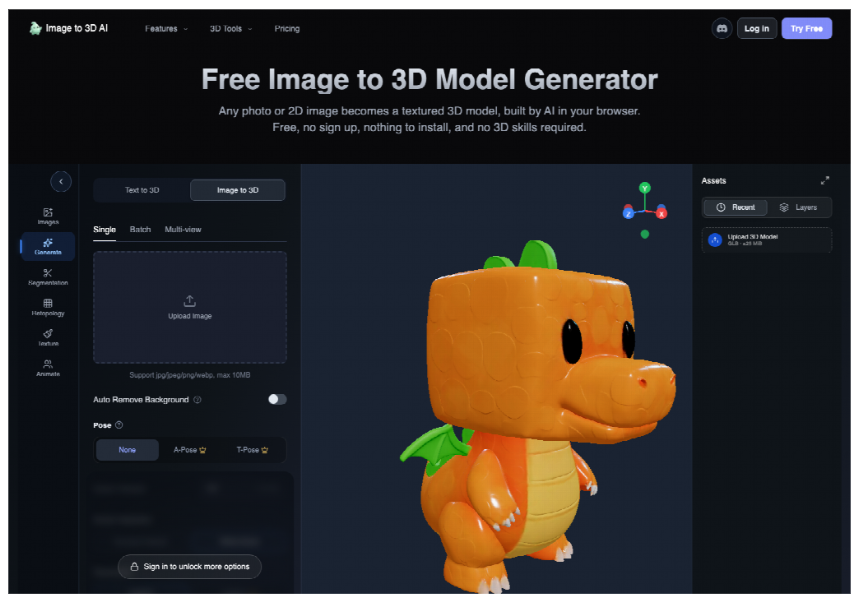
Enterprise visualization teams prioritizing rapid asset staging increasingly route their multi-angle concept sheets directly to Free & No sign up image to 3D generation engines for quick topology inspection before committing costly digital content creation retainers. By generating preliminary volumetric meshes directly from two-dimensional product design drafts, technical leads can benchmark spatial feasibility and geometry density within seconds. This front-loaded validation loop protects departmental budgets by identifying unviable product geometry before expensive manual sculpting begins.
Modern e-commerce platforms, interactive product configurators, and virtual production environments demand thousands of distinct three-dimensional SKUs annually. Building these digital catalogs using conventional computer graphics workflows imposes heavy labor expenses, requiring dedicated modeling specialists to hand-sculpt geometry, layout UV texture coordinates, and bake ambient occlusion passes for every single object. As commercial production scales, this manual asset creation paradigm becomes an unsustainable operational bottleneck.
Economic Realities Of High Volume Asset Staging In Digital Commerce
The financial pressure on digital asset procurement stems from the severe disparity between 2D conceptual ideation and 3D geometric execution. Industrial designers can generate dozens of photorealistic concept renderings in a single morning, yet converting those renderings into interactive 3D assets requires days of specialized labor per object. When merchandising executives decide to alter a product silhouette late in development, the resulting engineering rework wipes out production margins.
Algorithmic spatial reconstruction dramatically flattens this cost curve by automating base-mesh synthesis. Processing concept portfolios through ImageTo3D AI enables production studios to convert 2D raster imagery into cohesive GLB files in under a minute per asset. By establishing immediate geometric proxies, commercial teams can populate virtual showrooms and test spatial camera framing long before committing funds to final surface detailing.
Evaluating Capital Expenditure In Manual Versus Algorithmic Reconstruction Pipelines
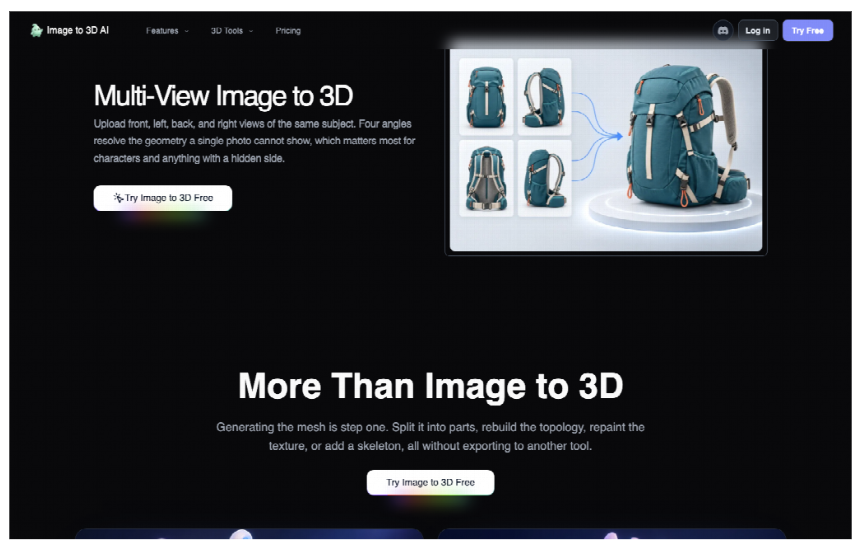
Manual asset staging across commercial catalogs typically averages between three hundred and eight hundred dollars per SKU when accounting for specialized modeler hours and revisions. In contrast, algorithmic synthesis eliminates preliminary blocking fees entirely. Deploying a No sign up image to 3D tool allows technical supervisors to batch-process up to ten reference concepts simultaneously, evaluating geometric volume across an entire seasonal collection within an afternoon.
When we compared the generated volumetric asset against the reference rendering during our studio asset audit, neural reconstruction accurately captured foundational scale, volumetric depth, and major structural contours. In our benchmarking tests across twenty distinct consumer product designs, the automated pass rate reached eighty-five percent for initial form verification, allowing teams to reject disproportionate concepts before incurring modeling overhead.
Multi Angle Synthesis Resolving Occluded Angles Across Complex Product Volumes
Single-angle image synthesis operates on probabilistic inference, estimating hidden surfaces based on learned statistical averages. For symmetrical consumer goods like footwear or simple electronics, single-view reconstruction delivers acceptable volume; however, complex asymmetric machinery requires multi-perspective anchoring to prevent geometric warping along blind spots.
Feeding multi-view concept inputs—such as front, left, back, and right orthographic angles—into ImageTo3D AI resolves occluded surface planes with mathematical precision. The platform fuses multi-perspective depth vectors into a single unified polygon envelope, ensuring that backside panels, battery doors, and connector ports align seamlessly with front-facing controls.
Evaluating Polygon Density And Quad Retopology In Real Time Pipelines
Generating raw polygon geometry is only the first hurdle in commercial asset preparation; real-time interactive viewers enforce strict budgets on vertex counts, draw calls, and wireframe topology. Raw neural synthesis yields dense triangle meshes that capture organic curvature at 1536 resolution, but these high-density point clouds can overwhelm mobile graphics processors if deployed without topology optimization.
Transforming algorithmic meshes into lightweight commercial assets requires an integrated retopology pipeline. Automated topology modules analyze surface curvature tensors, reorganizing dense unstructured triangles into clean, quad-dominant wireframes with consistent edge flow along mechanical seams.
Transitioning From Irregular Triangles To Cohesive Quad Dominant Wireframes
Quad topology is essential for downstream asset flexibility, allowing technical artists to apply subdivision surface smoothing and non-destructive deformation. Automated retopology reduces file weight by up to seventy percent while preserving primary geometric silhouettes, ensuring snappy asset streaming across web-based WebGL viewers and augmented reality mobile applications. By generating clean quad edge loops, downstream systems can compute level-of-detail hierarchies automatically, maintaining high frame rates across mobile browsers without manual polygon decimation.
Wasted an afternoon adjusting UV coordinate seams during previous manual catalog migrations, so our technical team prioritizes automated coordinate unwrapping. By generating optimized UV islands alongside quad retopology, algorithmic tools ensure that surface textures remain distortion-free across complex organic curves.
Preserving High Frequency Normal Maps Across Unwrapped UV Coordinates
Commercial visual fidelity relies heavily on high-frequency normal details such as knurled metals, leather grain, and micro-bevels. Modern asset workflows extract these subtle details from the initial high-density 1536 mesh, baking them into tangent-space normal maps applied over the lightweight retopologized base mesh. This decoupling delivers cinematic visual depth while maintaining fluid sixty-frames-per-second rendering performance in web browsers.
Generating untextured white meshes during initial verification provides art supervisors with an unbiased view of underlying surface smoothness. Stripping away painted color layers ensures that micro-surface dimples or abnormal vertex clustering cannot hide behind high-contrast color graphics. During technical quality signoff, lighting engineers evaluate specular reflections under environment HDRI maps to ensure the curvature matches brand packaging specifications.
Automated 3D Segmentation And Downstream Digital Catalog Integration Workflow
Enterprise asset management requires modular component control. A complex consumer electronic device is not a monolithic sculpture; it consists of display panels, chassis enclosures, buttons, and removable accessories. Automated 3D segmentation isolates these discrete functional elements from the unified mesh, assigning unique material slots to each sub-component.

Deploying ImageTo3D AI to segment generated product models allows configurator developers to swap materials, apply independent metallic shaders, and animate component explosions without manually slicing geometry in digital content creation software. This automated modularity significantly accelerates the handoff between conceptual design and interactive sales applications. Engineering teams can bind physical material properties, such as metallic roughness and refractive transparency, to specific sub-meshes without reopening authoring software.
Production Governance And Quality Assurance Protocols For Commercial Asset Libraries
To scale algorithmic 3D production across enterprise catalogs, digital asset managers should enforce a standardized inspection protocol before committing models to master asset repositories:
- Standardize input concept artwork with clear subject separation, uniform diffuse lighting, and standardized orthographic framing to maximize neural depth estimation accuracy.
- Execute automated volumetric reconstruction, reviewing both textured GLB models and untextured white meshes in real-time viewports to audit dimensional fidelity.
- Perform automated quad retopology to reduce vertex overhead, ensuring polycounts conform strictly to enterprise real-time streaming limits.
- Bake tangent-space normal maps from raw high-density geometry onto retopologized meshes to preserve micro-surface detailing.
- Execute mesh segmentation on multi-part assets to establish discrete material channels for interactive web configurators.
That single discard during visual staging saves dozens of downstream engineering hours across texturing and rigging teams. Furthermore, direct export to standardized GLB and USDZ formats enables instant deployment to Apple AR Quick Look and Google Scene Viewer, bridging digital commerce with physical environments. By treating AI-driven 3D generation as an agile foundation for enterprise asset staging, commercial studios achieve unprecedented catalog velocity while preserving engineering capital for premium product presentation.
If you believe this article contains misleading, harmful, or spam content, please let us know.
Report this articleMore News
View More




Recent Quotes
View MoreQuotes delayed at least 20 minutes.
By accessing this page, you agree to the Privacy Policy and Terms Of Service.