




Financial News
From Test Tubes to Artificial Intelligence: How Modern Laboratories Are Changing Scientific Research
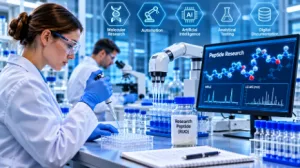
Scientific laboratories are undergoing a technological transformation. Traditional equipment such as microscopes, test tubes and chemical analysis instruments is increasingly being used alongside automated systems, digital databases and artificial intelligence.
The combination is changing how researchers investigate molecular structures, analyze experimental results and manage scientific information. Among the areas where these technologies intersect is peptide research, a field that brings together chemistry, biotechnology and molecular biology.
While computer systems can help researchers process large amounts of information, physical experiments remain essential for determining whether scientific predictions are accurate.
The modern laboratory is becoming a place where traditional experimental methods and advanced digital technologies work together.
Small molecules present big scientific challenges
Peptides are relatively short chains of amino acids connected through chemical bonds. Although their structures may appear simple compared with larger proteins, their chemical properties can vary considerably.
The order of amino acids, molecular structure and chemical modifications can influence how a peptide behaves under laboratory conditions.
Even a change involving a single amino acid may alter its electrical charge, stability, solubility or interactions with other molecules.
These differences make peptides an interesting subject for researchers studying molecular recognition, chemical reactions and biological signaling.
However, investigating such small structures requires specialized equipment and carefully designed analytical methods.
Researchers cannot determine the identity or composition of a peptide simply by examining its physical appearance.
Instead, laboratories rely on instruments capable of separating, detecting and characterizing individual molecular components.
Automation is changing laboratory workflows
Many traditional laboratory procedures involve repetitive tasks, including sample preparation, liquid handling, instrument operation and data recording.
Automated systems can perform some of these activities under controlled conditions.
Robotic liquid-handling equipment, for example, can transfer samples between laboratory containers. Automated analytical instruments can process multiple samples while recording experimental measurements.
These technologies can help improve consistency and reduce the amount of time researchers spend performing repetitive procedures.
However, automation does not remove the need for scientific expertise.
Researchers must still select appropriate methods, establish experimental controls, monitor equipment performance and interpret the results.
An automated system operating under unsuitable conditions can produce inaccurate measurements just as a manually performed experiment can.
The value of automation therefore depends on how effectively it is incorporated into a validated laboratory workflow.
Artificial intelligence enters molecular research
Artificial intelligence is introducing additional tools for investigating chemical and biological structures.
Computer models can analyze amino acid sequences, compare molecular characteristics and generate predictions about possible interactions between compounds.
In peptide research, these tools may help scientists identify structural patterns and prioritize questions for experimental investigation.
Computational systems can also assist with interpreting complex analytical datasets.
However, a prediction generated by artificial intelligence is not equivalent to a confirmed scientific discovery.
A computer model may suggest that two molecules could interact, but laboratory experiments are needed to establish whether that interaction occurs under the conditions being studied.
Similarly, predicting the structure of a peptide does not confirm the identity or purity of a physical sample.
For this reason, computational research and experimental chemistry remain complementary disciplines.
Specialized scientific materials support laboratory research
Behind modern research facilities is an extensive network of businesses supplying analytical instruments, chemical reagents, laboratory equipment and technical services.
Some suppliers focus on broad categories of scientific equipment, while others specialize in particular groups of chemical compounds.
Peptide research is one example of a field that requires access to materials with clearly defined molecular characteristics.
Researchers may need information about amino acid sequences, molecular mass, chemical modifications and analytical specifications before determining whether a material is appropriate for an experiment.
Specialized online platforms, including SEMAX POLSKA, represent one segment of this scientific supply ecosystem, presenting chemical reagents and peptide-related laboratory materials through digital catalogues.
The availability of such catalogues can make it easier to locate information about different compounds. However, researchers must independently assess whether the available specifications and documentation meet their experimental requirements.
Materials intended for laboratory research should also be clearly distinguished from pharmaceutical products, dietary supplements and other consumer goods.
How laboratories identify molecules that cannot be seen
One of the most important developments in analytical chemistry has been the ability to characterize substances at the molecular level.
High-performance liquid chromatography, commonly known as HPLC, is frequently used to separate components within a chemical mixture.
As the sample passes through the analytical system, its components may interact differently with the materials inside the instrument. These differences allow compounds to be separated and detected.
The resulting chromatogram provides information about the signals recorded during the analysis.
Another important technique is mass spectrometry, which examines ions according to their mass-to-charge ratios.
For peptide research, this information can help scientists assess whether the measured molecular mass is consistent with the expected chemical structure.
Laboratories may also combine liquid chromatography with mass spectrometry in a technique known as LC-MS.
Together, these methods provide complementary information about chemical composition and molecular identity.
Nevertheless, no single analytical measurement necessarily establishes every characteristic of a research material.
Digital records are becoming part of scientific quality control
Scientific research generates large amounts of information, ranging from sample identification records to instrument measurements and experimental observations.
Managing these records is an important part of maintaining research quality.
Electronic laboratory notebooks and laboratory information management systems allow researchers to organize experimental information in digital environments.
Depending on the system, laboratories can record sample identifiers, instrument settings, analytical results and changes made during an investigation.
These records can help researchers understand how an experiment was conducted and identify possible sources of variation.
For peptide materials, documentation may also include information about chemical identity, production batches and analytical testing.
A certificate of analysis can provide results for specific quality parameters. However, its usefulness depends on the methods employed, the information reported and whether the document corresponds to the material being examined.
Digital documentation can improve access to information, but it does not independently guarantee the accuracy of the underlying data.
Reproducing scientific results remains a challenge
One of the central principles of scientific research is reproducibility.
Researchers need sufficient information to determine whether an experimental result can be obtained again under comparable conditions.
In molecular research, seemingly small differences can influence the outcome of an experiment.
These may include variations in sample composition, environmental conditions, instrument calibration, reagent characteristics or analytical methods.
Peptides, for example, can undergo chemical changes or interact with their surrounding environment in ways that complicate experimental measurements.
Some may form molecular aggregates, while others may undergo oxidation or other chemical transformations.
Such changes can affect the interpretation of laboratory results.
Researchers therefore need to document not only their findings but also the materials, methods and conditions associated with those findings.
Advanced instruments and digital systems can support this process, but careful experimental design remains essential.
Scientific supply chains face practical challenges
Laboratories depend on the availability of equipment, reagents, replacement components and other specialized materials.
Disruptions in manufacturing, transportation or international trade can affect research schedules.
Unlike many conventional consumer products, some laboratory materials require specific handling conditions, detailed documentation or specialized packaging.
The requirements vary according to the chemical properties and classification of the material.
International scientific procurement can introduce additional considerations, including customs procedures, transportation regulations and differences in national requirements.
For research institutions, obtaining a material is only one part of the procurement process. Its identity, documentation and suitability for the intended experiment must also be considered.
These requirements illustrate why scientific supply chains involve more than simply moving products from one location to another.
New technologies require new scientific skills
The integration of automation and artificial intelligence is also changing the skills required in laboratory environments.
Traditional knowledge of chemistry, biology and analytical techniques remains important. At the same time, researchers increasingly encounter software systems, digital databases and computational methods.
Understanding how to interpret automated measurements is becoming particularly relevant.
A researcher must be able to recognize when an instrument produces an unusual result, when a computational prediction requires further investigation or when the available evidence is insufficient to support a conclusion.
Data management, statistical interpretation and scientific communication are also important parts of modern research.
Technology may change how experiments are performed, but it does not eliminate the need for critical thinking.
The future laboratory will still depend on experimental evidence
Artificial intelligence, robotics and digital information systems are expanding the range of tools available to scientists.
These technologies may support more efficient workflows, improve access to scientific information and assist researchers in investigating complex molecular structures.
However, their capabilities also have limitations.
Computer-generated predictions require experimental verification. Automated instruments require appropriate calibration and monitoring. Digital records depend on the accuracy of the information entered into them.
Peptide research demonstrates how these different technologies can work together, connecting chemical synthesis, analytical testing, computational modeling and scientific documentation.
As laboratory technologies continue to develop, the fundamental principles of scientific investigation remain unchanged.
Reliable conclusions depend on well-designed experiments, appropriate analytical methods, transparent documentation and results that can be independently evaluated.
The laboratory of the future may look different from those of previous generations, but experimental evidence will remain at the center of scientific discovery.
This article is provided for general scientific and educational purposes. Peptides and chemical reagents discussed in this article are considered within the context of laboratory research. The article does not recommend experimental substances for human consumption, medical administration or personal use.
If you believe this article contains misleading, harmful, or spam content, please let us know.
Report this article




Quotes delayed at least 20 minutes.
By accessing this page, you agree to the Privacy Policy and Terms Of Service.