




Financial News
Blue Origin Is Gunning for AST SpaceMobile. Should You Sell ASTS Stock Now or Keep Betting on Gains?
After Jeff Bezos' Blue Origin announced that it would launch a new satellite communications network consisting of about 5,400 satellites, is AST SpaceMobile (ASTS) stock still worth buying? The company still maintains a first-mover advantage in providing direct-to-cell services, along with its ability to generate large amounts of revenue from providing other space-based services. And finally, both Blue Origin and AST will likely be able to generate sizable profits from their respective space communications networks.
About AST SpaceMobile
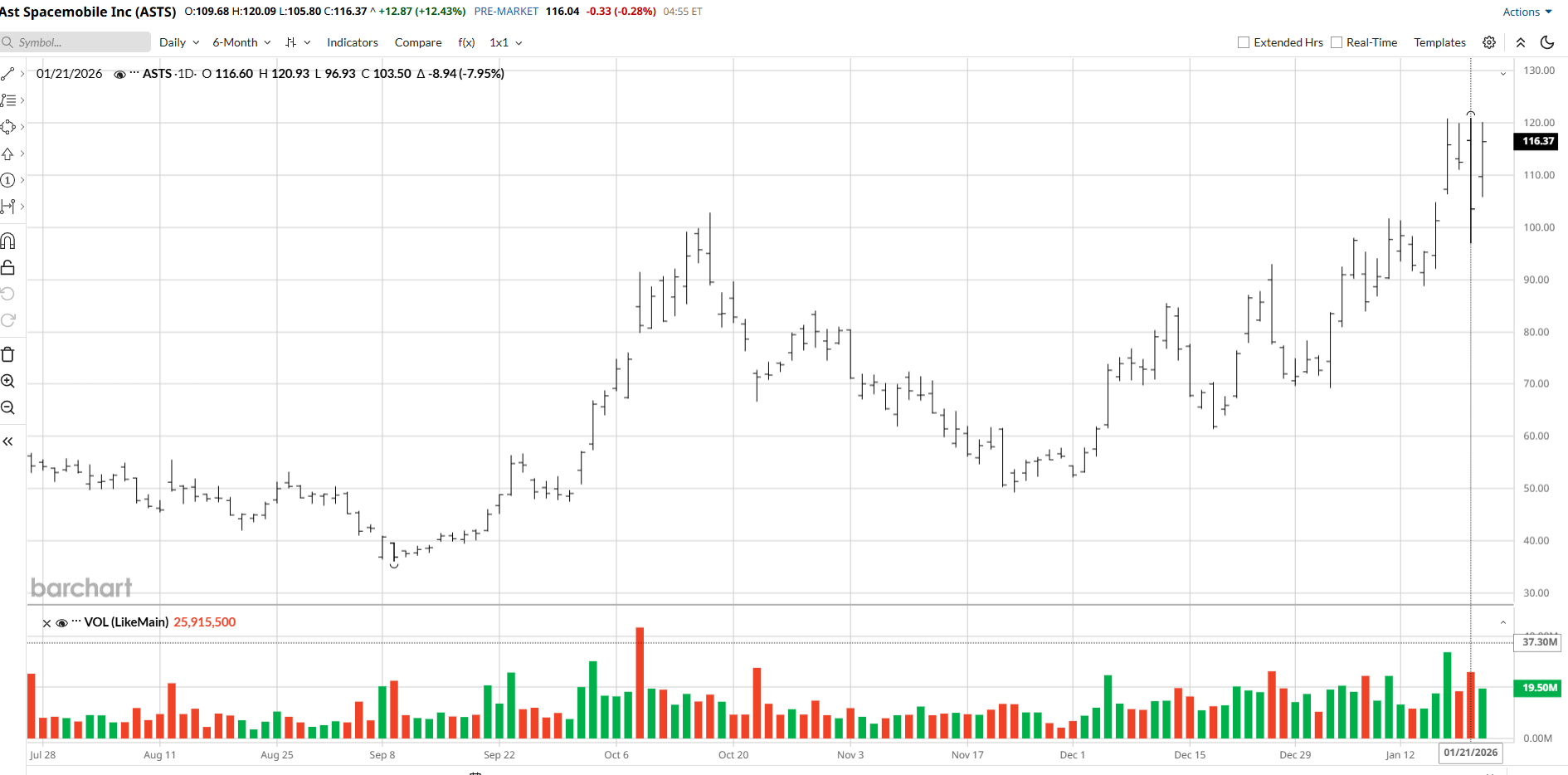
AST SpaceMobile is seeking to launch 45-60 satellites in 2026 to create a broadband network and provide services to standard smartphones. In the third quarter, the firm's sales soared 1,170% versus the same period a year earlier to $14.47 million. However, its operating cash flow sank 89.5% year-over-year (YoY) to -$136.5 million. The shares have a current price-sales ratio of 1,474 times and a forward price-sales ratio, based on analysts' mean 2026 revenue estimate of $193 million, of 222 times.
AST's First-Mover Advantage
As I have covered previously, AST has signed partnership deals with several large telecom companies, including Verizon (VZ), AT&T (T), and Vodacom (VOD), along with “major telecom service providers in Canada, Japan, and the Middle East/North Africa.” Under the agreements, AST is expected to “provide cellular service from satellites to conventional smartphones.” This service is called direct-to-cell.
In order to form similar alliances with Blue Origin, which is not slated to start launching its satellites until the end of 2027, these telecom companies would have to spend a significant amount of money and funds on launching deals with Blue Origin that are similar to their agreements with AST SpaceMobile. It's unlikely that the telecom firm will want to take this course because it would involve wasting significant corporate resources. Therefore, barring technical problems, I expect AST's agreements with these telecom companies to ultimately generate tens of billions of dollars of annual revenue for the firm, even if Blue Origin attempts to launch similar services.
It Can Provide Other Space-Based Services
In addition to direct-to-cell, AST can provide internet service and obtain new, lucrative contracts from the military. Moreover, a recent comment by the company's president indicated that the firm can benefit significantly from the likely launch of data centers in space.
Data on bidding for federal subsidies in Tennessee shows that providers of satellite internet services, including Elon Musk's SpaceX, “requested, on average, just one tenth of the funding fiber providers” sought, according to StateScoop. The data suggests that satellite internet service providers (ISPs) can price their fiber competitors out of the market. As a result, eventually AST can probably enter the ISP market and generate significant revenue and profits from it.
Turning to AST's potential revenue from the defense sector, the company recently received a contract from the United States Missile Defense Agency (MDA). Under the agreement, AST will be able to seek upcoming deals related to America's missile-defense initiatives. Since the Trump administration plans to spend $175 billion on such projects, AST can generate a great deal of revenue from MDA alone. And according to one forecast, global spending by the defense sector on satellite communication is expected to surge from $3.5 billion in 2024 to $41.45 billion by 2033. Given that AST, which has already won other contracts from the Pentagon, appears to have a good relationship with the agency, the company is well-positioned to generate significant revenue from providing communication services to the U.S. and its allies.
Finally, AST President Scott Wisniewski last month indicated that AST can benefit from the development of data centers in space. Both Musk and Bezos are planning to launch such data centers, suggesting that these projects are likely to be very profitable.
Wisniewski said that, “The add-on opportunities (for satellites) are really impressive, and you see that with all the data center conversations in the last week or so, whether it's communication services, noncommunication services to the U.S. government, or the next generation of commercialization of space, we'll be in a great position to build that out.”
Competition Is Unlikely to Stop AST
Today, around the world, there are many very profitable providers of internet service, military communications, technologies for cellular networks, and data centers. As these sectors transition to satellites, there will likely be many, very profitable satellite companies that provide the same products and services. Therefore, I don't expect Blue Origin's initiative to derail AST SpaceMobile.
The Bottom Line on ASTS Stock
The company's price-sales ratios are very high, but, given its tremendous opportunities, its current market capitalization of $42.75 billion is quite low. However, since the firm is a start-up that is in the beginning stages of launching its satellites, it does carry significant risk. Therefore, ASTS stock is only appropriate for risk-tolerant growth investors at this point.
On the date of publication, Larry Ramer had a position in: ASTS . All information and data in this article is solely for informational purposes. For more information please view the Barchart Disclosure Policy here.
More news from Barchart
- Why the Big 3 Cruise Stocks Are Looking More and More Like Sinking Ships
- Buy the Dip in Apple Stock Before January 29, According to Goldman Sachs
- Micron’s 2026 Earnings Upside Makes MU Stock Hard to Ignore
- Blue Origin Is Gunning for AST SpaceMobile. Should You Sell ASTS Stock Now or Keep Betting on Gains?
More News
View More




Recent Quotes
View MoreQuotes delayed at least 20 minutes.
By accessing this page, you agree to the Privacy Policy and Terms Of Service.