




Financial News
Vadzo Imaging Validates ONVIF Interoperability on InnoWave-821CRS 8.3MP Ethernet Wi-Fi Camera
FORT WORTH, TX / ACCESS Newswire / November 26, 2026 / Vadzo Imaging, a provider of embedded vision camera solutions for OEMs and system integrators, today announces the launch of the InnoWave-821CRS, an 8.3MP ONVIF Compliant Camera featuring the onsemi AR0821 image sensor. The InnoWave-821CRS is a 4K Ethernet Wi-Fi Camera built around the onsemi AR0821 color sensor, which offers up to 140+ dB of embedded HDR. It connects over 100Base-T or 1000Base-T Ethernet, switches to dual-band Wi-Fi when cabling is not an option, and draws power through PoE 802.3af. OEMs and system integrators building networked monitoring systems for power plants, factories, semiconductor facilities, and airports can use one camera design for both wired and wireless sites.
Why Vadzo Imaging Developed This Camera
Network cameras in industrial and public facilities rarely get a uniform installation environment. One site has a clean Ethernet run to every mounting point. Another has a mezzanine, a boiler room, or a taxiway-side building where pulling cable costs more than the camera. Integrators who serve both usually carry two hardware variants, one wired and one wireless, and qualify each against the same video management software.
Lighting adds a second problem. A furnace opening, a loading door, or a terminal window can place very bright and very dark areas in one frame. A conventional sensor either clips the highlights or loses the shadows, and the footage becomes hard to use for Intelligent Surveillance Camera workflows that depend on reading detail across the whole scene.
Vadzo Imaging developed the InnoWave-821CRS to remove both constraints from one platform. It is a single AR0821 Ethernet Camera design that also runs on Wi-Fi, so one board set covers every mounting condition in a rollout. The AR0821 sensor handles the lighting contrast in the pixel itself, and ONVIF conformity supports integration with compatible network video management systems. Integrators should verify the supported ONVIF profiles and platform compatibility for their deployment.
Engineering Challenge and Solution
Scenes with extreme lighting contrast. Multi-exposure HDR methods can introduce motion artifacts when separate exposures are combined. The onsemi AR0821 uses DR-Pix dual conversion gain technology and supports embedded HDR through in-pixel processing, with HDR modes depending on the camera implementation. The sensor's dynamic range capabilities help retain detail across bright and dark regions of a scene. Actual HDR performance depends on the selected mode and camera configuration.
One camera for wired and wireless sites. Fixed-interface cameras force a purchasing decision before the site survey is done. The InnoWave-821CRS offers 100Base-T and 1000Base-T Ethernet with dual-band Wi-Fi (802.11a/b/g/n/ac) on the same module. A deployment team can choose the link on site, and the 4K HDR Ethernet wifi camera hardware stays the same in both cases.
Product Overview
The InnoWave-821CRS is an 8.3MP ONVIF Compliant Camera built as a compact AR0821 Camera Module that combines the onsemi AR0821 sensor, a network interface, and a Wi-Fi radio on four boards measuring 38mm × 38mm. On a wired network it works as an AR0821 GigE Camera, and on a wireless network it works as an AR0821 Wi-Fi Camera. Over 1000Base-T it operates as an AR0821 Gigabit Ethernet Camera, and 100Base-T is also supported.
Innowave-821CRS Specifications
- Sensor: onsemi AR0821 CMOS, color
- Sensor technology: DR-Pix dual conversion gain, 2.1 µm backside-illuminated pixels
- Sensor format: 1/1.7-inch, 2.1 µm × 2.1 µm pixel size
- Maximum resolution: 8.3MP, 3848 (H) × 2168 (V)
- Shutter: rolling shutter
- HDR: up to 140+ dB embedded HDR through in-pixel processing
- Interface: 100Base-T and 1000Base-T Ethernet
- Wireless: switchable Ethernet or dual-band Wi-Fi (802.11a/b/g/n/ac)
- Connector: RJ45 Ethernet interface, Wi-Fi antenna
- Power: Power over Ethernet (PoE 802.3af, 36 to 57V)
- Time synchronization: IEEE 1588 PTP
- GPIO: external trigger and synchronization
- Optics: S-Mount (M12 standard) with electromechanical IR-cut filter
- Lens field of view options: 41°, 73°, and 111° DFOV
- Operating temperature: -30°C to +85°C
- Dimensions and weight: four boards at 38mm × 38mm, 35 grams without lens
- Supported operating systems: Windows, Linux
- Conformity: ONVIF compliant, RoHS 3, REACH
- Software: Vadzo NXT software and NXT SDK
The AR0821 is the trait that defines this camera. Its dual conversion gain pixels capture bright and dark regions in a single pass, and the in-pixel HDR processing keeps detail in highlights and shadows at the same time. A fixed-exposure sensor would need to give up one end of the scene. The same camera hardware supports wired Ethernet and dual-band Wi-Fi deployment. Actual streaming performance depends on network bandwidth, signal conditions, and stream configuration.
The camera is designed for fixed installations on a network. Vadzo NXT software and the NXT SDK support configuration, streaming, image tuning, and integration into Windows and Linux vision systems. The module also serves as an AR0821 Embedded Camera platform for teams that need a different host interface elsewhere in their product line. Vadzo supports form factor changes, firmware changes, enclosure design, and added NIR or color LED boards, so a Custom Network Camera Module can be built from this base for a specific Industrial Network Camera program.
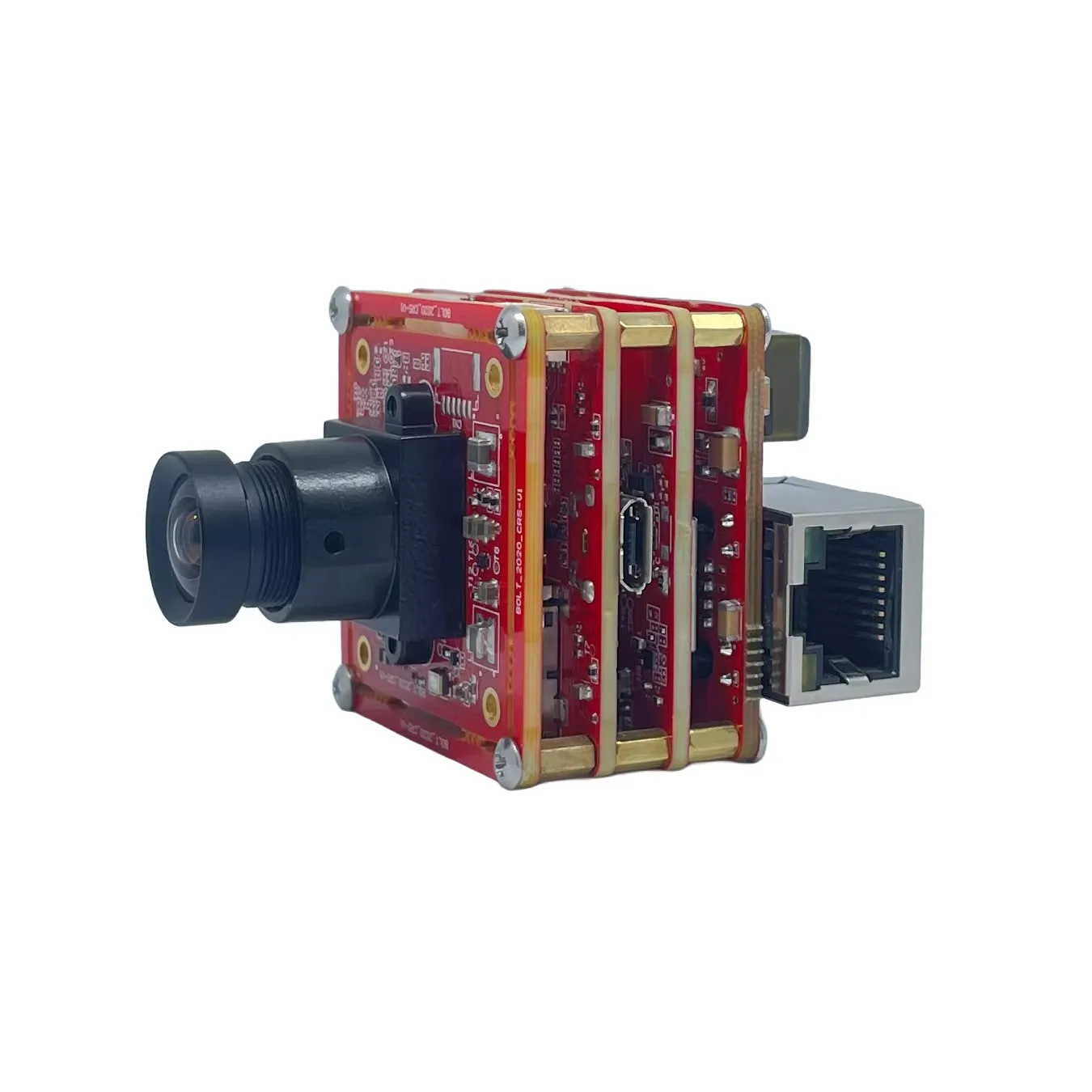
Key Features and Benefits
Switchable Ethernet and Dual-Band Wi-Fi on One Module: The InnoWave-821CRS integrates 100Base-T and 1000Base-T Ethernet with dual-band Wi-Fi in a single Dual Interface Camera, enabling the same hardware to run on a wired or wireless link. Unlike traditional network cameras that ship as separate wired and wireless variants, this approach allows one design to serve every site in a rollout. This eliminates the need to qualify and stock two models and simplifies deployment in applications such as plant floors, warehouses, and airport support buildings.
Embedded HDR of Up to 140+ dB: The InnoWave-821CRS uses the AR0821 sensor with DR-Pix dual conversion gain, enabling the camera to capture detail across high-contrast scenes to hold detail across very large differences in brightness. Unlike traditional multi-frame HDR approaches that merge separate exposures and can smear moving subjects, this approach processes the range inside the pixel and reduces motion artifacts. This removes the choice between clipped highlights and lost shadows and simplifies deployment in applications such as furnace monitoring, loading docks, and terminal entrances.
ONVIF Conformity for Existing Video Systems: As an ONVIF Compliant Camera, the InnoWave-821CRS is built to work with video management software that follows the ONVIF standard. Unlike proprietary network cameras that need vendor-specific integration for each platform, this approach allows an integrator to add the camera to an existing system through a standard interface. This reduces custom integration work and simplifies deployment in applications such as facility security networks, access areas, and perimeter monitoring. The same standard makes it an ONVIF Ethernet Camera that fits into mixed-vendor installations. Single-Cable Power with PoE 802.3af: The InnoWave-821CRS accepts Power over Ethernet at 36 to 57V, enabling data and power to travel on one network cable. Unlike cameras that need a separate power supply at every mounting point, this approach allows installers to place the camera wherever a PoE switch port can reach. This removes the need for local power outlets and simplifies deployment in applications such as high ceilings, outdoor poles, and remote plant areas.
IEEE 1588 PTP and GPIO for Multi-Camera Coordination: The InnoWave-821CRS supports IEEE 1588 PTP time synchronization and GPIO for external triggering, enabling several cameras on one network to share a common clock and respond to the same trigger. Unlike free-running cameras whose timestamps drift apart, this approach allows frames from different units to be matched in time. This removes a source of error in multi-view analysis and simplifies deployment in applications such as production line inspection, vehicle tracking, and area coverage.
Applications Power Plant IP Surveillance Camera: Power plant monitoring is defined by wide temperature swings, bright equipment openings next to dark corridors, and long distances between the control room and the equipment. The InnoWave-821CRS fits directly into these requirements: an operating range of -30°C to +85°C, up to 140+ dB HDR, and PoE over a single network cable enable placement near turbines, switchgear, and fuel handling areas without separate power runs. For equipment status checks and access monitoring, HDR imaging maintains visible detail in both lit and shadowed zones regardless of changes in ambient light.
Manufacturing Facility IP Camera: Manufacturing facility monitoring is defined by mixed lighting, many camera positions, and the need to line up footage from several viewpoints. The InnoWave-821CRS fits directly into these requirements: IEEE 1588 PTP synchronization, GPIO triggering, and ONVIF conformity enable multi-camera coverage that connects to existing video management software. For line supervision, safety zone observation, and material flow tracking, 8.3MP resolution maintains usable detail across wide fields of view at three lens options of 41°, 73°, and 111° DFOV.
Semiconductor Facility Surveillance Camera: Semiconductor facility surveillance is defined by controlled access areas, strict cabling rules in some zones, and bright task lighting beside dim service corridors. The InnoWave-821CRS fits directly into these requirements: switchable Ethernet or dual-band Wi-Fi, a 38mm × 38mm board footprint, and a 35 gram weight without lens enable placement where one link type is easier to approve than the other. For entry points, equipment bays, and logistics routes, HDR imaging keeps people and objects identifiable at both ends of the exposure range.
Automotive Factory IP Camera: Automotive factory monitoring is defined by large floor areas, moving vehicles and parts, and reflective surfaces under overhead lighting. The InnoWave-821CRS fits directly into these requirements: PoE power, 1000Base-T Ethernet, and PTP synchronization enable dense camera networks with matched timestamps and simple cabling. For assembly line observation, yard traffic, and docking areas, in-pixel HDR reduces motion artifacts and maintains image detail under glare from lights and glossy body panels.
Airport IP Surveillance Camera: Airport surveillance is defined by day and night operation, glass-heavy buildings, and a mix of wired terminals and hard-to-cable outdoor structures. The InnoWave-821CRS fits directly into these requirements: an electromechanical IR-cut filter, ONVIF conformity, and Ethernet or Wi-Fi connectivity enable consistent imaging across indoor and outdoor positions that report to one video system. For concourses, baggage areas, and perimeter approaches, 4K-class resolution and HDR maintain image detail at dawn, dusk, and under strong window light.
"Monitoring tasks in plants, factories, and airports ask a camera to hold detail in the brightest and darkest parts of one scene, and the AR0821 does that inside the pixel. The InnoWave-821CRS puts 8.3MP video, ONVIF control, and PoE power on one network cable, with dual-band Wi-Fi available when a site cannot be cabled. We are plain about the limits. The camera uses a rolling shutter, so very fast motion can show distortion; Wi-Fi throughput depends on the wireless conditions at each site, so full-resolution streams should be planned on Ethernet first; and the lens and cable are selected separately from the camera board. We help customers plan the lens, the network, and the power before they commit." - Alwin Vincent, Product Manager, Vadzo Imaging.
Availability and Evaluation
The InnoWave-821CRS, an 8.3MP ONVIF Compliant Camera featuring the onsemi AR0821 sensor, is available to order from Vadzo Imaging for evaluation and production. Integration teams can test PoE power on their own switches, check ONVIF discovery against their own video management software, compare Wi-Fi and Ethernet streaming in their own facility, and try the 41°, 73°, and 111° lens options on their own scenes before committing to a production bill of materials. That tells them more than a datasheet comparison alone. Teams that need a different form factor, firmware behavior, enclosure, or added illumination can ask Vadzo to review the setup. Contact Vadzo at support@vadzoimaging.com to request an evaluation unit or to discuss OEM integration requirements.
Frequently Asked Questions
Q: What does ONVIF compliance mean for a network camera?
ONVIF is an open standard that lets network cameras and video management software discover and communicate with each other. A camera that conforms to it can be added to a mixed-vendor system without a custom driver. Vadzo Imaging builds ONVIF conformity into its network cameras so integrators spend less time on software work and more time on deployment.
Q: Why does a surveillance camera need HDR?
Real scenes often contain very bright and very dark areas at once, such as a doorway at noon or a lit gate beside a shaded yard. A standard sensor loses detail in one of those areas. HDR sensors record both ranges together, which keeps faces, plates, and objects readable. Vadzo Imaging selects HDR sensors from onsemi and Sony so customers can match the sensor to the lighting at their site.
Q: Can one network camera work on both Ethernet and Wi-Fi?
Yes, when the camera is designed with both interfaces on the same module and a way to switch between them. This lets a team use a wired link where cable exists and a wireless link where it does not, without changing the hardware. Vadzo Imaging offers dual interface camera designs for this purpose and supports teams in choosing the right link for each installation.
Q: What is Power over Ethernet and why do integrators use it?
Power over Ethernet sends electrical power and data over the same network cable. Installers can mount a camera anywhere a PoE switch port can reach, without a separate outlet or power supply. Vadzo Imaging designs its Ethernet cameras to accept standard PoE, which shortens installation time and reduces cabling cost.
Why choose Vadzo Imaging for a custom camera program?
Vadzo Imaging designs and builds embedded cameras in-house, so the engineering team that supports a customer also built the hardware and firmware. Changes such as board shape, firmware features, enclosures, and added illumination are handled directly with that team. Vadzo also supports evaluation units, so customers can test a design in their own environment before production.
About Vadzo Imaging
Vadzo Imaging is a provider of embedded vision camera solutions for OEMs and system integrators. Its portfolio covers USB, MIPI CSI-2, GigE, Wi-Fi, and FPD-Link III cameras built on onsemi and Sony image sensors. Vadzo designs its hardware and firmware in-house and offers customization and engineering support from evaluation through production. Learn more at https://www.vadzoimaging.com/.
Media Contact
Alwin Vincent
Vadzo Imaging
Email: alwin@vadzoimaging.com
LinkedIn: Vadzo Imaging
YouTube: Vadzo Imaging
X: Vadzo Imaging
SOURCE: Vadzo Imaging
View the original press release on ACCESS Newswire
If you believe this article contains misleading, harmful, or spam content, please let us know.
Report this articleMore News
View More




Recent Quotes
View MoreQuotes delayed at least 20 minutes.
By accessing this page, you agree to the Privacy Policy and Terms Of Service.